
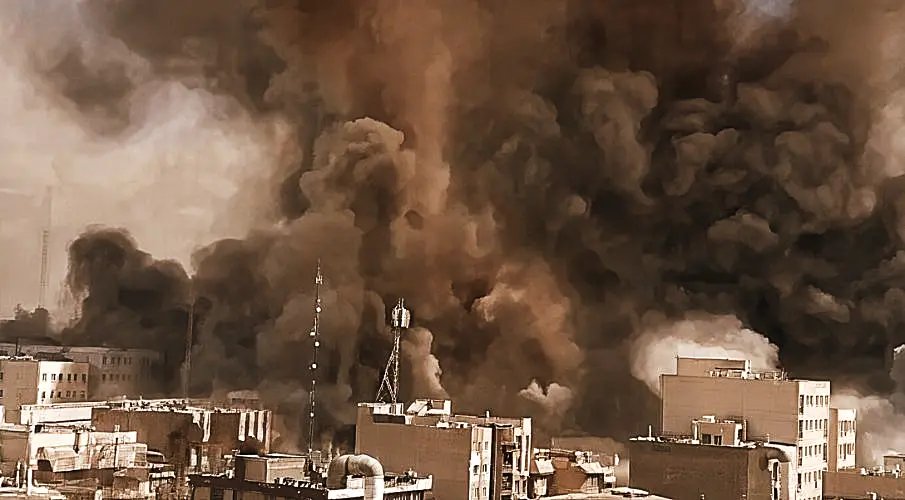
Tehran - While talks are still being mentioned behind closed doors, reality continues to escalate. Donald Trump publicly declares that serious negotiations with Iran are underway. At the same time, he threatens to completely destroy the country’s energy infrastructure - power plants, oil fields, the strategically important Kharg Island, and even desalination facilities. If there is no agreement and the Strait of Hormuz is not immediately reopened, the operation will be ended by “completely wiping everything out,” he wrote.

These words come at a moment when the conflict has long since spread across multiple countries. Iran has begun revoking residency permits for citizens of the United Arab Emirates - as a direct response to similar measures previously taken by the Emirates against Iranians. 1,200 Emiratis are affected. At the same time, the Iranian Hospital and the Iranian Club in Dubai have been closed. Militarily, Iran has recently fired more drones and missiles at the Emirates than at Israel. The United Arab Emirates reported intercepting eleven ballistic missiles and 27 drones from Iran within just 24 hours. Figures that show how far the front has already shifted. This is no longer about isolated theaters. It is an open conflict across an entire region.
Pressure is also rising in Lebanon. Displaced people in Beirut are taking to the streets and condemning the expansion of the Israeli offensive in the south of the country. Prime Minister Benjamin Netanyahu wants to expand the operation. For many there, this is no longer a limited war, but a step toward permanent occupation. In Jerusalem, even the Catholic Church had to negotiate in order to hold its central holidays. Israeli police had initially prevented leading church representatives from accessing the Church of the Holy Sepulchre. Only after mediation by President Isaac Herzog was a solution found. Masses during Holy Week may take place - but without the public, under strict restrictions.
A direct appeal comes from Cairo. President Abdel-Fattah el-Sissi addresses Donald Trump publicly. Only he can end this war, he says. It concerns the entire region. The consequences of further escalation are unforeseeable. His words are calm, but clear. The situation is out of control.
At the same time, international alliances are shifting. Volodymyr Zelenskyy has concluded long-term agreements with Saudi Arabia, the United Arab Emirates, Qatar, and Jordan. The focus is on military technology, energy, and economic cooperation - designed for at least ten years. Ukraine is contributing its experience in the use of drones, including for securing sea routes. An indication of how much these conflicts are now influencing one another. Europe is reacting unevenly, but not passively. Spain is taking a clearer step than many other states. Defense Minister Margarita Robles states unequivocally that neither military bases nor airspace will be made available for American operations in this war. Prime Minister Pedro Sánchez describes the war as deeply illegal and deeply unjust.
Diplomatic movement is also continuing. Pakistan’s Prime Minister Shehbaz Sharif is speaking with European Council President Antonio Costa about ways out of the escalation. Both emphasize that only negotiations can end the conflict and warn of consequences for the global economy. At the same time, SMS campaigns are underway in Iran, calling on people to defend the country. Some originate from circles linked to the Revolutionary Guards, while others are difficult to attribute.
The situation is long out of control. While talks are still being mentioned, new targets are being defined and threats intensified at the same time. Everyone is reacting to the other - and driving the whole situation further upward. There is no point at which things are slowing down right now. The question is no longer whether the situation is escalating. It already has.
Updates – Kaizen News Brief
All current curated daily updates can be found in the Kaizen News Brief.
To the Kaizen News Brief In English


