
In the White House, there is talk of ongoing discussions, of productive contacts, of movement, of a process that has supposedly not reached an end. In Tehran, at the same time, it sounds like open mockery. An Iranian military spokesperson publicly declares that the Americans are now negotiating only with themselves. That, on this Wednesday, captures the entire state of this war. Washington claims the door to diplomacy is open. Tehran says there is no one on the other side it wants to talk to. In between, bombs fall, oil prices rise, troops are moved, states in the region protest, and with each passing day the impression grows that political language can no longer keep pace with military reality.
Editorial note: Many reports about an alleged Iranian renunciation of nuclear weapons are currently based solely on statements from Washington. There is no confirmation from Tehran - on the contrary: Iran rejects key parts of the narrative and sets its own conditions.
“You have reached a point where you are negotiating with yourselves. Do not call your defeat an agreement. There will be no more news about your investments in the region, and you will not see the previous prices for energy and oil again …” (Editorial note - This does not reflect the opinion of our editorial team, and we fully reject the regime in Iran. However, out of journalistic duty of care, we reproduce these statements in order to classify developments.)
Karoline Leavitt has repeatedly stated at the White House that talks with Iran are continuing. They are sensitive, fluid, and negotiations will not be conducted from the podium in place of the president. At the same time, she did not want to say with whom the United States is actually speaking. She also did not explain which Iranian side is being addressed, which channels are being used, or who on the other side is authorized. More than that: she did not fully reject reports of a U.S. 15 point plan, but said that there were elements of truth in it, while some parts were not entirely accurate. In doing so, she indirectly confirmed that there must indeed have been a substantive proposal, even if the White House still does not disclose its full version.
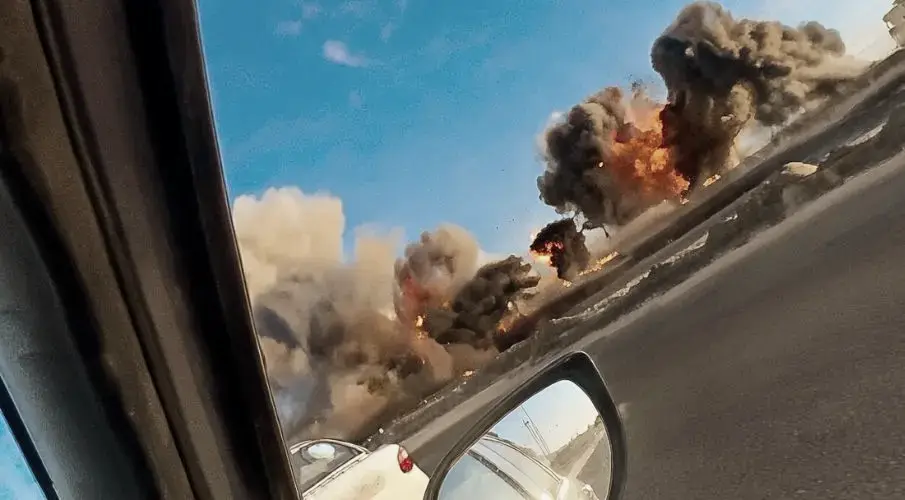
Airstrikes hit the industrial city of Alborz in Qazvin in the past hours
From the available reports and discussions, it emerges that this American proposal was transmitted to Iran via Pakistan. According to Pakistani officials, it included questions of sanctions relief, civilian nuclear cooperation, a rollback of the Iranian nuclear program, oversight by the International Atomic Energy Agency, limits on missile programs, and rules for passage through the Strait of Hormuz. An Egyptian mediator described these 15 points as something closer to a comprehensive agreement than a mere ceasefire. This was therefore not about a small pause in fighting, but about an attempt to package an entire set of military, economic, and security demands in the middle of an ongoing war.
Tehran has rejected this proposal. At first, the rejection came via Press TV, the English language arm of Iranian state television, which cited an anonymous official. Later, the message became sharper. Iranian military spokesperson Ebrahim Zolfaghari stated in a recorded address that America should not disguise its defeat as an agreement. Anyone who presents themselves as a superpower would have freed themselves from this situation long ago if they could. Particularly revealing was his wording that the Americans now appear to be negotiating only with themselves. He also said unambiguously that someone like Iran will never come to terms with someone like the United States - not now, not ever. This was not nuance, not cautious distancing, but a demonstrative rejection.
In addition, Iranian authorities have circulated their own counterproposal. According to reports, Tehran is demanding not only an end to the attacks, but reparations for the war, guarantees that a new war against Iran will not be launched again, an end to the killing of its officials, and the exercise of Iranian sovereignty over the Strait of Hormuz. This last point in particular is unlikely to be acceptable for Washington. The strait is no longer just a regional waterway, but has become the critical point of global energy supply. It is there that it is now decided how expensive fuel, transport, and production will be across large parts of the world.
“If Iran does not accept that it has been defeated, Trump will strike harder.”
The White House is trying to manage this contradiction rhetorically. Leavitt openly threatened further attacks if Iran does not accept the reality of the moment. If Tehran does not understand that it has been militarily defeated, Donald Trump will ensure that Iran is hit harder than ever before. This is notable because diplomacy and renewed escalation are being spoken of at the same time. On one side, there are supposed to be productive talks, on the other side there are threats of an even harsher next wave of strikes. This is not a stable negotiating position. It is a pressure scenario in which Washington appears to hope that military dominance can force political consent.
Conflicting signals are also coming from within Republican circles. Mike Johnson claims the war is nearing its end and that its objectives have been achieved. In almost the same breath, however, he says Iran should closely observe the buildup of American troops in the region. It is not about ground troops, but Iran must take note of the deployment. In other words: even where there is talk of conclusion, new deterrence is being built at the same time. This aligns with reports of additional paratroopers and Marines in the region and shows that Washington itself is not acting as if this war has already been politically contained.
Meanwhile, the war continues in very real terms. Many explosions are being heard in Mashhad in eastern Iran. The Israeli military stated that it had completed multiple waves of airstrikes on targets in Tehran and had also struck a submarine development center in Isfahan the day before. In Israel itself, sirens sounded again. Iran fired further missiles toward central and southern parts of the country, including areas near Dimona. From Lebanon, rockets and drones continued to be launched toward northern Israel. There is no sign of a genuine phase of calm.
It is particularly important that the civilian perspective remains clear. Residents in Tehran describe how Trump’s threats against Iranian power plants have triggered anger and confusion among the population. The facts are heavy damage to residential buildings and a pharmacy in western Tehran. People often sleep only in fragments, message friends immediately after each impact, and fear that civilian infrastructure and innocent people will be targeted next. At the same time, the government has almost completely cut international internet connections. Even the state controlled domestic system functions only unreliably. This is a crucial point, because not only are bombs falling, but the ability to inform oneself, stay in contact, and organize daily life is also collapsing. Necessity drives improvisation, and people help each other.
The situation is already radiating across the entire region. Kuwait has once again summoned the Iranian ambassador after a drone attack on a fuel tank at the international airport. It was already the third time since the beginning of the war. Pakistan is simultaneously reaffirming its unwavering commitment to the security of Saudi Arabia, while at the same time being mentioned as a possible mediator for talks between Washington and Tehran. Qatar is easing rules for outdoor gatherings after a quieter phase, but the damage to its gas facilities remains severe. France speaks of 17 percent of gas capacity in Qatar being destroyed and of 11 million barrels of oil per day currently missing from the market. South Korea is trying to compensate for shortages through alternative supplies. Japan is already in talks with the International Energy Agency about possible additional releases from strategic reserves. The economic shockwave of this war is therefore already global.
Egypt is also continuing to try to preserve a diplomatic opening. Foreign Minister Badr Abdelatty said the differences between Iran and the United States are bridgeable. Cairo is maintaining contact with the warring parties and hopes that negotiations could resume soon. He called it possibly the last opportunity to prevent a full escalation of the conflict. China is also calling for every window for peace to be used. Turkey is holding calls with several states in the region to push for deescalation. Behind all these efforts lies the same realization: if this window closes again now, the next step may no longer be controllable.
Yet even the potential locations for mediation show how uncertain everything is. IAEA chief Rafael Grossi said talks could take place in Islamabad over the weekend. A security analyst in Pakistan even spoke of rapid progress in indirect contacts, supported by Prime Minister Shehbaz Sharif, Army Chief Asim Munir, and other officials. At the same time, however, it is said that Iranian officials are extremely distrustful due to the targeted killing of political, military, and intelligence figures and would only agree to direct talks if Washington provides firm guarantees for an end to the attacks. Those guarantees are not visible so far.
The Houthis in Yemen also show how complex the landscape has become. Three officials from the group said they support Iran historically and religiously, but that participation in the war will be decided solely in Yemen and not dictated by Tehran. This is important because it emphasizes both alignment and operational independence. So far, the Houthis remain on the sidelines, although in the past their attacks on ships in the Red Sea have severely disrupted global trade. This sidelined position alone shows that additional fronts remain possible, but will not automatically open along a fixed command structure.
At the same time, the war is intensifying in other parts of the region. Benjamin Netanyahu said Israel is expanding the area it controls in southern Lebanon. The Israeli military is advancing further there. The Lebanese health ministry reports 1,094 deaths since the start of this phase of the war, including 121 children and 81 women. Within 24 hours, another 22 people were killed and 153 injured. In Tyre, a paramedic who worked for a civil defense unit of the Amal movement was buried. The health ministry also stated that since the renewed escalation, 42 emergency workers have already been killed by Israeli attacks. Such numbers quickly disappear in the discussion of plans and counterproposals, but they say more about the real state of the war than any press conference.
In financial markets, every statement from Washington and Tehran is immediately priced in. Hopes for a ceasefire temporarily pushed oil prices down and stocks up. Later, new doubts followed. On Wall Street, prices initially climbed sharply because an end to the war seemed conceivable. Brent temporarily fell below 95 dollars again. But political uncertainty remains. Christine Lagarde warned that European companies may react more quickly to rising energy prices this time than after Russia’s attack on Ukraine. The memory of inflation runs deep. In the United States, the Environmental Protection Agency approved an emergency rule for E15 gasoline, a higher ethanol fuel blend, to slightly dampen prices at the pump. But even there, experts say it may only reduce costs by a few cents and could drive other costs higher.
Domestic pressure on Trump is also increasing. A new AP NORC poll shows that 59 percent of Americans consider the military approach toward Iran excessive. Forty five percent are very concerned about being able to afford gasoline in the coming months. At the same time, there is continued support for the goal of preventing Iran from obtaining a nuclear weapon. This is precisely the problem for the White House. The strategic objective finds support, the actual conduct of the war less and less.
The fact that Trump is nevertheless scheduled to travel to Beijing on May 14 and 15 reinforces the impression of a president who is simultaneously managing war, announcing peace talks, and continuing major geopolitical engagements as if all of this could be neatly handled in parallel. That now appears doubtful. If negotiations were truly close to a breakthrough, it would have to be clearer who is talking, what is being discussed, and what is on the table. If they instead serve only as political staging, that also explains why Tehran mocks them so openly.
At the end of this day, there is therefore no diplomatic progress, but a strange in between situation. Washington speaks of productive talks, but will not say with whom. Tehran rejects the American plan, presents its own conditions, and ridicules the idea of ongoing negotiations. Israel continues to bomb targets in Iran and at the same time expands its operations in Lebanon. States such as Egypt, Pakistan, China, and Turkey try to keep a channel open, but trust is scarce. The Houthis are still holding back, the Gulf states remain nervous, energy markets react as if electrified, and for civilians in Iran, Lebanon, and Gaza all of this is not a strategic debate, but a daily reality of fear, fire, and disruption.
The real signal of this Wednesday is therefore not that talks are taking place. The real signal is that governments are now speaking as if diplomacy and further escalation could coexist effortlessly. That is the most dangerous illusion of this war.
Updates – Kaizen News Brief
All current curated daily updates can be found in the Kaizen News Brief.
To the Kaizen News Brief In English


