
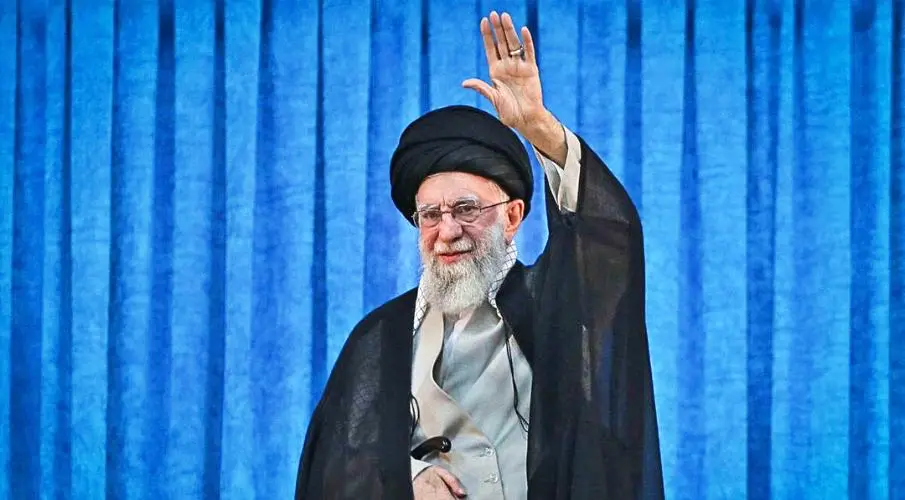
The man who shaped the Islamic Republic for nearly four decades is dead. According to Iranian state media, Ayatollah Ali Khamenei was killed in the US Israeli airstrikes on Saturday. Hours earlier, Donald Trump had already announced his death and said it was not only justice for the Iranian people but also for Americans and others worldwide who had lost their lives because of Khamenei’s policies. At first, Iranian officials dismissed the reports as boasting or psychological warfare. On Sunday morning, the state news agency confirmed the death. Tasnim reported that Khamenei died in his office in Tehran.
On Iranian state television, the death of Ayatollah Ali Khamenei was announced
With Khamenei gone, the center of a system tailored to him since 1989 has fallen. As Supreme Leader, the 86 year old had the final word on all state matters, controlled the military, the judiciary and foreign policy, and repeatedly crushed protests with deadly force. Human rights groups speak of at least 7,000 deaths in the suppression of the January protests alone. Iran has now declared forty days of state mourning and a one week national pause. State television broadcast Quranic verses, a spokesman spoke of the fulfillment of his “dream of martyrdom” and announced that his death would ignite a great uprising against oppressors. The Revolutionary Guards announced that within “moments” they would launch the largest offensive operation in their history against Israel and US bases in the Middle East. This is no longer a mere announcement but a direct declaration of confrontation. If Tehran carries out this step, the conflict would enter a new and openly waged phase.
Who leads now remains unclear. The Islamic Revolutionary Guards stated that the death of their leader would only make them more determined and promised retaliation. According to Israeli statements, several senior security officials were also killed, including General Mohammad Pakpour, Defense Minister Amir Nasirzadeh and Ali Shamkhani. Succession formally lies with the Assembly of Experts. According to reports, Khamenei had named several possible candidates: Gholam Hossein Mohseni Ejei, Ali Asghar Hejazi and Hassan Khomeini, grandson of the founder of the revolution. His son Mojtaba is also considered influential, although Khamenei officially rejected a dynastic solution.
On the streets of Tehran, the country’s division became visible. In some neighborhoods, people celebrated with fireworks, motorcades and chants for freedom. Others mourned. “Are we dreaming?” a man shouted in a verified video. At the same time, new airstrikes began overnight. The Israeli military spoke of another wave targeting missile positions and air defense systems. US Central Command stated it was delivering “swift and decisive measures.” Trump announced that the bombardments would continue throughout the week as long as necessary to achieve peace in the Middle East. At the same time, he called on Iranian soldiers to lay down their weapons and urged the population to take over the government. How this is supposed to happen in practice remained unclear.
Iran responded with missiles and drones against Israel as well as attacks on US bases in Qatar, Kuwait, Bahrain and the United Arab Emirates. In Israel, at least one woman was killed and more than one hundred people were injured. The Emirates reported intercepted projectiles and injuries. Shipping through the Strait of Hormuz fell by about seventy percent according to assessments. Fifty five oil tankers are stranded in Iranian waters. The disruption affects about one fifth of global oil trade.
Civilian casualties in Iran have so far not been independently verified. The organization HRANA speaks of at least 133 civilians killed and hundreds injured. Reports of children killed in a strike on a girls’ school in the south of the country are circulating. The Pentagon stated that it is reviewing indications of civilian harm.
Outside Iran as well, reactions are intense. In Los Angeles, home to the largest Iranian diaspora outside Iran, many celebrated Khamenei’s death as a possible end to a 47 year rule. Others warned of the human cost and a power vacuum. Worldwide and in New York, Chicago, Washington and more than seventy other cities, people demonstrated against a new war. In London, hundreds gathered against the strikes, while in Tehran supporters of the regime protested. In Pakistan, Shiite groups took to the streets in support of Iran.
Russia’s UN ambassador Vasily Nebenzya called the attacks irresponsible and in violation of international law. It is Russia, of all countries, whose own record of breaching international law has been devastating for years and which, with its invasion of Ukraine, has itself violated fundamental principles of the international order, now presenting itself as a guardian of legality. UN Secretary General António Guterres warned of a chain reaction that no one would be able to control. Marco Rubio canceled a planned trip to Israel. The world faces an open question: Will Khamenei’s death lead to transformation or to even deeper chaos? The power structures he built remain intact. But the face at the top has disappeared.
Perhaps the most important question is not who wins militarily today, but whether we are still prepared to believe in what we call international law and human rights, or whether we gradually abandon them once they become inconvenient. Where do these rights begin, and where do they end? If a state, even for good reasons, even in the face of a brutal regime, intervenes militarily to force political change, what remains of the principle of state sovereignty? From the perspective of international law, such an attack is a clear breach, just as other interventions before were breaches as well. Many people in Iran, especially women, have suffered under this regime, executions, torture, persecution, people were beaten, imprisoned, humiliated. But does this suffering grant the international community or individual states the right to create a new order with bombs? And if we accept this principle, what prevents a powerful president tomorrow from deciding that another country no longer suits him? Sanctions show how limited their impact is, how easily they can be circumvented. In the end, does only the power of the stronger remain, raw force as a means of politics? Perhaps everyone must answer this question for themselves. But whoever does not ask it has already decided it.
Updates – Kaizen News Brief
All current curated daily updates can be found in the Kaizen News Brief.
To the Kaizen News Brief In English


