
The war between the United States, Israel, and Iran is intensifying the situation across the entire region, which is no longer merely a spectator. On Monday, the Pentagon identified the seventh fallen U.S. soldier. Army Staff Sergeant Benjamin N. Pennington, 26 years old, from Glendale, Kentucky, succumbed to the injuries he sustained on March 1 during an attack on Prince Sultan Air Base in Saudi Arabia. Pennington was assigned to the 1st Space Battalion, 1st Space Brigade at Fort Carson, Colorado. His unit was responsible for missile warning systems, GPS, and satellite based communications over long distances. He was posthumously promoted to Staff Sergeant. Previously, six Army reservists had been killed in Kuwait when an Iranian drone struck an operations center at a civilian port.

Iran’s nuclear program has once again come under scrutiny. According to the International Atomic Energy Agency of the United Nations, a second Iranian nuclear site was struck. IAEA Director General Rafael Mariano Grossi told journalists in Paris that in addition to impacts at the Natanz facility, there had also been a strike in Isfahan. The damage in Isfahan appeared to be minor. Grossi did not provide details about when the site was hit or which forces were responsible. Satellite images of the Natanz facility show damage to buildings as well as additional destruction within the complex. Since the beginning of the current military campaign, “some impacts in Natanz - a few - and one in Isfahan” had been recorded, Grossi said. However, it was not a very serious hit. A visible impact could be seen near an axis or close to one of the tunnel entrances there. Nothing more had been identified so far.
The casualty numbers are rising on all sides. According to official, though still difficult to verify, figures, at least 1,230 people have been killed in Iran so far, 397 in Lebanon, and 11 in Israel. The United Nations Children’s Fund reports that in Lebanon alone, since March 2, at least 83 children have been killed and 254 injured. More than ten children killed per day. UNICEF’s Regional Director for the Middle East, Edouard Beigbeder, spoke of a devastating toll and said that children are dying and being injured at a rate that defies all measure. Families are fleeing, shelters are overcrowded, many children are sleeping in cold and uncertainty.
At the same time, new power is consolidating in Tehran. Ayatollah Mojtaba Khamenei has been appointed successor to his killed father. He is assuming control over the armed forces and will henceforth decide on war, peace, and the nuclear program. President Masoud Pezeshkian said the country’s problems could be resolved through wise leadership and the trust of the population. The appointment is seen as a demonstrative signal of steadfastness amid ongoing American and Israeli bombardments.

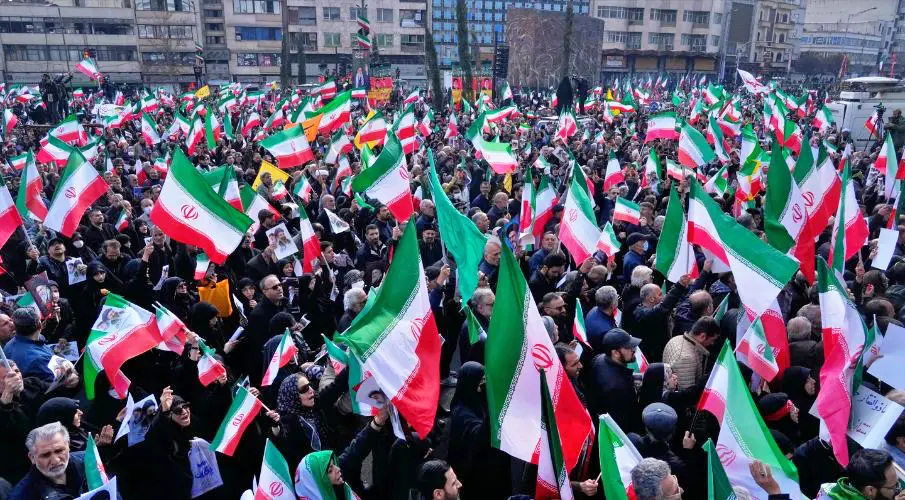
In Tehran today, people gathered with Iranian flags at a rally in support of Ayatollah Mojtaba Khamenei as successor to his late father, Ayatollah Ali Khamenei, as Supreme Leader of the country.
Meanwhile, Israel reports that an Iranian cluster munition struck in Yehud in the center of the country. One person was killed, others are in critical condition. Cluster munitions open in the air and disperse dozens to hundreds of smaller explosive devices to increase the probability of impact. The Israeli military says Iran is deploying such weapons almost daily. The Gulf states are also coming under increasing pressure. The United Arab Emirates reported on Monday that 15 ballistic missiles and 18 drones had been launched at its territory. Since the start of the war, there have been 253 missiles and 1,440 drones. Four foreign nationals were killed and 117 people injured. Qatar said it had intercepted 17 missiles and six drones. Sirens wailed again in Bahrain. Kuwait summoned the Iranian ambassador and delivered another protest note. The wording from Kuwait was unusually sharp and spoke of blatant violations of sovereignty.
The war is now directly reaching Europe. After the drone attack on the British military base in Cyprus - the first attack of this conflict on European soil - French President Emmanuel Macron ordered a comprehensive military response. The French frigate Languedoc was dispatched to the waters off Cyprus to reinforce air defenses there against drone and missile attacks. In addition, Paris plans to deploy ground based systems to defend against drones and missiles to the island.

Macron also announced that a total of eight warships would be sent to the eastern Mediterranean and the broader Middle East to strengthen security along the European Union’s eastern external border. These include the aircraft carrier Charles de Gaulle as well as two helicopter carriers. At the same time, France is working on an initiative that - once the most intense phase of fighting subsides - would allow for military escort of oil and gas tankers through the Strait of Hormuz. In doing so, Paris is responding not only to the security situation but also to the growing threat to global energy and trade routes.
In Turkey, NATO intercepted a ballistic missile that had entered Turkish airspace, according to the Ministry of Defense. Debris fell onto fields in the province of Gaziantep, with no casualties reported. It was already the second incident of this kind since the start of the war. Ankara emphasized that it would act decisively in the face of any threat to its territory.
At the same time, military pressure on Iran is expanding. Israel declared that it had begun a large scale wave of attacks on Tehran, Isfahan, and targets in the south of the country. New explosions were reported in the capital, Tehran. The Israeli army said the number of rockets fired by Iran per salvo had decreased. In the first days of the war, there had been dozens, now fewer than ten to twenty per attack. Around 60 percent of Iranian launch ramps had been destroyed, but the focus remained primarily on launch systems and production facilities.
U.S. Secretary of State Marco Rubio said the country was on a good path to destroying Iran’s ability to threaten its neighbors and the world with missiles. The goal of the airstrikes was to eliminate the ballistic arsenal, production capacities, and launch capabilities. This was being done with overwhelming force and precision. The war is already spilling into the global economy. Oil prices rose significantly on Monday. Japan’s benchmark Nikkei 225 fell by as much as seven percent at its peak, and other Asian markets also declined. The G7 finance ministers decided for the time being not to release strategic oil reserves. France’s Finance Minister Roland Lescure said they were not yet at that point but were keeping coordinated steps for market stabilization open.
Diplomatically, the lines are also hardening. The United States ordered the departure of non essential personnel and their families from the consulate in Adana in southern Turkey. It is the tenth U.S. foreign mission for which such an order has been issued since the beginning of the war, and the first in a NATO country. Egyptian President Abdel Fattah el Sissi condemned Iran’s attacks on neighboring states and at the same time warned against further escalation that could shake the global economy and energy security. He called for preventing an Israeli invasion of Lebanon.

Clear words are also coming from Europe. German Chancellor Friedrich Merz said in Berlin that it was solely up to the Iranian regime and the so called Revolutionary Guards to end the fighting. As long as that did not happen, he would assume that Israel and the United States would continue their defense. Iran was the center of international terrorism, and that center had to be closed.

President Volodymyr Zelenskyy stated that Ukraine had received eleven requests from states seeking assistance in defending against Iranian drones, including neighboring countries of Iran, European states, and the United States. The requests concerned interception systems, electronic warfare, and training. Kyiv wanted to help as long as its own defense capability was not weakened.
While fighting continues on the fronts, escape corridors are also opening. Turkmenistan is now operating its border crossings with Iran around the clock. About 250 people from 16 countries have entered so far and are receiving assistance with onward travel or contact with their embassies. Already during the 2025 war, Turkmenistan had enabled thousands to leave.
Amid all this, an unusual debate is drawing attention: President Donald Trump called on Australia to grant asylum to Iran’s women’s national soccer team. If Canberra does not do so, the United States would take in the players. At the same time, Australia’s national news agency quotes Iranian coach Marziyeh Jafari as saying the team wants to return to Iran as soon as possible. In Australia, a petition is circulating to ensure that players seeking protection are allowed to remain.
This war is no longer a short engagement. It reaches into airspaces, into markets, into diplomatic relations, and into the lives of children, soldiers, and civilians. With each passing day, the pressure on all parties increases. And with every additional name the Pentagon releases, it becomes clearer that the cost of this war is not distant from everyday life but is written in faces and families.
Updates – Kaizen News Brief
All current curated daily updates can be found in the Kaizen News Brief.
To the Kaizen News Brief In English


