
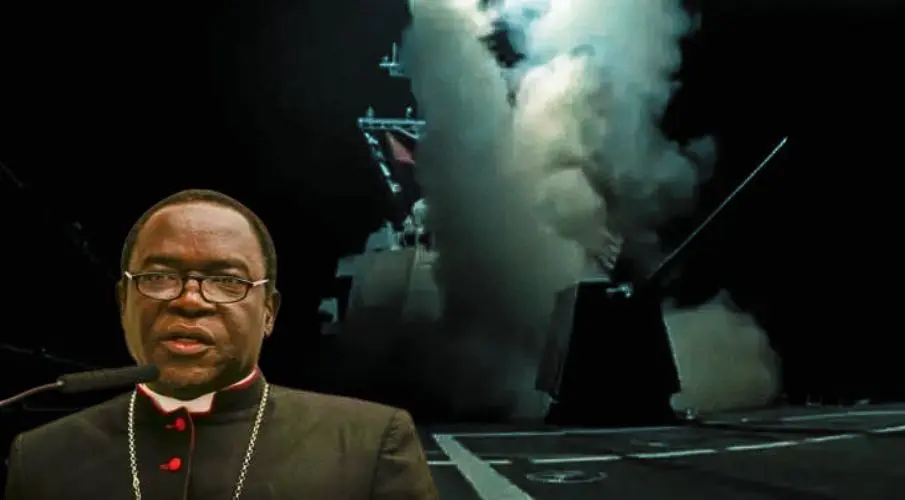
After the U.S. airstrikes in northwestern Nigeria, Donald Trump declared that the targets had been fighters of the Islamic State who were brutally murdering Christians. The message was clear, sharpened, easy to connect with. But it was also misleading. What happened on the night into Thursday in Sokoto fits this narrative only poorly, it is a lie. More than a dozen Tomahawk missiles struck in Sokoto State, a region that is almost entirely Muslim and where Muslims have for years made up the majority of victims of armed violence. Even the Catholic bishop of Sokoto, Matthew Hassan Kukah, has repeatedly emphasized that there is no problem of systematic persecution of Christians there. The idea of a targeted attack on Christian communities does not stand up to the reality on the ground.
Always on air – FOX NEWS: violations of international law live into the living rooms of Americans with turkey and masa – but the world watches too, as it almost only does anymore
The question of whether the armed groups in Sokoto are even affiliates of the Islamic State is also open. Some analysts see possible links to the IS Sahel Province, which is mainly active in Mali, Niger, and Burkina Faso. Others consider these assumptions to be thinly supported. Research shows the same picture. The group known locally as Lakurawa has been operating for years in various states. At first it gained support by acting against bandits. Later it turned against the rural population itself. Its structure is unclear, its loyalties shifting.
“There is no genocide taking place in Nigeria, and Christians are also not being deliberately targeted there,” said the Chairperson of the African Union Commission, Mahmoud Ali Youssouf, in response to U.S. President Trump. (November 13, 2025)
Despite the public rejection of Trump’s talk of a Christian “genocide,” the Nigerian government chose to cooperate. It seized the opportunity to use American firepower against armed groups that are destabilizing entire regions. Foreign Minister Yusuf Tuggar made clear that Abuja had agreed to the strikes. After talks between the U.S. Department of Defense and Nigeria’s military, the green light had been given. President Bola Ahmed Tinubu had also been involved. At the same time, Tuggar emphasized that Nigeria had insisted on not narrowing the communication to religious questions.

The U.S. strikes took place in northwestern Nigeria, in Sokoto State, including areas near Jabo. This is a region that is predominantly Muslim and does not belong to the areas where the severe, documented attacks on Christian communities occur.
The areas where there are in fact regular massacres, attacks on churches, and targeted assaults on Christian villages lie mainly in Nigeria’s so-called Middle Belt – particularly in Plateau State, Benue State, and parts of Kaduna State. There, ethnic conflicts, land disputes, militias, and religious tensions intersect. These regions lie several hundred kilometers southeast of Sokoto.
To put the distances in context:
- Sokoto – Plateau (Jos): about 500 to 600 kilometers etwa 500 bis 600 Kilometer
- Sokoto – Benue: in some cases over 700 kilometers teils über 700 Kilometer
- Sokoto – Kaduna (central region): around 400 kilometers rund 400 Kilometer
These are not neighboring areas, not border zones, not overlaps. Militarily and socially, they are completely different conflict spaces.
This is also confirmed by voices on the ground: the Catholic bishop of Sokoto, Matthew Hassan Kukah, explicitly says that there is no systematic persecution of Christians in his diocese. The violence there primarily affects Muslim village communities, not Christian minorities.
Result of the research:
The airstrikes took place far from the regions where Christians are actually said to be persecuted or attacked. Anyone who claims that these strikes were a direct response to persecution of Christians is deliberately mixing different conflicts – geographically, religiously, and politically. Entirely different interests are at play here.
Nigeria also provided the United States with intelligence information, according to its own statements. The aim of the strikes was to deter further attacks. Airstrikes, according to the logic, are something armed groups can hardly evade. Whether this goal was achieved remains unclear. As early as Friday morning there were reports that one of the hit areas lay on the outskirts of the town of Jabo, where according to observers neither terror camps nor bandit bases are known. A resident of Jabo described how he heard a droning sound in the middle of the night, followed by a siren and a pressure wave that nearly lifted roofs. People ran to a nearby field because they thought a plane had crashed. There they found fragments of munitions. A simple hut burned, no one was injured. He knew nothing of terrorists.

The U.S. military itself also acknowledged that assessing the damage would take time. The impact sites were so remote that it would only become clear after days what had actually been hit. The strike comes at a time when Trump is deliberately linking foreign policy threats with domestic political messages. Just last month he had threatened Nigeria with attacks or the deployment of troops if the government did not act quickly. This language resonates with parts of his political environment, particularly with groups in the United States that have for years spread the thesis that Christians are being deliberately persecuted in Nigeria. The fact that Nigeria is a country with hundreds of millions of Muslims and Christians who are equally victims of complex violence does not fit into this picture.
Even if it were true that Muslims in Nigeria were deliberately attacking Christians because of their religion, that would not give an American president unilateral legal authority to order a U.S. military intervention as long as there is no immediate threat to the national interests of the United States. (Moe Davis, U.S. Air Force, veteran) Veteran)
What is certain is that the best documented links between Nigerian extremists and the Islamic State are found in the northeast of the country. We have always conducted research on these areas as well, for other reasons too. There the Islamic State West Africa Province is active, which once split from Boko Haram. In this region, for example in the Sambisa Forest, an attack would hardly have been surprising. Sokoto, by contrast, lies far from it. At the same time, armed groups from the Sahel zone are expanding their radius of action southward. They are looking for new safe havens, new routes, new recruits. The Sahel is now responsible for more than half of all global terror victims. Northern Nigeria and the coastal states of West Africa are increasingly coming under pressure as a result.
“No persecution problem” – What really shapes Sokoto

The Catholic bishop of Sokoto, Matthew Hassan Kukah, contradicts the common portrayal of systematic persecution of Christians in northern Nigeria. In Sokoto, a predominantly Muslim region, there is no fundamental problem of persecution, but rather restrictions on freedom, primarily at the bureaucratic level. Religious practice is possible, even public processions pose no obstacle. Difficulties arise mainly with permits for new church buildings and with religious instruction in public schools. Kukah emphasizes that these issues are solvable, through dialogue and negotiation. He describes coexistence with the Muslim majority as respectful, relations with Muslim leaders as constructive. His statement aims to defuse the situation without denying existing problems. Sokoto, Kukah says, is not a theater of religious war, but a place where coexistence is under pressure, above all due to violence by jihadist groups.
History, education, instrumentalization – The roots of the violence
Kukah sees the causes of jihadist violence not in a religious antagonism, but in history and social reality. Before colonial times, a Muslim caliphate existed in what is now northern Nigeria, which was dismantled by British rule. This legacy still has an impact today. Many people falsely associate Christianity with colonialism, although missionaries did not come to exploit. Added to this is the massive education gap in the north of the country. Millions of children have no access to school, out of fear that education could lead away from Islam. While the Muslim elite has its children well educated, the broad population is left behind. This mixture of ignorance, frustration, and social inequality provided fertile ground for groups like Boko Haram. Kukah emphasizes that jihadist violence has claimed more Muslim than Christian victims. Anyone who speaks of a pure religious conflict misjudges reality.
Pastor Wale Adefarasin, senior pastor and a prominent, credible voice of the Guiding Light Assembly, rejects Trump’s false claims about an alleged Christian genocide in Nigeria. (November 3, 2025)
Against this backdrop, Trump’s portrayal appears factually unsupported, saying more about political needs in the United States than about the situation in Nigeria. The strike may be militarily part of a broader security cooperation. The public justification, however, leaves out central facts. It simplifies a conflict that defies any simple categorization. And it risks emphasizing religious lines where the violence has long had other causes and other victims.
Updates – Kaizen News Brief
All current curated daily updates can be found in the Kaizen News Brief.
To the Kaizen News Brief In English


Wie immer
Heiße Luft und große Worte.
Und am Ende bleibt die nackte Wahrheit, die der Lüge den Mittelfinger zeigt.