
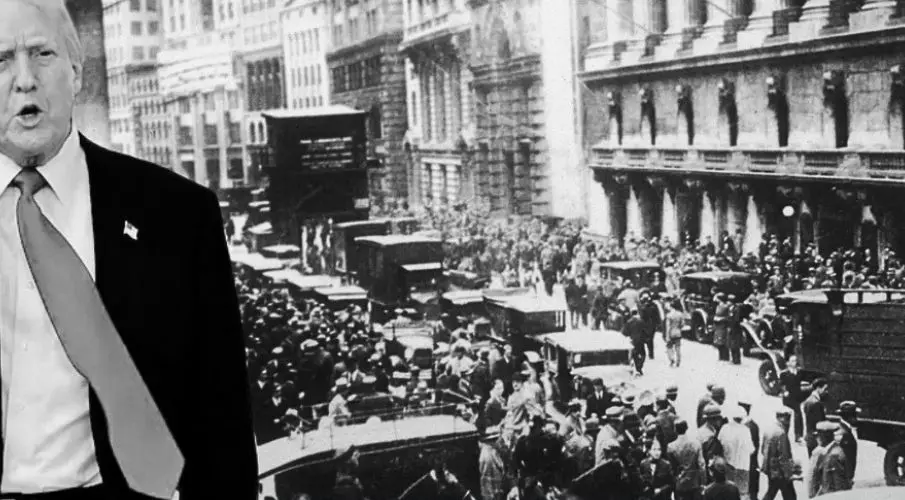
In the hour of political darkness, when economic reason yields to propaganda, history returns as farce. President Donald Trump, a man whose understanding of history is shaped less by archives than by autobiographies, recently declared that high tariffs could have prevented the Great Depression. He casts himself as the man now teaching this lesson again, no matter the cost. But history contradicts him. With full force.
The Tariff King and the Legacy of Smoot-Hawley
Trump, who styles himself as a protectionist in the tradition of William McKinley, grounds his policy on a foundation of historical misinterpretation. When the Great Depression swept the country in the 1930s like a plague, Congressman Willis Hawley of Oregon and Senator Reed Smoot of Utah believed that protecting American farmers and factories could be achieved through import tariffs. The Smoot-Hawley Tariff, a monument to economic nationalism, was signed into law in 1930 by President Herbert Hoover. More than a thousand economists had urged him in writing to show restraint. In vain. The bill, originally intended as a protective measure for agricultural products, mutated under industrial pressure into an all-encompassing tariff massacre. More than 20,000 products became more expensive, trading partners retaliated, a global tariff war erupted. The world economy, already weakened, plunged deeper into crisis.
Trump, however, immune to historical evidence, turns the world upside down. “If they had stuck with tariff policy, there never would have been a Great Depression.” The United States was born with tariffs. The Tariff Act of 1789, signed by George Washington, was a pragmatic means of financing the young state. Decades of high tariffs followed, intensified after the War of 1812 and during the industrial revolution. Tariffs served not only to protect American industry but also to manage debt after the Civil War.
But anyone who believes that tariff policy ended with the introduction of the income tax in 1913 is mistaken. The 1920s saw a new historical peak in trade barriers with the Fordney-McCumber Tariff of 1922, a preview of Smoot-Hawley. Then as now, protectionism did not lead to prosperity but to a bubble.
The Crash of 1929 – When the Market Held Its Breath
The economic foundation was already crumbling when the Federal Reserve raised interest rates in 1928. The goal was to deflate the speculative bubble on Wall Street. But the measure also hit the real economy, not only in the United States but worldwide. On October 29, 1929, Black Tuesday, the bubble burst. The Dow Jones collapsed. Credit evaporated. Unemployment and despair spread like smoke in a burning house. Instead of an active social policy, Washington delivered the Smoot-Hawley Tariff. At a moment when international cooperation was vital, America sealed itself behind a wall of fees and national pride. Export markets collapsed, global trade dried up, and the rise of fascism in Europe received an economic template.
“There were industries that benefited,” says economic historian Gary Richardson. “But overall, people in the United States and around the world were the losers.”
Herbert Hoover was many things before he became president: mining engineer, humanitarian relief organizer, secretary of commerce. A technocratic idealist with a reserved demeanor. Not a man of spectacle. Donald Trump, by contrast, is spectacle. He did not come to serve but to dominate. Where Hoover hesitated, Trump acts unilaterally and simply declares an “economic emergency” to impose tariffs.
Trump’s policy is not a correction of globalization but its sabotage. It ignores the fact that America’s prosperity in the twentieth century grew not despite but because of declining trade barriers. After World War II, the United States built a world order of free trade from which it benefited most of all. That Trump now demands the opposite is a relapse into the logic of the 1930s, a relapse riddled with memory gaps.
The tariffs of the twenty-first century no longer bear the name Smoot-Hawley, but they carry its spirit. Trump’s narrative is seductively simple: tariffs make you strong, globalization makes you weak. It is the mantra of a man who mistakes complexity for weakness and historical facts for messaging.
But history cannot be tweeted. It demands insight, learning, humility before its mistakes. The Great Depression was not the result of free markets but the outcome of a toxic mixture of speculation, protectionism, and political paralysis. Anyone who sells tariffs today as a cure-all sells the past as myth and the future as risk.
“Who controls the past controls the future. Who controls the present controls the past.”
And perhaps that is precisely the goal.
Investigative journalism requires courage, conviction – and your support.
Please support our journalistic fight against right-wing populism and human rights violations. We do not want to finance our work through a paywall, so that everyone can read our investigations – regardless of income or background.


