
The war in the Middle East has reached a new dimension. According to consistent information from U.S. security circles, Russia is providing Iran with targeted intelligence data about American forces in the region. Transmitted, they say, were the locations of U.S. warships and military aircraft - information that Tehran is using in attacks on American facilities. It is the first clear signal that another nuclear armed great power is indirectly intervening in this war.
Since the fighting began on Saturday, Russian entities are said to have passed on positional data regarding military objects. One participant spoke of a comprehensive approach. How far this support extends is not fully known. What is clear, however, is this: Iranian forces are striking targets with striking accuracy, even though their own reconnaissance capabilities have been limited after only a few days of combat. On Sunday, six American soldiers were killed in a drone attack in Kuwait, and several others were injured. Iran has launched thousands of so called one way drones and hundreds of missiles at U.S. bases, embassies, and civilian targets. At the same time, the joint American Israeli operation has attacked more than 2,000 targets in Iran - including missile positions, naval units, and elements of the leadership. A White House spokesperson, Anna Kelly, declared that the Iranian regime would be “absolutely crushed.” Retaliatory strikes were decreasing daily, the navy would be destroyed, and production capacities would be eliminated.

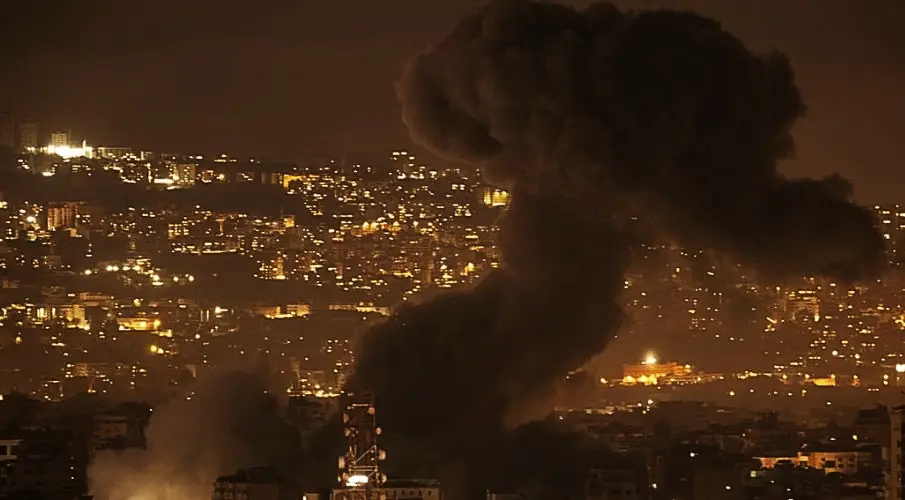
Satellite images show a large fire in the Fujairah Oil Industry Zone in the United Arab Emirates after a drone attack yesterday
She did not comment on possible Russian assistance. The CIA and the Pentagon declined to issue a statement. Defense Secretary Pete Hegseth said when asked that Russia and China were “not a factor” in this conflict. Two individuals familiar with the situation strongly contradicted that assessment, at least with regard to Moscow. There were no indications of Chinese involvement. In recent days, not only military installations have been hit. In Riyadh, a building next to the headquarters of the 5th U.S. Fleet in Juffair, Bahrain, was damaged by an Iranian drone. The CIA station at the U.S. Embassy in Riyadh was also attacked. In Doha, smoke rose near the Al Udeid Air Base.
The selection of targets points to precise reconnaissance. Iran is attacking early warning radars, over the horizon systems, as well as command and control structures. Military experts note that Tehran possesses only a limited number of its own military satellites and does not operate a comprehensive satellite network. Russian space capabilities would therefore be of considerable value - especially since Moscow has refined its targeting in the war against Ukraine over the course of years.
What is happening here, as investigations show, is more than technical support. In recent years, Russia has repeatedly enabled Iranian satellite launches, thereby deepening strategic cooperation in space. Even if these systems are officially declared civilian, they expand Iran’s access to high resolution earth observation. Added to this is the possibility that Moscow is sharing its own operational pictures. Whoever can track the movements of fleet formations or air operations almost in real time alters the starting conditions of a battle. It is not only the drone that matters, but the image that guides it.
From academic circles as well comes the observation of increased precision in Iranian strikes. Observers speak of a striking level of professionalism both in target selection and in the ability to penetrate American and allied air defenses. The quality of the attacks has even improved compared with the twelve day war with Israel last summer. At the same time, the Pentagon is consuming precision munitions and interceptor missiles at a high rate. Internal warnings about shortages had already been voiced by General Dan Caine, chairman of the Joint Chiefs of Staff, when President Donald Trump decided on the operation. The administration sought to downplay that assessment.
Systems such as Patriot, SM-2, or SM-6 are not assets that can be replaced at short notice. Their production is complex, supply chains are strained, and since the war in Ukraine manufacturing capacities have been operating at high utilization. A prolonged conflict in the Middle East forces Washington to reorder priorities: protection of its own forces in the Gulf, continued support for Kyiv, and simultaneous deterrence in the Indo Pacific. This triple burden is not theoretical, but an industrial reality.
Russia’s role alters the previous structure of this global contest. Since the large scale attack on Ukraine in 2022, Russian forces have received support from Iran, China, and North Korea - directly military or through industrial supply chains. The United States, in turn, supplied Ukraine with billions of dollars in equipment and shared intelligence about Russian positions to improve Kyiv’s targeting accuracy.

Now the pattern is partially reversing. Ukrainian President Volodymyr Zelenskyy announced that Washington had requested assistance in protection against Iranian drones; Kyiv would dispatch specialists. In recent years Iran was one of Moscow’s most important partners and provided technology for inexpensive attack drones used by Russian units against Ukrainian cities. A U.S. official said Moscow had been well aware of American support for Ukraine and had now apparently seen an opportunity to “pay back.” While the quality of Russian intelligence does not match that of the United States, it remains among the best in the world.
Should it be confirmed that Moscow is systematically providing positional data to Tehran, this would have immediate political consequences in Washington. The issue would no longer be limited to regional escalation, but to the indirect confrontation of two nuclear powers. Pressure on President Donald Trump would increase, as would calls in Congress for a clear response to Russian interference. A narrow line separates deterrence from expansion of the conflict - and that line is now moving to the center of the strategic debate.
For the Kremlin, a prolonged war between the United States and Iran also offers strategic advantages: rising oil prices and a distraction of the West from the war in Ukraine. At the same time, Moscow is holding back militarily. Experts note that Russia must concentrate its resources on Ukraine. From a strategic perspective, that war remains the Kremlin’s priority. The conflict in the Middle East is therefore not only a confrontation between Washington and Tehran. It is part of a larger shift in which old front lines overlap and new ones emerge. If Russian satellite data are guiding Iranian drones, that is not a side issue, but a clear signal: the separation between regional war and global power struggle no longer exists.
Updates – Kaizen News Brief
All current curated daily updates can be found in the Kaizen News Brief.
To the Kaizen News Brief In English


Aber, aber, aber . . . Vladi ist doch Donnie’s Freund 😳
….die Fakten und Recherchen in/mit einem grossen Journalistenteam mit 12 Leuten, führen zu einem anderen Resultat
Da glaube ich euch ja, aber für Donnie muss das ein herber Schlag sein.
… man hat ihn oft genug gewarnt
Nur gehört hat er nicht.
In seiner Parallelwelt sind er und Putin dicke Buddies.
Da kann Trump mal sehen was es heißt, wenn man von einem Bündnis spricht.
Aber Trump kennt ja nur harte Männer – so wie Putin einer ist – den er bewundert – und der ihm nun mächtig einheizt.
Ganz ehrlich?
Nur so lernt Trump es- vielleicht!?
Und wer hat jetzt schlechte Karten?
Der lernt nicht.
Der ist komplett beratungsresistent.
Ihm geht es ja auch nicht um Menschen.
Ihm geht es um sich.
Ironie des Schicksals.
Trumps großes Vorbild Putin hilft dem Iran.
Nicht ihm, wo sie doch -in Trumps Augen- beste Buddies sind.
Immer wurde Russland mit Samthandschuhen angefasst.
Die Ukraine mit Boxhandschuhen.
Und nun fragt die USA wirklich die Ukraine um Hilfe?
Wo sie doch gerade erst mit Russland (!) Und China gegen die UN Resolution gestimmt haben?
Ich hoffe, dass Selensky für die Hilfe was für die Ukraine aushandelt.
Was vielleicht etwas abfedert, dass Trump sie quasi hat fallen lassen.
Und ich hoffe, dass kein NATO Bündnisfall eintritt….