
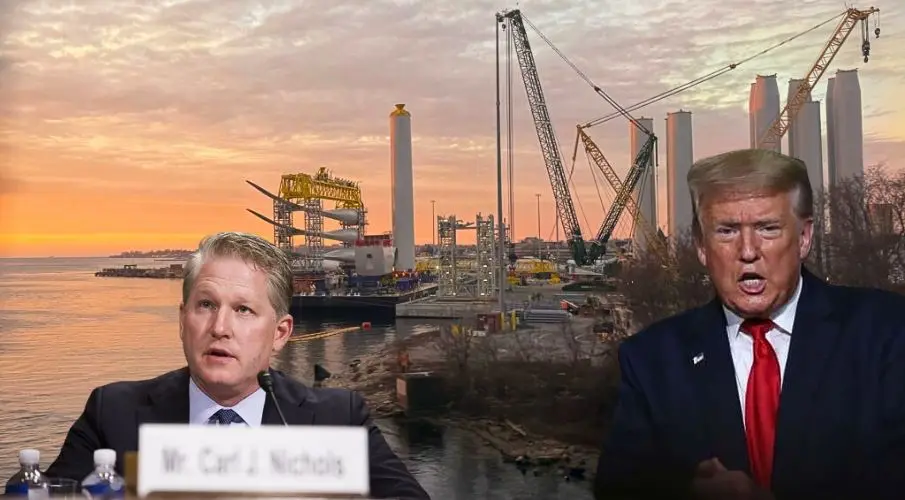
Federal Judge Carl J. Nichols has delivered another setback to the Trump administration. The multibillion dollar offshore wind project Empire Wind off Long Island is allowed to continue construction. The construction halt imposed by the Department of the Interior was unlawful and would cause the project severe and irreparable harm, Judge Carl J. Nichols ruled at the federal court in Washington. Empire Wind, a project worth around five billion dollars by the Norwegian energy company Equinor, is already about 60 percent complete. According to the operators, any further delay would have had existential consequences. Contracts worth more than one billion dollars would have collapsed, and a specially equipped construction vessel would have been forced to leave the area to be deployed elsewhere. The judge accepted this assessment and made clear that the damage was real and immediate.
His criticism of the government was particularly sharp. The Trump administration had not even remotely demonstrated that it gave the company an opportunity to respond before imposing the construction halt. That step is required by law. The Justice Department also failed to present any substantive evidence for the alleged national security concerns. The decision by the Department of the Interior was therefore legally vulnerable. Notably, Judge Nichols himself was appointed by Donald Trump. This is already the second time within a few days that courts have blocked Trump’s course against offshore wind. Earlier in the week, Judge Royce Lamberth, also in Washington, ruled that the Revolution Wind project off Rhode Island and Connecticut may continue construction for now while lawsuits are reviewed. As a result, the administration’s attempts to stall multiple wind farms along the East Coast are increasingly faltering.
Shortly before Christmas, the Department of the Interior had ordered work to stop on a total of five projects. In addition to Empire Wind and Revolution Wind, Sunrise Wind off New York, Vineyard Wind 1 off Massachusetts, and Coastal Virginia Offshore Wind were also affected. The justification was vague, claiming that at least 90 days were needed to review supposedly classified security issues. Concrete indications or briefings never followed, not even for the states directly affected. In total, the projects represent investments of around 25 billion dollars. Under current plans, the facilities are expected to supply electricity to more than 2.5 million buildings and secure thousands of jobs. Several states and project developers therefore went to court to overturn the construction halt.
Trump himself has repeatedly attacked offshore wind in sweeping terms. Without evidence, he claimed that wind farms destroy the environment and kill birds and whales. In the first month of his term, he issued an executive order halting new permits for wind energy on federal land and in US waters. A court later struck down that order as arbitrary. In the spring, the administration escalated its approach and began targeting projects that were already approved and under construction. In New York, this met with open resistance. Governor Kathy Hochul made it clear that she would not be fobbed off with slogans. If there were truly a security threat off the coast, it would need to be explained and substantiated. She said she never received an answer. For Hochul, the stoppages are nothing more than political sabotage that harms jobs, the economy, and the state’s energy future.
In court as well, the government failed to provide explanations. Representatives of Empire Wind said they have still not been told why offshore wind should suddenly be considered a security risk. Several companies requested confidential briefings for appropriately authorized representatives. Even those requests have so far been denied. Supporters of wind energy see the security arguments as a pretext. All five projects had undergone years of environmental reviews, received permits, secured financing, and begun construction. They were considered central components of a shift away from fossil fuels initiated under the previous administration.
While opponents of the wind farms are now pushing for appeals, attention is already turning to the next case. Vineyard Wind has also filed an emergency motion to lift the construction halt. A hearing date has not yet been set. The decisions so far, however, paint a clear picture. Trump’s attempt to slow offshore wind through administrative means is running up against legal limits. Courts are demanding evidence, procedure, and transparency. Mere assertions are not enough to stop billion dollar projects. And if this case also ends in a defeat for Trump, as always.
To be continued .....
Updates – Kaizen News Brief
All current curated daily updates can be found in the Kaizen News Brief.
To the Kaizen News Brief In English


Offshore Windräder sind Trump ein Dorn im Auge.
Darauf ist er fixiert.
Seine Racheagenda eben.
Sicherheitsrelevante Belange wurden ausgiebig vor Genehmigung der Bauanträge geprüft.
Woher kommen denn plötzlich die Sicherheitsprobleme? Die, die nie benannt oder belegt wurden.
Gut, dass zwei Richter dem erstmal einen Riegel vorgeschoben haben.
Allerdings fürchte ich, dass auch das Thema zum Supreme Court getragen wird.
…trump wird da kaum chancen haben, er hat alle prozesse bisher verloren in diesem bereich
Es gibt sie also doch noch, Rechtsprechung, die auf Gesetzen gründet. Nicht genug, um mich zu beruhigen, das wird nicht ausreichen, um den irren, größenwahnsinnigen Präsidenten unter Kontrolle zu bringen, aber eine kleine Pause zumindest…..
aktuell ist der stand, das trump 83% der prozesse verloren hat