
More than 200,000 fallen Russian soldiers have now been confirmed by open sources, the influx of new volunteers is drying up, and in the fifth year of the war the Ministry of Defense is reaching into places where young people are supposed to learn: lecture halls. At more than 80 universities and two dozen colleges, a coordinated recruitment campaign is underway. Students are being courted for "elite drone units," for high one time payments, for quickly closing academic gaps, for switching to a state funded study place. Officially, it is called information. In fact, it is about contracts with the military.

"Unique opportunity to serve in the Plekhanov student unit"
"Military service under special contract guaranteed for a duration of 1 year"The motif shows no war, but a career. Drones, a flag, a virtual reality headset - the military contract is staged as a technological project of the future. This is exactly how the shift works: deployment at the front is linguistically reduced to a "one year special contract," packaged in university aesthetics and promises of the future.
The Vladimir branch of RANEPA, RANEPA is the Russian Presidential Academy of National Economy and Public Administration, a state elite university with nationwide branches for the training of administrative and leadership personnel, speaks of a "prospect for self realization" and promises service "far from the front line." In Krasnoyarsk, the Siberian Federal University explains that young people are particularly suited to controlling drones because they grew up with smartphones and computer games. The Russian University of Transport promises social benefits, academic leave during the contract, and the possibility of switching to a state funded study place after service. The language resembles an elective course. The content is a military contract.

Excerpt from the project description of Plekhanov University, which is in our possession:
The university guarantees participants in the project several concrete advantages: First, free study in any degree program at Plekhanov University is promised. Second, during the one year contract, one time and regular payments are pledged - totaling 5.2 million rubles. Third, the university promises full equipment and modern gear at its own expense. Fourth, official veteran status of the so called "special military operation" with all legal rights and benefits is guaranteed. Fifth, studies are to be completed early by no later than May 15, 2026; organization and defense of final theses would be accelerated, requirements partially lowered.
At the College of Aerospace Engineering and Technology of A. A. Leonov Technological University in Korolyov, students were summoned at short notice to a "lecture." Those who attended were to submit a written declaration. Those who were absent risked poor grades. A student who wishes to remain anonymous for security reasons reports threats involving absences and disciplinary measures. At the same time, a Telegram channel already existed in which students criticized grievances: bullying, coarse tone, infrastructure problems, resistance to the introduction of the messenger Max. After a post about the recruitment event, suspected administrators were summoned before a disciplinary commission. Director Elena Antropova, Student Council Chair Andrei Morusak, Deputy Branch Director Nikolai Kruglov and other officials accused them of damaging the university’s reputation nationwide. They were only informing, it was said. There could be no talk of coercion.

The exhibition stand of Plekhanov University REU with a clearly military technical focus. On the podium stands the university logo next to the state emblem, in front of it drone models and technical components are placed. In the background an industrial robot arm, a screen labeled "Flight Control Center," as well as additional unmanned systems can be seen.
The staging combines university identity with military adjacent technology. Drones, robotics, and control systems are not presented as external cooperation, but as a visible component of the university infrastructure. The image conveys the impression of a technically oriented training environment in which civilian teaching and militarily usable systems stand closely side by side.
At the Technological University itself, service is described as the acquisition of "practical skills": repair of unmanned systems, 3D modeling, technical maintenance. Brochures promise the "opportunity to become a hero in real life." At Bauman University in Moscow, the recruitment message appears directly in the student app inbox. At Saint Petersburg State University, the administration sent emails offering a contract and announced a "special scholarship" of 50,000 rubles per month. Presentations calculate between two and six million rubles for the first year of service, including federal and regional bonuses. Financial attractiveness stands alongside the assurance of a "secure specialization" and an allegedly guaranteed contract termination after one year.
In colleges, the tone is sharper. Maria Kirsanova, director of the Novosibirsk College of Transport Technologies, is said to have publicly reprimanded students who did not want to sign. Elsewhere, the approach is more subtle. A lecturer at a college affiliated with Plekhanov University reports that teachers were instructed to bring a certain number of students per group into the auditorium. Questions were unwelcome. A vice rector, an active soldier, and administrative representatives appeared. They did not speak of a contract, but of an agreement. Up to five million rubles upon signing were promised, monthly payments, early graduation, enrollment into the first year of university, veteran status, career opportunities. "You will be the first in the elite drone troops. You will return popular," was the message. The actual service time would be less than a year, two months of training, 35 days of leave. The focus would be on repair, not combat missions. That the contract provides for transfer to other branches in case of "unsuitability" was not mentioned to the audience.

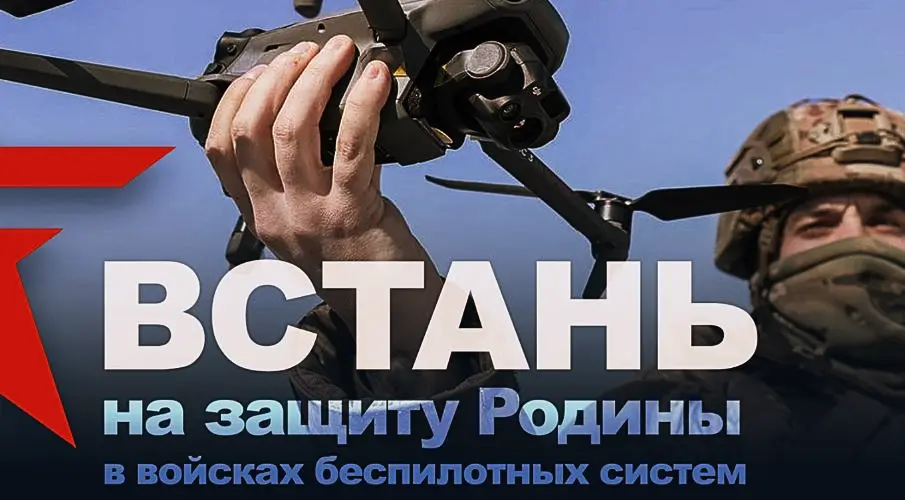
The poster originates from the environment of the Russian armed forces and openly promotes entry into the "troops of unmanned systems." The slogan "Rise to defend the fatherland" combines patriotic rhetoric with modern drone technology. Shown is a soldier with unmanned flight technology, military service appears as a technically controlled, contemporary deployment. Drone warfare is thus staged as a national task and an attractive field of the future.
(https://vlad.ranepa.ru/news/stan-chastyu-komandy-budushchego-sluzhba-v-voyskakh-bespilotnykh-sistem/)
In one on one conversations, the pitch went further. Loans of up to ten million rubles were mentioned, which would later be forgiven. There was talk of safety, of round the clock supervision by a university curator, of serving together with fellow students. Around 70 students are said to have signed. At the same time, a retraining program to become an "operator of an unmanned multirotor aircraft" is underway at Plekhanov University, supplemented by mandatory courses whose attendance is strictly monitored. Officially, it is about qualification. Unofficially, about numbers.
Legal advisors such as Timur Tukhvatullin report since January of calls from students across the country. In some universities it remains at urgent offers, in others there are threats of expulsion. At first, mainly technically skilled students with academic backlogs were approached, now any recognizable system appears to be lacking. Artem Klyga of the Movement of Conscious Objectors speaks of centrally distributed instructions from the Ministry of Defense to university administrations. At Far Eastern Federal University in Vladivostok, 32 individuals were to be recruited by the end of February, at Novosibirsk State Pedagogical University 109 by April 2026. It resembles a quota.

The brochure advertises entry into the "troops of unmanned systems" and addresses students directly. Extensive social benefits are listed: service housing or rent subsidy, free medical care, veteran status, pension entitlements after 20 years of service as well as tax relief. It also promotes credit holidays and possible debt forgiveness of up to ten million rubles. Childcare, additional regional bonuses, and retention of jobs and study places during service are also promised.
In the section on the application process, it is explained which documents must be submitted - including passport, military documents, educational certificates, medical and psychological assessments. Responsible contacts at the university are named. The message is clear: the military contract is not presented as an exception, but as a structured career path with administrative support from the university.
Particularly vulnerable are students with academic debt or expiring deferments from military service. In Saint Petersburg, those with soon expiring deferments were summoned to the dean’s office. They filled out questionnaires, had to justify why they did not want a military service contract and under what conditions they would agree. Those who declined received calls from unknown numbers. At the Higher School of Economics, students with backlogs are said to have been offered a contract as an alternative to expulsion as early as late January. In Kazan and Voronezh, those affected report that they were unlawfully denied repeat examinations and instead advised to join the army.
Most respond with mistrust. Some sign nonetheless. A student at Peter the Great St. Petersburg Polytechnic University tells of a fellow student who, despite all promises, even dropped out of his studies. His further path is unclear.
Legally, proving pressure is difficult. Formally, universities refer to study regulations, performance requirements, information events. In fact, a climate emerges in which academic deficits become leverage. Legal advisors recommend documenting every threat, submitting written applications for lawful repeat examinations, recording conversations, contacting organizations such as School of the Conscript, DSO, or Go to the Forest. Those who have already signed have only limited room for maneuver, particularly as long as the mobilization decree effectively remains in force.
What is sold as an "innovative specialization" is a military recruitment campaign within the education system. The decisive questions do not appear on glossy slides: Is the promise of drone units binding? Can a transfer be refused? Does one actually return to studies? Between scholarship promises and millions of rubles lies a signature that determines life, education, and freedom. And a generation that is to become the replacement for missing volunteers.
Updates – Kaizen News Brief
All current curated daily updates can be found in the Kaizen News Brief.
To the Kaizen News Brief In English


Ich erinnere mich gut an Euren Bericht zur Militarisierung schon in den Grundschulen.
Logisch, dass man sich jetzt die Erwachsenen greift.
Der Krieg braucht Menschen.
Gefragt wird da Keiner, egal was nach außen gesagt wird.
Es gilt mitmachen oder extremen Repressionen ausgesetzt zu sein. Nicht nuf man selber, sondern die ganze Familie
Viele Optionen haben diese jungen Menschen nicht.
Manch einer wird dem begrenzten Drohnendienst zustimmen um sich bicht im Schützengraben wieder zu finden.
Für den Frontdienst halten weiter wenig gebildete Russen, Straftäter, Nordkoreaner und Kenianer her. 😞
Und Putin hockt in einem seiner Paläste und sieht zu, wie sein Volk leidet und stirbt.
Hauptsache seine Agdnda wird durchgesetzt.
Ich frage mich, woher das Geld kommen soll, was all den Studierenden versprochen wird.
Schon jetzt erfolgen viele der Sonderzahlungen nicht.
Wie bei ICE die Prämien zumeist nicht gezahlt wurden.
Interessant all die Parallelen.
…geld ist genug vorhanden, sanktionen werden genügend umgangen