
First and foremost: Never access the Epstein files at the Department of Justice without a secure, independent VPN connection. Based on the information currently available, search queries and document retrievals appear to be traceable. Anyone reviewing sensitive materials should assume that digital footprints are created and that those footprints can be analyzed. We are currently conducting several parallel investigations in this area. The indications are mounting that access is not merely logged but systematically recorded. Therefore, one rule applies: Technical safeguards are not paranoia, they are self-protection. Check your connection, avoid using personal devices without adequate security measures, and proceed as if every click were being recorded.
They are two stories from two worlds, and yet they tell the same thing: those who are supposed to exercise oversight are themselves overseen. Those who ask questions are measured. And those who protest are turned into files. In Washington, it concerns members of Congress who want to review the so called Epstein files. In Texas, it concerns a Reddit user who calls for a legal demonstration. Both cases end where a democratic state must never end up: in the quiet reversal of roles.

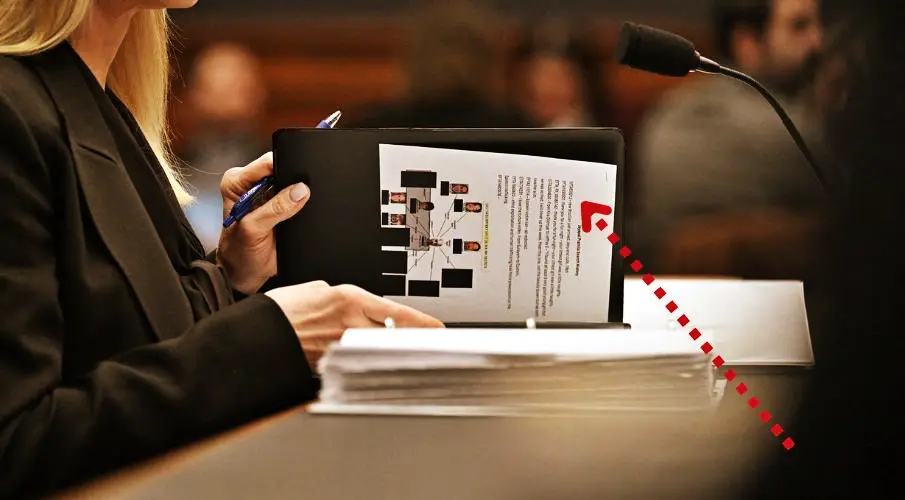
Jayapal Pramila search history
Selected entries:
- "New Brazilian just arrived, sexy and sweet, 19 years old."
- "Thanks for a fun night - your youngest girl was a little naughty."
- "From Kira Dikhtyar to Jeffrey E - 'I found at least three very good young girls, but I was so tired. I will follow up this week. Meet this one, not the beauty you like so much.'"
- "Epstein victim list - everything redacted."
- "I love the torture video. From Sulayem to Epstein."
- "Child exploitation and human trafficking - task force presentation on Epstein trafficking."
Graphic title:
"(U//LES) Jeffrey Epstein 3I E NY-3027571"
In the graphic shown below, Jeffrey Epstein is at the center. Lines of connection extend from him to several individuals; some names are visible, others redacted.
In Congress, it was a photo that suddenly made the suspicion visible. While Attorney General Pam Bondi testified before the Judiciary Committee, cameras captured a printout in her folder. At the top it read: "Search history Jayapal Pramila." Beneath it: file names, brief descriptions, a list of what an elected member of Congress had allegedly searched for. Pramila Jayapal, Democrat from Washington, responded with a sentence that should not even be up for debate: it is completely inappropriate and an attack on the separation of powers if the Department of Justice monitors members of Congress while they review files they are examining as part of their oversight of the executive. She wrote that Bondi appeared with a folder that printed out which emails she had searched for. That is outrageous, she said, and she would pursue it and stop this spying.

What matters is not only that this list existed. What matters is that it apparently appeared as working material in a public hearing, as if it were normal to confront members of Congress with their search terms. Jayapal later said that the listed searches matched what she had actually entered in the secure room. She also spoke of possible bipartisan agreement: oversight without surveillance. She had spoken with the Speaker of the House, Mike Johnson, about it. This is not about sensitivities. It is about the fundamental question of whether the legislative branch can do its work without the executive logging who looks up what.

"I think members should of course have the right to review these documents at their own pace and at their own discretion. I do not think it is appropriate for anyone to track that," Johnson said. "I will make that clear to everyone involved at the Department of Justice - and I am sure it was a mistake," Johnson continued, an excuse no one believes. Because even if it had been a mistake, the question remains: why did Bondi have these documents with her at all - and why did she reach for them at the exact moment when the member in question was asking her critical questions?
The file review itself is already a tightly controlled corridor. Members of Congress are not allowed to freely take the less redacted documents with them, but are to view them on a few computers in a secure room at the Department of Justice, in a system that is cumbersome and in which department staff remain present. Jamie Raskin, the ranking Democrat on the Judiciary Committee, described it like a supervision scenario: one sits at Department of Justice computers, uses unwieldy software and reads documents while staff look over one’s shoulder. He called it a brazen intrusion into parliamentary oversight and announced that he would ask the inspector general to investigate. His demand is clear: stop the tracking, release the files, but with the survivors’ data consistently protected, and only theirs.
The fact that even a Republican member confirms the allegation makes the matter harder to dismiss. Nancy Mace of South Carolina wrote that she can confirm that the department tracks which documents members of Congress search for, open and view. She said she understood the system well enough to know what is marked in the background, without giving details. She too spoke of someone sitting in the room observing and that members are assigned identifications when logging in. The picture that emerges is not a friendly one: oversight does not take place freely, but under the supervision of those who are supposed to be overseen.
While the Department of Justice initially did not respond to these allegations, another point remains that makes the whole thing appear like a threat backdrop: in the same hearing, there was discussion about the delayed release of the files, about continued redactions, about names that remain hidden despite legal requirements and about embarrassing errors in protecting victims, including sensitive information and images that appeared in released documents. Anyone who already has to face the question of whether files are being withheld or mishandled should not at the same time begin logging the search paths of the overseers. That is exactly what shifts the balance of power, with protocols and log files.
And then there is the second story, which at first glance seems far away, but in truth reflects the same pattern. An internal bulletin from Border Patrol, a memo from January. The subject: a Reddit user. Name known to the editorial team. Not an alleged violent offender, not a smuggler, not a terrorist. Just someone who allegedly called for a protest near a Border Patrol station in Edinburg, Texas.

The concrete trigger for the internal security document is a simple Reddit post from Edinburg, Texas. A user calls to "protest against ICE" and to stand up for "rights and freedom" - not only for themselves, but for neighbors, family and community. Volunteers are sought who are to "be witnesses and raise awareness." As a meeting point, the author names the intersection of 281 and Trenton near a Border Patrol station, around 6 p.m. The tone is appealing, but not violent. It is about presence, visibility and support. Precisely this call - a few sentences, openly formulated, without specific threats - was classified by authorities as a security relevant event and turned into a comprehensive analytical paper.
The paper explicitly notes that the protests in Texas had generally been lawful and that there were no indications of planned violence. And yet the conclusion reads: any demonstration near a facility could pose operational, security related and reputational risks and must continue to be monitored.

An internal Border Patrol bulletin shows how far authorities now go. The occasion was a Reddit post by a user from Edinburg, Texas, who on January 24 called for a protest rally against ICE near a facility of the Rio Grande Valley Sector. The demonstration was to take place the same evening.
The document explicitly states that there are no concrete indications of planned violence against personnel or facilities. Nevertheless, any gathering near the site is classified as a possible "operational, safety, and reputational risk" that must continue to be monitored. Even generally "lawful" protests in cities such as Brownsville, Austin, or Dallas are described as part of a statewide pattern of mobilization.
What is striking is the line of reasoning: not documented incidents, but "perceived" grievances and civil rights concerns are already considered triggers for real-world protests. In this way, a brief online call becomes a security-relevant event. The paper shows how public criticism turns into a subject of surveillance - even when no concrete threat exists.
This is the logic that is toxic in democracies: there is no concrete indication of violence, but the mere location and the mere fact of a demonstration suffice to justify surveillance. In the bulletin, a term appears that actually comes from military operational areas: "force protection." A concept that may make sense in war is transferred to a call in a regional forum. A discussion thread becomes a danger zone. Political criticism becomes an object of "further observation."

It becomes even more grotesque where the paper shows how deep the evaluation goes. To assess the "risk," not only the few lines of the protest call were examined. The user’s entire digital environment was combed through. Where else they write, what they are interested in, which forums they use. The listing includes harmless topics: sports comparisons, movies, books, nostalgia about television layouts from the seventies. None of it is illegal. None of it is a threat. But precisely this banality makes the message so clear: it is not about a concrete danger. It is about profiles. It is about patterns. It is about who thinks how, who expresses themselves how, who mobilizes, who disrupts.
The paper even speaks of trend and relationship analyses, of a kind of sociology of unrest. Protest as a "symbolic target" of government buildings, mobilization through social media, a "baseline" view of mobilization potential. These are words that come from a surveillance apparatus that understands everything as a situational picture. And at the end there is a warning notice to personnel that in its severity makes its own claim absurd: although there are no indications of planned violence, it is recommended to wear ballistic vests, use long guns and, if possible, work in groups.

The internal paper goes even further and attempts to derive a nationwide pattern from a single Reddit call. Under the heading "Pattern, Trend and Relationship Analysis," the agency describes an allegedly new form of short term mobilization via social media: little planning, low organizational structure, spontaneous participation. Precisely this spontaneity is evaluated as a problem for the authorities’ "situational awareness."
At the same time, the choice of location is interpreted as "symbolic target selection." Protests near Border Patrol facilities are thus regarded not merely as assemblies, but as deliberate focusing on centers of state power. Earlier demonstrations in front of city halls or police departments in Austin and Dallas are placed in the same context. Finally, the document constructs a "nationwide mobilization potential." Several, predominantly peaceful protests in various Texas cities are interpreted as evidence of heightened attention toward immigration policy. From temporal proximity, strategic dynamics are made - and from public debate, a security relevant trend.
One can consider these two processes separately. That would be convenient. But together they show a development that is dangerous because it remains gradual. In Washington, search histories of parliamentary oversight are made visible, as if overseers themselves could be overseen. In Texas, a protest call without reference to violence is framed with the vocabulary of the battlefield, as if the population had to be read like a hostile environment. In both cases, the result is the same effect: deterrence. Those who know that their search is logged search differently. Those who know that their post ends up in a bulletin write differently. Democracy is damaged not only by prohibitions, but by the expectation of being watched.
And that is precisely why the line that remains at the end is so unsettling: Spying no longer appears to be an exception under this administration, but a routine. Not spectacular, not accompanied by grand speeches, but carried out through printed lists in a minister’s folder and through notices about people who post a few sentences in an online forum. When that becomes a habit, a republic does not lose its freedom all at once. The Trump administration, like many other governments, is betting in 2026 that surveillance will eventually wear people down and sap their courage — unless they have miscalculated. Our investigations will continue without interruption, and we would appreciate your support for our work.
To be continued .....
Updates – Kaizen News Brief
All current curated daily updates can be found in the Kaizen News Brief.
To the Kaizen News Brief In English


Unglaublich Rainer, was Ihr da aufgedeckt habt.
Die nicht rechtmäßige Kontrolle von Parlamentariern, die eine gewisse Immunität besitzen.
Jeder Klick, alles wird dokumentiert und archiviert.
Es wird genutzt um unbequeme Gegner zu identifizieren, zu diffamieren.
Das ist schlimmer, als Stasi und SS.
Das ist Hightech Stasi.
Etwas, was es einem (noch?) Demokratischen Staat nicht geben darf.
Hoffentlich gibt es da einen Konsens der Parlamentarier.
Aber Johnson und Co stecken ja bis zu den Schultern im Allerwertesten von Trump.
.ich danke dir ..es ist schon erschreckend, was aktuell läuft und es ist für deutschland wichtiger als die meisten vermuten, ….