
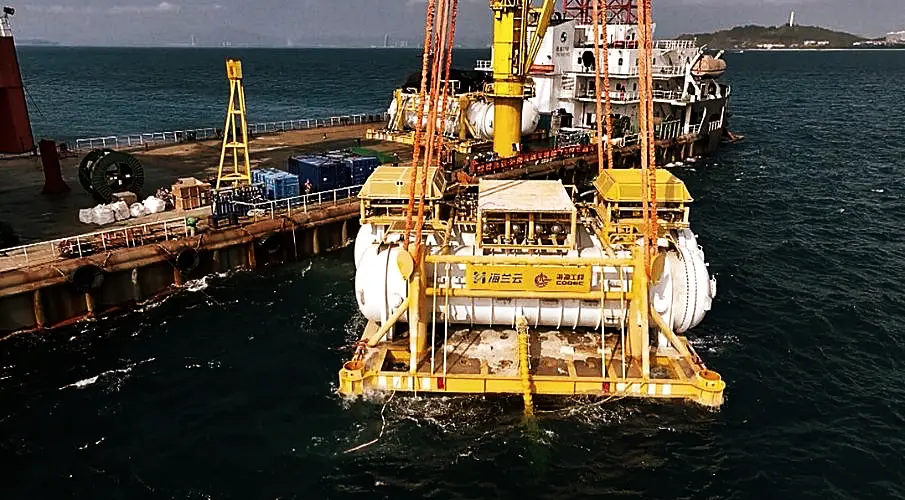
China is building data centers where cooling is no longer a problem: in the sea. Off the coast of Shanghai, a facility is currently being developed that not only uses new technology, but addresses a fundamental problem of the digital world. Server farms consume enormous amounts of electricity and water. A large portion of this is used for cooling alone. The machines run around the clock, densely packed, generate heat and must be continuously cooled, otherwise failures and data loss threaten. In conventional facilities, hundreds of thousands of liters of water are pumped through systems every day, cooled, evaporated. At the same time, these locations are often in regions where water is already scarce - Arizona, parts of Spain, the Middle East. The conflict is obvious: computing power grows, water becomes scarcer.
China reverses the approach. Instead of consuming water, it uses it directly. The project off Shanghai is being built about ten kilometers off the coast and is supplied with energy from an offshore wind farm. According to Li Langping of Hailanyun, the facility is expected to run on 97 percent wind power. The servers are housed in pressure resistant modules underwater. Seawater is guided through cooling systems, absorbs the heat and carries it away. This saves energy. Internal calculations together with the China Academy of Information and Communications Technology estimate at least 30 percent lower power consumption compared to land based facilities.

Off the coast of Shanghai, the project has long moved beyond the planning phase. About ten kilometers offshore in the Lingang zone, initial modules have already been installed and partially put into operation. This is no longer about testing, but about ongoing expansion. Current capacity is in the low megawatt range, with plans to scale to a multiple of that. The facility is directly connected to offshore wind power and is intended to be almost entirely supplied by it. Cooling is carried out continuously using seawater, without the massive use of freshwater required on land.
The scale is deliberately staged. In the first phase, nearly two hundred racks are installed underwater, designed for several hundred AI servers. This is small compared to conventional large scale facilities, but exactly as planned. China is not pursuing a single large project, but is building step by step and expanding in parallel. After the pilot project off Hainan, Shanghai is the point where an experiment becomes a system.
Timing is important. Since 2025, initial units have been active while expansion continues. This means the technology is no longer being tested, it is being used. At the same time, experience is being gathered to prepare larger facilities. The goal is significantly higher capacities in the coming years, with direct coupling to renewable energy at sea.
The first expansion stage is manageable. 198 racks, space for several hundred AI servers. Still, the number shows where things are heading. The facility is expected to have enough capacity to train a model at the level of GPT-3.5 within a single day. For comparison: conventional medium sized data centers in China operate with up to 3,000 racks, large facilities with over 10,000. The project off Shanghai is not an endpoint, but a test run for scaling.
The idea itself is not new. Microsoft had already tested a similar system years ago with Project Natick off the coast of Scotland. A container with over 800 servers was placed at a depth of 35 meters for two years. The result was positive. The systems ran stably, there were fewer hardware failures than on land. The sealed environment, filled with nitrogen instead of oxygen, reduced corrosion. At the same time, many risks from human intervention were eliminated. Nevertheless, the project was not continued. Microsoft today describes it as a research platform, not an operational deployment.

This is exactly where China steps in. Hailanyun has managed in less than four years to move from the pilot project off Hainan to commercial implementation. Zhang Ning from the University of California, Davis, sees this as a decisive difference. While others have tested, this is being implemented.
The advantages are obvious. Lower energy consumption, hardly any freshwater demand, direct connection to renewable energy at sea. At the same time, the problems shift. The question of environmental impact remains open. In its test, Microsoft observed only minimal warming of the surrounding water, just a few thousandths of a degree. Other studies warn that these effects could intensify at higher sea temperatures. Warmer water contains less oxygen. This can become critical for marine life, especially in already stressed regions.
Security also plays a role. A study from 2024 shows that underwater facilities could theoretically be damaged by targeted sound waves. Attacks would not need to be visible, they could occur from a distance. Hailanyun refers to its own tests in the Pearl River Delta. There, the facility caused less than a one degree temperature increase and no measurable damage. The assessment is: no relevant impact.
At the same time, global interest is growing. But while other countries are examining and planning, China is already operating initial facilities. The technology is no longer the main obstacle. What will be decisive is how quickly questions of permits, environmental protection and infrastructure are resolved. China has begun to address exactly these points on a large scale.
The pressure behind this is clear. Artificial intelligence is driving demand for computing power massively upward. Every new application, every model, every automation consumes energy and generates heat. Existing infrastructure is reaching its limits, not technically, but ecologically. Water, electricity, space are becoming bottlenecks.
China is responding with a radical step. Data centers are moving to where cooling is no longer a cost factor. The sea becomes part of the infrastructure. Whether this model will prevail worldwide does not depend on whether it works. It already does. What matters is whether other countries are willing to follow the same path.
Updates – Kaizen News Brief
All current curated daily updates can be found in the Kaizen News Brief.
To the Kaizen News Brief In English


