
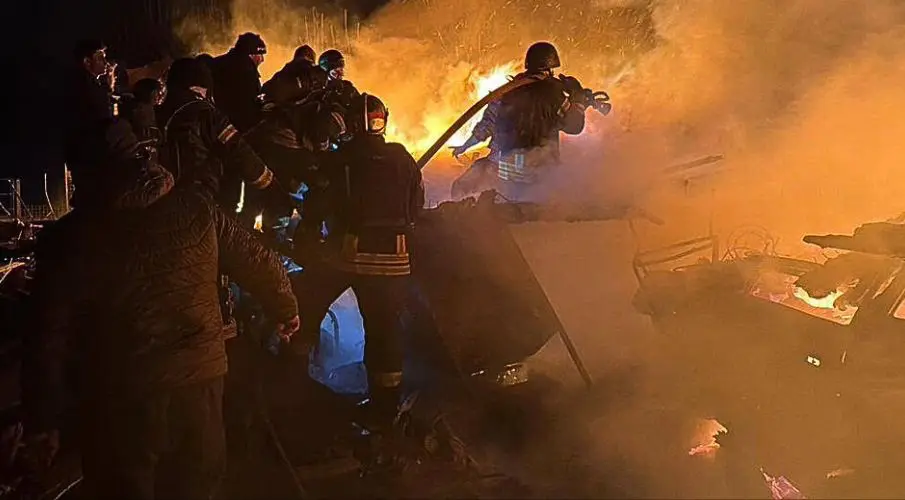
Shortly before midnight, the Ukrainian Air Force issued an unusual warning. From Kapustin Yar, a Russian strategic missile test site near the Caspian Sea, the launch of a ballistic missile was possible. Shortly thereafter, explosions shook the region around Lviv in western Ukraine. Kyiv did not confirm whether a nuclear-capable intermediate-range missile had actually been used from that area. Yet the mere possibility marks a new quality of threat.
If the suspicion is confirmed, it would be only the second time since the start of the war that Russia has used a missile from one of its strategic test sites against Ukraine. As early as 2024, Moscow fired the Oreshnik, a new intermediate-range missile, also from Kapustin Yar. At that time it carried decoys instead of warheads and caused only limited damage. The message was nevertheless unmistakable. Russia demonstrated what it is technically capable of - and that it is willing to deploy these capabilities politically.
During the night, several residential buildings in Kyiv were hit by Russian drones and missiles, as Russia once again carried out a large-scale combined attack on Ukraine. There are dead and injured. According to information as of 3:15 a.m. local time, the attacks are still ongoing, further missiles are in the air, and air raid alerts remain in effect across large parts of the country. In the Brovary district, a five-year-old child and three adults were rescued from the basement of a house after the building was struck by a Russian attack. All those affected had to be taken to hospital, including for carbon monoxide poisoning and other injuries.
Once again, the timing does not appear accidental. Ukraine has rejected Russian demands for territorial concessions in talks. At the same time, the U.S. government has sidelined a close ally of Moscow by arresting Nicolás Maduro in Venezuela. In this situation, the suspected missile launch appears as a signal to several audiences at once.
The Ukrainian Air Force dated the warning to around 11:30 p.m. Shortly afterward, Lviv mayor Andriy Sadovyi reported explosions and damage to critical infrastructure. He did not provide details. What stands out, however, is the proximity of the impact area to the Polish border. Poland is a member of NATO and the EU. An attack in this region brings the war geographically closer to the alliance without formally crossing its border. When the Oreshnik was used in November 2024, President Vladimir Putin publicly named the missile and justified its deployment. He spoke of retaliation for the permission granted by the United States and the United Kingdom for Ukraine to use Western weapons deep inside Russian territory. At that time, the missile struck an aviation plant in Dnipro. The damage was limited, the symbolic effect immense.
According to the Pentagon, the missile used is based on the RS-26 Rubezh, an originally intercontinental missile modified for shorter ranges. It carries multiple warheads that separate in flight. Ukraine has no systems capable of intercepting such a weapon. This technical fact alone alters the balance of power, even if the missiles are equipped with conventional or empty warheads. Parallel to the explosions in the west, the country experienced another night of massive attacks. In Kyiv and the surrounding area, drones and missiles struck residential neighborhoods. Several apartment buildings were hit. In Brovary, a five-year-old child and three adults were rescued from the basement of a house after the building was damaged. They suffered, among other things, from carbon monoxide poisoning and had to be hospitalized. In another part of the capital, an entire family was reportedly killed after their apartment building was directly hit.
In the Kyiv district of Darnytsia, a so-called double strike occurred. First, a Russian attack hit a residential building. As emergency responders were providing assistance on site, a second targeted strike followed. According to current information, a paramedic was killed and three other medical responders were injured.
Even hours later, no end to the attacks was in sight. Shortly after three o’clock in the morning, the air raid alert was still ongoing, missiles were still in the air. In at least one case, a building caught fire after an impact. Even shelters no longer offered reliable protection. Dead and injured were reported from multiple regions. That residential areas are being deliberately targeted, or at least accepted as collateral, is no longer an exception. The attacks of this night fit into a pattern that has been intensifying for months. Russia relies on mass, on combinations of drones and missiles, on overwhelming defenses and on intimidating the civilian population. The possible use of a nuclear-capable delivery missile adds another layer to this pattern.
Four gaps that cannot be talked away
- no common European deterrence strategy
- no clear red lines that would also carry consequences
- no political initiative that goes beyond managing the war
- no response to attacks that are moving ever closer to EU borders
The political message is clear, even without official confirmation from Moscow. Russia is demonstrating reach, unpredictability and a willingness to escalate further. The proximity to Poland increases pressure on the West without crossing a formal red line. For Ukraine, it means another night of fear, fire and loss. For Europe, it is yet another indication of how close this war has come to its borders. What remains is the image of a country under constant bombardment. Children rescued from basements. Families dying in their apartments. Cities hearing sirens minute by minute. And above it all, the threat of weapons that do not only destroy, but also carry a political promise - that Russia is prepared to take the next step.
Updates – Kaizen News Brief
All current curated daily updates can be found in the Kaizen News Brief.
To the Kaizen News Brief In English