
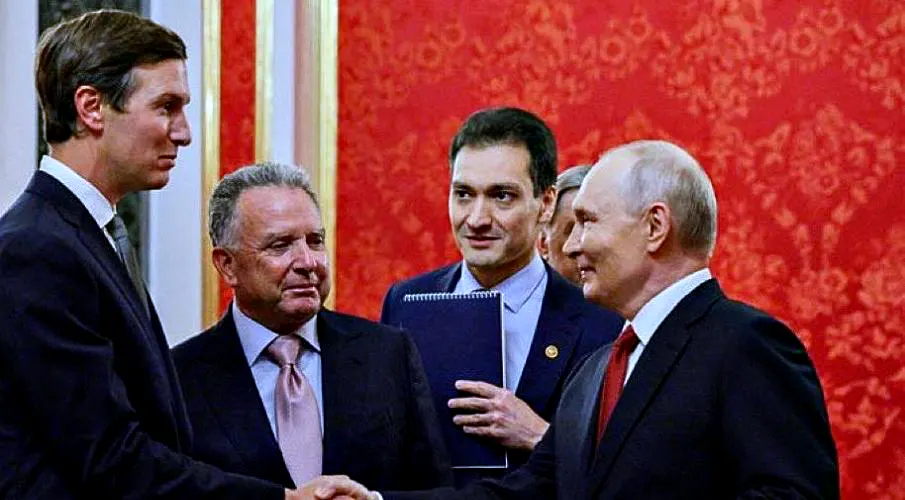
At the Kremlin on Saturday, Vladimir Putin welcomed Donald Trump's two envoys with warm words. Jared Kushner, the president's son-in-law, offered greetings in Russian for Moscow City Day, with special envoy Steve Witkoff standing beside him. Putin thanked the American president and promised to ensure the safety of his negotiators. The situation they had to deal with today was certainly not an easy one, he said.
The two had arrived through Moscow's Vnukovo Airport. Before the meeting, they ate at an upscale restaurant in the city center, a little over 1.5 kilometers north of the Kremlin, while a motorcade of around 12 vehicles and a crowd of journalists waited outside. They then rode to the Kremlin in a Russian Aurus limousine, not an embassy car. Witkoff has been sitting across from Putin since Trump took office in January 2025, Kushner joined toward the end of the year; for both of them, the trip to Kyiv would be their first.
The meeting lasted a good three hours, and afterward it remained vague. Kremlin adviser Yuri Ushakov called it highly useful without naming any concrete result. The Americans had laid out several ideas about possible paths toward a settlement, but he did not say which ones. The meeting had gone beyond a simple exchange of views, he said, and economic issues and possible major Russian-American projects had also been discussed at length. The meeting had come at the right time for both sides. Kirill Dmitriev, Putin's man for financial matters, later called it an important peace visit. Both Ushakov and Dmitriev were at the table. Witkoff and Kushner themselves stayed silent and soon flew out again, and Volodymyr Zelenskyy is expecting them in Kyiv this Sunday.
In front of the cameras, Putin praised Trump's efforts to end the war. Trump had stepped into a difficult situation and was still not backing away from trying to help settle the Russian-Ukrainian conflict, he said. Trump, for his part, had hinted at a new proposal the day before without explaining it. The host then repeated the old lines to his guests: Russia was truly making progress on the battlefield and would achieve its goals. All the root causes of the conflict had to be addressed. Moscow has been repeating those sentences since the struggle began more than 4.5 years ago, while the front barely moves and both sides intensify long-range strikes.
Between the polite words and what is happening on the battlefield lies the whole war. A host who says thank you while demanding more land grants a short pause and keeps the substance. The images from the Kremlin travel around the world faster than any movement at the front. The gift brought to the guests was silence. Kremlin spokesman Dmitry Peskov said Putin had ordered the military not to attack Kyiv for three days in connection with preparations for the American talks there. In the 10 days before that, Russia had pounded the Ukrainian capital day and night with missiles and drones, and on Friday a strike hit the headquarters of the domestic intelligence service, the SBU. Putin claimed that no attack on Kyiv had been carried out since midnight, even though the city heard air raid warnings at that hour and several times afterward. Elsewhere in Ukraine, the bombardment continued without pause. Peace had an address that weekend, and the only name on it was Kyiv.
A few hours before the pause, a major Russian attack had hit Kyiv's two most important airports. Zelenskyy interpreted the strike as a response to preparations for a possible flight by the Americans into Ukraine and announced that Ukraine would strike Russian airspace the following week. Since Russia's invasion in 2022, all of the country's civilian airports have been closed. Later, Zelenskyy said he had spoken with Witkoff and Kushner while they were sitting in Moscow, and that Ukraine would spare the Russian capital until Monday. The pause was a quiet reciprocal bargain.
That night, the sky over Russia was silent. The airports, often shut down by Ukrainian attacks, were operating normally in the morning, and Mayor Sergei Sobyanin reported that no drone had been intercepted outside Moscow. For one night, the country looked like one at peace. The envoys' trip came just over a week after CIA Director John Ratcliffe had delivered a grim assessment of Russia's prospects in Moscow and pressed for an end to the war.
Since spring, the situation has shifted and moved closer to Russia's own doorstep. Since April, Ukraine has been deliberately targeting fuel and supply infrastructure. Russian refineries and oil depots went up in flames. Warehouses belonging to online retailer Wildberries burned as well. The war has now arrived in Russian cities, where for a long time it had existed only in the news. Russia is exploiting Ukraine's depleted air defense stocks and hitting more targets across the country, making daily life in Kyiv more dangerous. Both sides are paying a growing price for expensive technology, for jet-powered drones and ballistic missiles. Both budgets are being hit by costs that rise month after month.
A gulf still separates Moscow and Kyiv over how the deadliest war in Europe since World War II is supposed to end. A person close to the Kremlin said even before the trip was announced that Putin wanted to take more territory. An agreement on the front line was out of the question until Russia had secured the rest of the Donetsk region, and according to reports from his commanders, that would happen by the end of the year. Western military experts consider that far off given the slow Russian advance. Ukraine will not give up land it has defended at heavy cost and rejects such conditions as surrender.
This campaign has been dragging on for a long time, and it barely moves anymore except in the numbers of dead and in the costs. Negotiations begin and freeze again, most recently in February, when Washington and Israel attacked Iran and that new war began consuming the Trump administration's attention; fighting at sea has also intensified since then. One visit and one dinner, and underneath it all the same map as before. On Friday, the Kremlin called the line Putin drew in a speech 2 years ago unshakable: Ukraine should give up the entirety of four claimed regions and abandon its bid to join NATO. Peskov praised the Americans' goodwill but insisted that Ukraine withdraw its troops from Donetsk and Luhansk before any ceasefire could be possible. Putin added that regardless of all American mediation, Russia and Ukraine first had to reach an agreement themselves.
So what remained from a Saturday full of courtesies was a handshake and a 3-day ceasefire over Kyiv. Nobody touched the map that matters. Peace could be photographed, while the war sits in both sides' books as a growing bill.
Updates – Kaizen News Brief
Alle aktuellen ausgesuchten Tagesmeldungen findet ihr in den Kaizen Kurznachrichten.
To the Kaizen News Brief In English


