
The Kremlin has a problem: too many espionage scandals, too many exposed agents, too little credibility abroad. So Vladimir Putin is restructuring his propaganda machine. In August 2025, he dissolved the Directorate for Interregional and Cultural Relations with Foreign Countries - the agency officially responsible for soft power but in reality involved in manipulating elections, planting spies, and collecting compromising material on foreign politicians. In its place came the Presidential Directorate for Strategic Partnership and Cooperation. The name is new, the methods are old. Investigations show: most departments were simply carried over, the structures remained intact. Only the faces at the top have changed - and that is precisely the point.

With Decree No. 906 of December 8, 2025, the President of the Russian Federation created an independent administrative unit within the Presidential Administration for “strategic partnership and cooperation.” The new structure is to coordinate international projects and programs with selected states, prepare negotiations, and advise the president on foreign policy initiatives, development issues, and cross border cooperation.
The office collects and analyzes information, participates in international treaties, prepares draft laws and decrees, and organizes international meetings involving the president. It also coordinates cooperation with state bodies, foundations, civil society actors, and media, as well as public communications on related projects. The leadership reports directly to the Presidential Administration; the agency head is appointed by the president and bears responsibility for implementing its tasks. The mandate can be expanded at any time by presidential decision.
The Man Nicknamed “Pancake”
The search for a director without direct ties to the intelligence services proved difficult. Igor Chaika was initially under consideration, the son of the former prosecutor general. But his appointment stalled in the presidential office. “Apparently the superiors decided that Chaika is more of a businessman and would focus abroad on his own interests,” several sources say. In addition, he is under sanctions and had embarrassed himself in Moldova when he financed the opposition there.

At the end of October, Sergei Kiriyenko, first deputy head of the Presidential Administration, presented Putin with another candidate: Vadim Titov, a longtime subordinate from his days at the nuclear corporation Rosatom. In Irkutsk, where Titov worked in the early 2000s as a critical moderator, people affectionately called him “Pancake” because of his corpulence. In 2009, Moscow brought him into Rosatom’s press department; later he headed Rosatom International Network and constantly flew between Europe and Southeast Asia. In November 2025, Titov officially traveled to Kyrgyzstan for the first time - a country whose banks and crypto services help Russia circumvent international sanctions. In Bishkek, he opened the Eurasian Center for Russian Language and Culture. On its board sits a former Miss Moldova who now serves in parliament for Putin’s party United Russia. The center is financed by fugitive Moldovan oligarch Ilan Shor, whose organization was sanctioned in 2024 by the United States and the EU for election interference in his home country.

Titov also helped launch Nomad TV, a channel broadcasting content from the Russian state network NTV. The editor in chief is a former Kremlin pool reporter; most journalists were trained free of charge at Shor’s Eurasia Center. Maria Zakharova from the Russian Foreign Ministry, who accompanied Titov to Bishkek, stated openly: the channel must spread the “correct perspective” to “counter attempts to distort historical truth.”
The Deputy Director Who Looks Like Lenin
Titov’s deputy Anton Rybakov, a shadow figure, knows Central Asia well. He was already responsible for the region in the old directorate. After studying journalism at Moscow State University, he worked for the Kremlin aligned newspaper Moskovsky Komsomolets. He never became investigative. But his résumé on the job portal Rjb.ru caught the Presidential Administration’s attention: “Fluent English, translates American publications. Ready to travel. Holds international press credentials, can get interview partners to talk.” In 2017, FSB Colonel Valery Maximov, seconded to the Presidential Administration, hired him. The former KGB man Maximov headed the planning department and organized elections in Georgia, Abkhazia, South Ossetia, Armenia, and Kyrgyzstan. In 2020, then director Dmitry Kozak fired him after the Moscow funded Alliance of Patriots of Georgia won only 3.14 percent of the vote. But now, after Kozak’s departure, Maximov could return.

Rybakov remained and built his own contacts in the post Soviet space. “Anton Lvovich became an important figure and personally participated in briefings for Kozak on the situation in Central Asia,” a source from the Presidential Administration said. “Of course he owed that to his friendship with Colonel Maximov. He grew a mustache and a small beard and looked like the young Lenin. That’s what we called him among ourselves.” Rybakov works closely with the National Research Institute for Communication Development, whose supervisory board includes former executives of the Foreign Intelligence Service SVR and the FSB. The institute is headed by Vladislav Gasumyanov, an SVR reserve officer who spied in Europe and befriended Italian Prime Minister Silvio Berlusconi.
An FSB Hacker for Africa
At the end of December, an internal seminar for directorate staff took place in Moscow. The topic: methods of soft power in the post Soviet space and in Africa. The lecturers warned of the “revival of neo Nazism” in Ukraine and the Baltic states, of the “totalitarian dictatorship” in Moldova, and of Armenia’s Western orientation. Kyrgyzstan, by contrast, was presented as a success story - its leadership listens to Moscow’s advice, Russian companies control almost half the economy.
Among the participants was FSB Lieutenant Colonel Alexei Kleshchev, who came from the Presidential Directorate for Public Projects and was responsible there for Africa. Kleshchev served at the highly secret 16th Center of the FSB, responsible for monitoring, decrypting, and analyzing electronic communications. The center comprises ten departments and employs 566 staff members.
Badges of Vanity – How FSB Employees Exposed Their Own Cyber Center
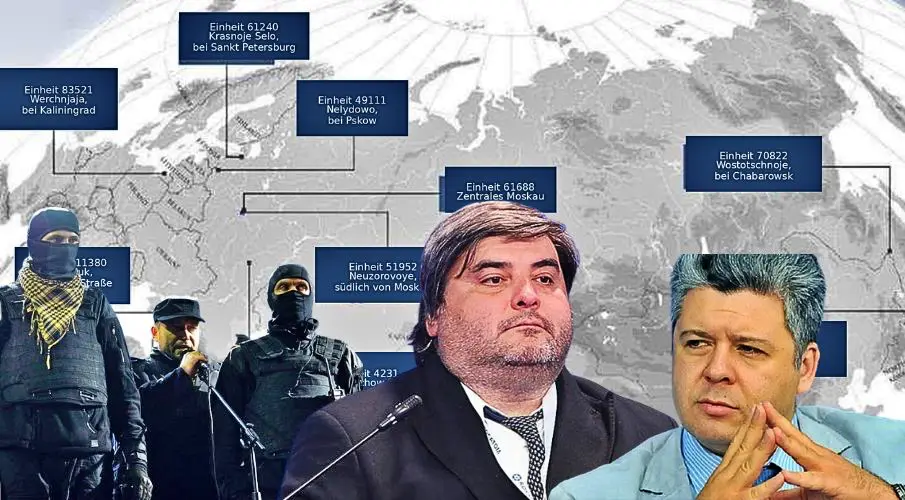
Sometimes you do not need whistleblowers, leaks, or satellite images. Vanity is enough. A part of the FSB’s 16th Center, responsible for signals intelligence and cyber operations, became partially visible through the sale of internal badges and medals in open forums. What began as collector trading became a data trail. OSINT analysts from the Finnish company Check First evaluated more than 200 publicly accessible images of service badges. The symbols, inscriptions, and numbering made it possible to reconstruct parts of the center’s internal structure. At least ten administrations within the 16th Center were identified, marked by letters from “A” to “T.” In addition, there are two regional departments, No. 3 and No. 7, the latter based in Novosibirsk. Based on open personnel data, analysts estimate the minimum strength of the center at 566 employees.

Some of the units can be assigned to specific tasks through their emblems. The badge of Administration “K” features a computer - a clear indication of cyber operations. The designations “B” and “D” are associated with security tasks and decryption. These are not wild speculations, but conclusions drawn from symbolism, location information, and recurring patterns. Particularly revealing was the trail leading to the so called Centers for Special Communications. Based on map fragments and inscriptions on the badges, analysts identified a network of ten such facilities subordinate to the 16th Center and apparently monitoring conversations between military and civilian structures. Many of these sites lie near borders: Kaliningrad, Pskov, Saint Petersburg, Vladivostok, Khabarovsk, as well as Adler and Temryuk in Krasnodar Krai. Others are located in Moscow, the Moscow region, and the Saratov region.

Distributed locations of several units of the 16th FSB Center for signals intelligence and cyber operations - from Kaliningrad through Moscow to Vladivostok. Striking is the concentration at strategically sensitive points: border regions, metropolitan areas, militarily relevant coastal sections. The geographic spread indicates a nationwide networked system covering both western and eastern external borders. Moscow visibly functions as the organizational hub.
Historically, the 16th Center traces back to a corresponding unit of the Soviet KGB. Since 2003 it has been part of the FSB structure. Its role in cyber operations is also internationally known. In 2022, the US Department of Justice indicted hackers linked to this center for attacks on energy infrastructure, including a nuclear power plant in Kansas. A year later, US authorities announced they had neutralized malware that for nearly two decades had siphoned documents from diplomats and government employees in NATO states.
That such an apparatus becomes visible through souvenirs says less about technical weaknesses than about human ones. In an organization built on secrecy, a few sold badges are enough to reveal structure, responsibilities, and geography at least in outline. Not through a major betrayal, but through small carelessness. Three of his colleagues from the 16th Center - Pavel Akulov, Mikhail Gavrilov, and Marat Tyukov - are wanted by the FBI. They face up to 20 years in prison each. The charges: between 2012 and 2017, they penetrated computer networks, including through supply chain attacks. Their targets were companies and organizations in the international energy sector, including oil and gas firms, nuclear power plants, utilities, and electricity transmission companies.
Vladimir Balobayev, who moved from the old to the new directorate, now heads the civil society division. Previously he founded in Kaliningrad a Baltic information and analysis center that supposedly monitored the Baltic Sea. The Insider found that the “environmentalist” transferred money to Andrei Solopenko, editor in chief of the Kremlin aligned portal BaltNews, which is banned in the EU. Anton Kurevin is considered the chief legal adviser, Maxim Grigoryev could take over the Baltic department. Kurevin graduated in 2002 from the Military University of the Defense Ministry and served in the military intelligence service GRU. Later he worked at the PR firm Mikhailov & Partners and became an adviser to billionaire Gennady Timchenko on sanctions evasion. Most recently he was active at the agency Bureau Up, which develops ideological concepts for state institutions and large corporations.

Grigoryev wrote propaganda books with titles such as “Anti Maidan,” “White Helmets: Accomplices of Terrorists and Sources of Disinformation,” or “Crimes of the US Led Coalition in Syria.” In 2023 he retrained at the General Staff Academy and volunteered for the invasion of Ukraine. Today he sits in the Public Chamber of the Russian Federation and heads a tribunal on alleged war crimes of “Ukrainian nationalists and their collaborators.”
The restructuring is complete, the directorate operational. Putin has staffed his propaganda headquarters with fresh faces - but the old connections to the FSB, SVR, and GRU remain intact. The Kremlin continues to rely on disinformation, manipulation, and espionage. Only the names on the business cards have changed.
Updates – Kaizen News Brief
All current curated daily updates can be found in the Kaizen News Brief.
To the Kaizen News Brief In English


Wohin man auch guckt – überall die selben Machenschaften und Strukturen.
Je autoritärer ein Staat, desto tiefer der Griff in die totale Überwachung – und Lügen über Lügen.
Deckt man eine Schweinerei auf, wird diese durch den/ die nächste ersetzt.
Medusa lässt grüßen.
Würde man diese kriminelle Energie in Projekte zum Wohle der Menschheit- Flora und Fauna – Ozeane setzen – wo wir dann wohl stehen würden?
KGB, FSB … alles das Gleiche.
Gleiche Strukturen, gleicher Zweck, gleiche Überwachung.
Neue Gesichter.
Aber der „Durchschnittsrusse“ kennt ohnhin Keinen dieser Männer.
Sie kommen und gehen.
Loyalität an oberster Stelle und an zweiter Stelle „gewünschte Ergebnisse“.
Wer nicht das erreicht, was gefordert wird oder doch mal Kritik äußert, verschwindet.
Mal kurz- mal längerfristig… oder auch schon mal ganz.
Dieses Recherche sollten die Geheimdienste in Europa und im Westen mal ausgiebig studieren.
Wahrscheinlich habt ihr mehr aufgedeckt, als die wussten.