
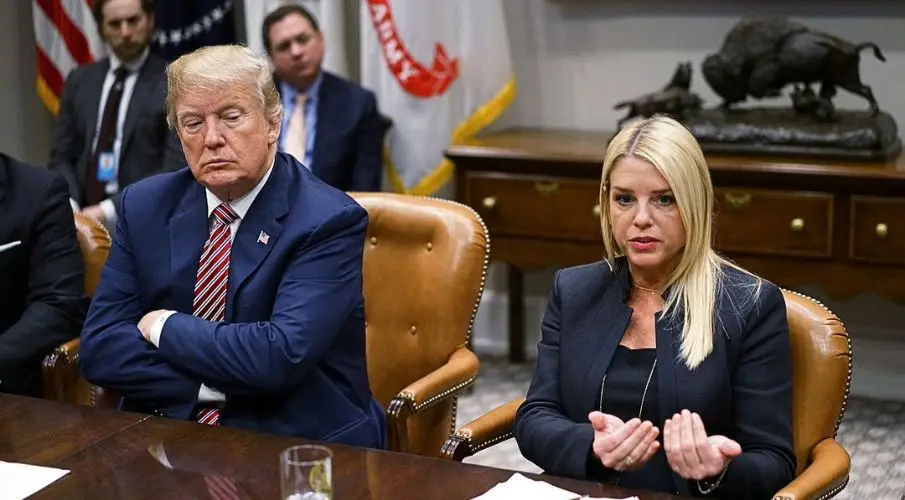
On April 2, 2026, Pam Bondi was dismissed as U.S. Attorney General. Anyone who read our reporting from February 11, 2026 knows: This did not come as a surprise. We had already written at the time that Bondi was on her way out. Now it has happened.
See our article: Between Assertion and Shouting - Pam Bondi, the Epstein Files, and a Department in Defense Mode
The story that led to this end stretches over more than a year - and it is less about Epstein than about how someone fails when they listen to only one person and lose everyone else in the process. Pam Bondi entered office as Attorney General with an announcement larger than anything she would later deliver. In February 2025, she appeared on Fox News and spoke of “breaking news” in the Epstein case. She claimed the decisive documents were on her desk - including a client list. Shortly afterward, she appeared at an event with right wing influencers at the White House and distributed half filled white binders labeled “Epstein Files: Phase 1.” The contents: almost nothing new. Her team hinted that there might be no Phase 2. Several of her close confidants now describe that moment as the mistake she never recovered from.
Bondi herself initially underestimated the scope. She told a senior official involved in the investigation that the Epstein case was an online story with limited interest among the broader public. Nevertheless, she initiated an FBI review of all existing files. In July 2025, she released a joint statement with the FBI: There was no basis for new charges, no client list, no evidence of blackmail of “prominent individuals,” and releasing sealed investigative materials would only endanger the victims. The reaction in right wing circles was immediate and intense. Trump, whose political base in part was built on the expectation that Epstein revelations would hit the old elites, felt the pressure. Bondi walked it back and reopened the investigation. She told committee members, including Representative Jim Jordan of Ohio and others, that what remained in the files was essentially child pornography - and no one wanted to see that. Representative Thomas Massie of Kentucky reported this.
Behind the scenes, the conflict with FBI Deputy Director Dan Bongino intensified, who together with FBI Director Kash Patel pushed for the most comprehensive possible release of the Epstein materials. The two had found little in the files beyond what was already publicly known about Trump’s contacts with Epstein - and saw a broad release as the only way to limit political damage. Bondi was far more cautious and pointed to her experience as a prosecutor in Tampa in human trafficking cases: An unredacted mass release could expose details about Epstein’s victims, including children. The conflict between her and Bongino escalated in July 2025 into a heated confrontation at the White House, during which Bondi accused Bongino of leaking negative information about her to the press.
In November 2025, the House of Representatives passed a law mandating the release of the files. A subsequent discussion about a possible impeachment of Bondi for failing to comply with the law briefly gained momentum - and then subsided again. But the rumors of her replacement never fully disappeared.
In February 2026, Bondi appeared before the House Judiciary Committee. What she herself saw as her strongest and most combative appearance was viewed by many of her own allies as a miscalculation. For hours, she berated committee members, said things like “The Dow is above 50,000!” and avoided substantive questions. She did not look the victims of Jeffrey Epstein, who were seated directly behind her, in the eyes. When the negative reactions came in, she blamed Chairman Jim Jordan for not defending her enough and for giving Democratic questioners too much space.

For Trump himself, the appearance was fine. He values volume and loyalty. And that is Bondi’s problem summed up: She was so completely aligned with Trump that she lost everyone else.
In the meantime, Bondi was also confronted with pressure from Trump to pursue criminal cases against his political enemies. Trump brought cases against former FBI Director James Comey and New York Attorney General Letitia James - both failed, both were pursued against the advice of U.S. attorneys appointed by Trump himself. At a reception for federal prosecutors in December 2025, Trump publicly berated the U.S. attorney for Maryland, Kelly Hayes, for not charging Senator Adam Schiff with mortgage fraud - while Bondi and other officials looked on in disbelief. Bondi and her deputy Todd Blanche understood the message and intensified investigations against several Trump targets, including the Democratic fundraising organization ActBlue, former CIA Director John Brennan, and former White House aide Cassidy Hutchinson.
Massie: “Can you determine who redacted the name of Les Wexner as a co-conspirator in an FBI document?” Bondi: “We corrected that within 40 minutes.”
Massie: “Within 40 minutes after I caught you in the act.” Bondi: “This man suffers from Trump obsession. You are a failed politician.”
In mid March 2026, Representative Nancy Mace of South Carolina and four other Republicans on the Oversight Committee voted with Democrats to subpoena Bondi for testimony under oath. Committee Chairman James Comer of Kentucky scheduled the hearing for April 14. Bondi said she would comply with the law, but at the same time worked with Comer to avoid the subpoena - although it was unclear whether that was even legally possible. She appeared on March 18 for an informal briefing before the committee. Democrats asked questions and then demonstratively left the room, stating that this was no substitute for sworn testimony. Bondi began contacting individual Republican committee members directly, including Representative Michael Cloud of Texas. Some who had voted for the subpoena softened their position - including Lauren Boebert of Colorado and Tim Burchett of Tennessee.
Mace summarized the mood of part of the Republican base as follows: “We want to know why the Justice Department is more focused on protecting the powerful than delivering justice.” The Epstein case was “one of the biggest cover ups in American history.” In recent weeks, Trump discussed, according to four people familiar with the conversations, the possibility of firing Bondi and replacing her with Lee Zeldin, the administrator of the Environmental Protection Agency. He complained about her weaknesses as a communicator and that the Justice Department was not aggressive enough against his enemies. At the same time, he publicly praised her loyalty and spoke with her several times a week by phone - sometimes to seek advice or test ideas.
Susie Wiles, Trump’s chief of staff and a longtime friend of Bondi, publicly called Bondi’s first appearance in the Epstein matter a complete failure - “binders full of nothing.” Most recently, she referred to Bondi as “my sister.” Both together describe the situation in the White House quite precisely.
On April 2, 2026, it was over.
Updates – Kaizen News Brief
All current curated daily updates can be found in the Kaizen News Brief.
To the Kaizen News Brief In English


