
Tehran - In Washington, what is being prepared right now is not an airstrike, not a quick strike, not a limited operation. What is being discussed is an operation that would bring American soldiers directly onto Iranian soil. Days, possibly longer. The objective is nothing less than securing around 453 kilograms of enriched uranium. Donald Trump has not yet made the decision. But he is having it evaluated. And that alone shows how far the situation has already escalated.
According to information from within the government’s circle, Trump is openly considering securing the material by force if necessary. His goal is clear: Iran must never be in a position to build a nuclear weapon. At the same time, he is trying to pressure Tehran into handing over the uranium voluntarily - as a condition for ending the war. There are no direct talks so far. States such as Pakistan, Turkey, and Egypt are mediating in the background, without a breakthrough. The president’s wording leaves no room for interpretation. Iran must do what the United States demands, otherwise it will “no longer have a country.” About the uranium, he said they will get it. These statements are not a side note. They define the framework in which military options are now being prepared.
The reality behind this option is brutally complex. This is not about a quick strike. Experts describe one of the most difficult operations U.S. forces could carry out. The facilities are deep - secured underground, spread across multiple locations. Isfahan and Natanz are particularly in focus. Both have already been attacked. Even so, experts assume that large quantities of enriched material are still located there. Rafael Grossi, head of the International Atomic Energy Agency, sees the decisive stockpiles exactly there. Iran also possesses centrifuges and the capability to build new facilities underground. Even after attacks, the program therefore remains operational.
A military securing operation would require multiple phases. First, American units would have to be flown into the area - under fire from Iranian air defense and drones. Then the actual work begins. Combat troops secure the site. Specialists search for booby traps. Engineers work their way through destroyed structures. Only then do teams come in who are even capable of handling radioactive material.

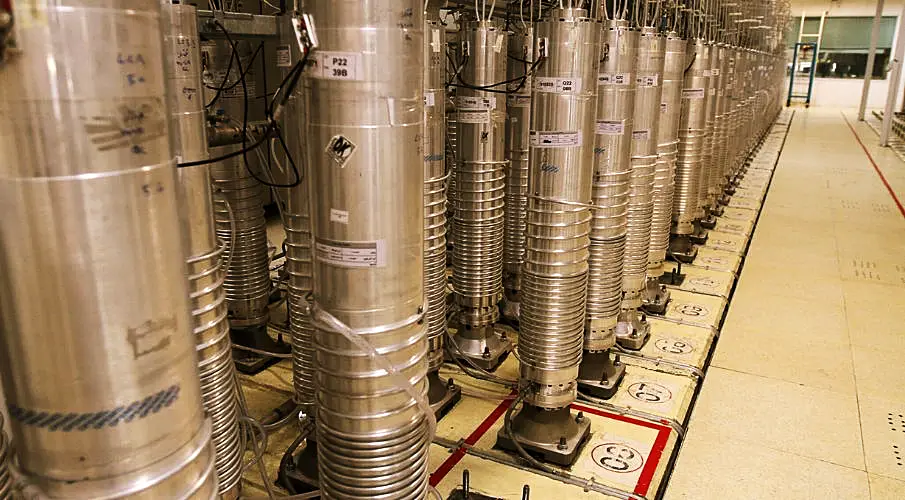
The uranium itself is likely stored in 40 to 50 special cylinders. These must be secured, loaded into transport containers, and removed. That requires heavy equipment, protection systems, and time. A lot of time. Several days are realistic, possibly a week. Another critical point is logistics. Without a secured airfield, an improvised infrastructure would have to be built on site. At the same time, every unit remains vulnerable. Iran would hardly stand by idly. A military response is considered certain.
Joseph Votel, former commander of U.S. Central Command, puts it bluntly: This is not a quick operation. Anyone who starts it does not know how long it will last. Preparations are underway in parallel at the Pentagon. Additional forces are being considered. Up to 10,000 soldiers could be deployed to create operational flexibility. Naval units and elements of the 82nd Airborne Division are already being positioned in the region. Scenarios for securing strategic points - such as islands off the Iranian coast - are also being examined.
At the same time, there is an alternative. If Iran is willing to hand over the uranium, such an operation could be avoided. The United States has done this in the past. In 1994, highly enriched uranium in Kazakhstan was secured and removed. There were similar operations in Georgia. At that time, however, without war, without active combat.
That is exactly the difference today.
Within the government, the situation is tense. Trump does not want a long war. His advisers are urging him to focus on domestic issues. The midterm elections are approaching, polls show risks for Republicans. At the same time, pressure is growing to deliver results in the Iran conflict. Marco Rubio emphasizes that key objectives can be achieved without ground troops. Pete Hegseth remains deliberately vague, but speaks openly about the existence of military options. He says no more - and that is the message.
One crucial point is often overlooked: according to U.S. assessments, Iran is currently not enriching uranium further. The step toward a weapon would still be possible, but it requires additional processes. Iran also does not possess intercontinental missiles capable of reaching the United States. Projections place that capability no earlier than 2035. That does not change the strategic assessment in Washington. For Trump, the existing material itself is the problem. And that very material is now at the center of a decision that goes far beyond this war.
Updates – Kaizen News Brief
All current curated daily updates can be found in the Kaizen News Brief.
To the Kaizen News Brief In English


