
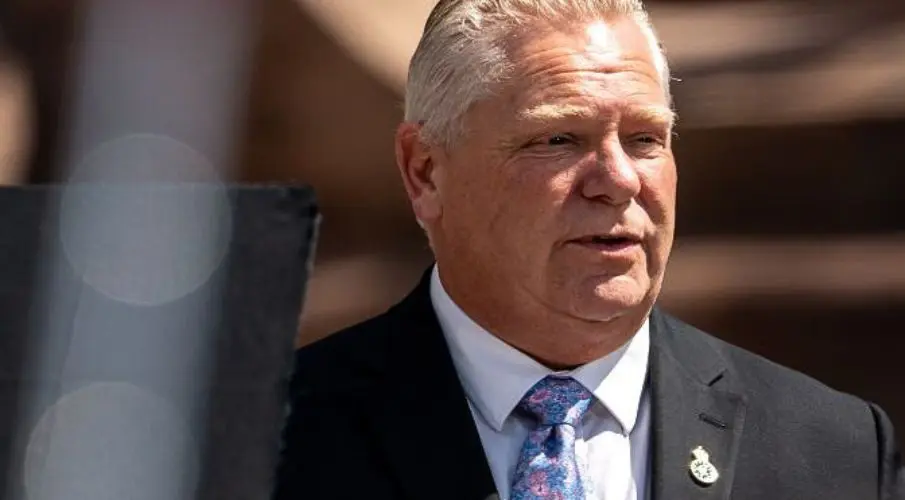
Doug Ford is drawing a clear personal consequence from Donald Trump’s policies. The premier of the Canadian province of Ontario has stated that he will not travel to the United States under Trump’s presidency. This is not a diplomatic maneuver, but a deliberately set boundary. Ford thus openly says that he cannot accept the political atmosphere, the tone, and the direction being dictated from the White House.
At the same time, he publicly contradicts Trump on a crucial point. Ford makes clear that his own decision is not meant to become a general instruction for others. Canadians, he emphasizes, should continue to travel to the United States if there are family reasons, professional obligations, or other necessities. No one should allow Donald Trump to dictate where they travel or whom they visit. That freedom, Ford suggests, does not belong to a president, but to the people themselves. Ontario Premier Doug Ford also commented on Canadians who are canceling their vacations to Florida in protest. He noted that the economic consequences on the ground are already being felt. “Down there, it really hurts right now,” Ford said. The travel boycott, in his assessment, is hitting regions that are heavily dependent on tourism.
Ontario Premier Doug Ford says that he will not travel to the United States under Trump, but at the same time emphasizes that Canadians should continue to travel if it is necessary for family or other essential reasons, and should not let a “tyrant” named Trump dictate what they do.
Trump’s approval ratings in his first year are the lowest of any president in a hundred years – commenting on Canadians boycotting Florida vacations, he remarked: “Down there, it really hurts right now. They are hurting on all fronts.”
The clarity of his words is striking. Ford openly describes Trump as a tyrant. For a leading politician from a neighboring country that is closely intertwined with the United States, this is an extraordinary statement. It is a deliberate characterization that does not refer to individual decisions, but to Trump’s overall conduct. What he means is a form of politics that operates with threats and disregard for human rights, with pressure, with the devaluation of opponents, and with attempts to exert influence and spread fear even beyond its own borders. See also our article on the current situation and our work: “Christmas in Hell – When ICE Uses the Holidays for Mass Arrests” – at the link: https://kaizen-blog.org/en/weihnachten-in-der-hoelle-wenn-ice-die-feiertage-fuer-massenverhaftungen-nutzt/
Ford also justifies his stance by looking at the situation within the United States itself. He speaks of a country that is visibly, profoundly suffering. Economically, socially, and politically. Trump’s approval ratings, Ford says, are the lowest of any US president in the first year in roughly a hundred years. This observation is more than a statistic. It is part of his argument that this kind of politics does not stabilize, but causes damage, including domestically. At the same time, Ford avoids a blanket condemnation of the United States. He clearly distinguishes between government and population. His statements are not directed at Americans, whom he encourages, but at the president and his radical style. Families, friendships, economic ties, and the long shared history between Canada and the United States are not being called into question. On the contrary, this is precisely why, his message goes, it is important not to poison individual relationships politically. In this distinction lies the core of his statement. Ford denies Trump the personal legitimation of a visit, but not contact with the people of the United States. He assigns responsibility upward and freedom downward. He decides for himself without prescribing how others should act. This stands in deliberate contrast to the understanding of power he attributes to Trump. For Ontario, this position carries weight. The province is Canada’s economic center, closely intertwined with several US states, dependent on trade, supply chains, and cross border traffic. When Ontario’s premier publicly marks distance from the US president, this is not a symbolic act without consequences. It is a political signal that is being noticed in Washington and on the streets of America.
At the same time, Ford’s stance shows how political criticism can be expressed without sliding into isolation or moral elevation. He does not call for a boycott, he does not stoke fear of travel, he does not declare friendships illegitimate. He simply says: this kind of politics deserves no visit.
In a time when many governments rely on cautious phrasing and avoid conflict, this openness is unusual. Ford makes clear that respect is not a given and that closeness does not have to be maintained at any price. In the end, a candid message remains. One can refuse a president without allowing oneself to be dominated by him. One can criticize without taking freedom away from others. And one can draw clear lines without severing the connection to the people on the other side of the border. Ontario’s premier has done exactly that.
Updates – Kaizen News Brief
All current curated daily updates can be found in the Kaizen News Brief.
To the Kaizen News Brief In English


Wenn man dieses Video ansieht, das nicht KI erzeugt zu sein scheint (man muss inzwischen ja vorsichtig sein), dann fragt man sich, ob dieser Mann nicht oft nur die Marionette seiner Hintermänner ist, die seinen Narzissmus, seine Gier nach Geld und Komplimenten für sich instrumentalisiert. Aber vielleicht trügt der Eindruck. Ich traue mir da keine Einschätzung zu. https://www.facebook.com/reel/4080698585516445 .
…. Trump hat die Fäden schon in der Hand und die Hintermännertheorie ist einfach wieder ein Mythos, der dank social media grossen absatz findet. es sind die einfachen lösungen, er ist einfach ein schlechter mensch. das video wo ihr link hinführt ist echt, keine ki, aber uns war es nicht wichtig zu zeigen, da wir mit aufklärung und unterstützung schon an unserer grenze sind
Doug Ford wie man ihn kennt, direkt und klar ausgesprochen.
Ich war dieses Jahr sechs Monate in 🇨🇦 und hab erlebt, dass die Kanadier sauer sind, verständlich… Man kauft kanadische Produkte wann immer möglich, vermeidet Reisen in die USA und viele verkaufen auch ihre Häuser in den USA. Und viele US-Amerikaner bestätigten, dass der Boykott mehr als spürbar ist.
Gut dass 🇨🇦 andere Wege geht, sich nicht mehr auf die südlichen Nachbarn verlässt!
Das sollte Europa auch tun