
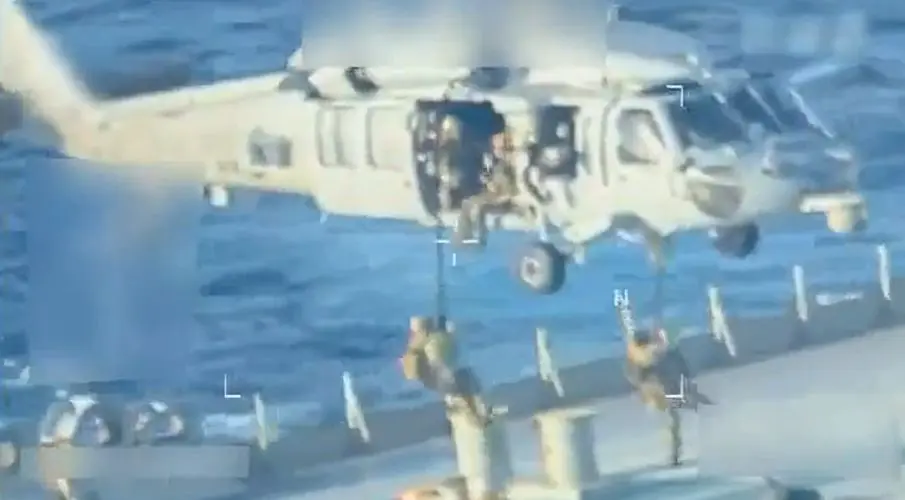
Arauca, Colombia - Donald Trump has tightened the tone in the Caribbean once again. An oil tanker, the Skipper, was stopped by the Coast Guard in international waters off Venezuela, its boarding enabled by a helicopter from the aircraft carrier USS Gerald R. Ford, which has been patrolling the area demonstratively for weeks. Trump announced the seizure during an event at the White House as if it were a footnote and stunned the world with a single sentence. What would happen to the oil. “We keep it, I guess.” The nonchalance with which a president speaks about property that is not his meets an operation whose legal basis few inside his own administration are willing to explain openly.
How the operation unfolded is shown in videos released by Pam Bondi’s office. A helicopter from the USS Gerald R. Ford hovers just a few feet above the deck as special forces rope down and secure the ship’s access points. Later, they move through the superstructure of the tanker with weapons drawn, an image that resembles a covert military operation more than a standard Coast Guard action. The fact that Bondi, not the Pentagon, released the footage first has caused raised eyebrows in Washington. The aircraft carrier has been operating in the Caribbean for only a few weeks, yet its presence now shapes the entire political space in which Trump makes his decisions.
The video of the oil tanker seizure has been released. It is striking that the first post did not come from Pete Hegseth’s Department of Defense but from Pam Bondi’s office
Behind the scenes, it is said that a sealed warrant targets the Skipper because it previously smuggled Iranian oil. The fact that it was now carrying Venezuelan cargo makes the case even more sensitive. Caracas sees the move as a direct attack on its economic lifeline. The Skipper was reportedly sailing under a false flag, its destination supposedly Asia. Three U.S. officials confirmed the operation, speaking anonymously of course, and emphasized that the crew did not resist. It is a seizure that extends far beyond the ship itself. According to information from Washington, the United States plans to target additional tankers to weaken Nicolás Maduro’s government financially. A step that could rattle oil markets and push a fragile nation deeper into chaos. Skipper Behind the scenes, it is said that a sealed warrant targets the Skipper because it previously smuggled Iranian oil. The fact that it was now carrying Venezuelan cargo makes the case even more sensitive. Caracas sees the move as a direct attack on its economic lifeline. The Skipper was reportedly sailing under a false flag, its destination supposedly Asia. Three U.S. officials confirmed the operation, speaking anonymously of course, and emphasized that the crew did not resist. It is a seizure that extends far beyond the ship itself. According to information from Washington, the United States plans to target additional tankers to weaken Nicolás Maduro’s government financially. A step that could rattle oil markets and push a fragile nation deeper into chaos.
Further information and documents from the PDVSA environment show that roughly half of the nearly two million barrels of crude were tied to a state-run Cuban importer. That fact gives the seizure a geopolitical edge that extends far beyond the operation at sea. It is not only about Venezuelan oil but about an entire web of state dependencies, political alliances, and decades-old energy commitments between Caracas and Havana. Our investigation determined that half of the cargo was destined for Cubametales, the state-run Cuban oil importer that has played a central role in the energy exchange between Havana and Caracas for years. The company was sanctioned by the U.S. Treasury Department in 2019 for continuing to funnel Venezuelan oil to Cuba despite embargoes, thereby reinforcing the political bond between the two states. That this particular shipment was intercepted gives the operation additional political force. It hits not only Venezuela but also one of the region’s last surviving alliances, and with it a pillar Washington has long sought to weaken.
The Skipper itself was not an unknown vessel. Previously operating under the name Alisa, it was sanctioned by the United States in 2022 for allegedly being part of a shadow network that transported crude on behalf of Iran’s Revolutionary Guard and the Lebanese Hezbollah. According to the U.S. Treasury Department, the network was run by a Ukrainian trader based in Switzerland, another indication of how deeply the global oil market is intertwined with discreet structures that major powers either quietly exploit or aggressively confront.

At the same time, American fighter jets are flying closer to the Venezuelan border than at any point in this administration. Two Navy F/A-18 jets flew over the Gulf of Venezuela, only minutes from the airspace of a country whose president has been warning for months that the United States seeks to remove him. Officially, it is described as a routine training flight, yet the timing fits with a massive military buildup that surged abruptly in the fall. More than 15,000 troops, multiple destroyers, guided missile cruisers, the world’s largest aircraft carrier. Trump now announces that ground attacks may follow soon, without offering a single word on whom or what he intends to strike.
The number of people killed in the boat strikes tells its own story. At least 87 people have died in 22 strikes since September, including two survivors who were still in the water after the first hit and were killed by a second attack. Pressure is mounting on the Pentagon to release the unedited videos. But Defense Secretary Pete Hegseth hesitates. Congress demands answers while the administration continues to escalate. The suspicion is plain. The line between drug enforcement and covert warfare is dissolving.

The moment could not have been more delicate. On the same day, the Nobel Peace Prize was awarded in Oslo to María Corina Machado, a Venezuelan opposition figure in exile. While Europe honors her, the U.S. government is conducting a military campaign that pushes the country she fled to the brink of an international confrontation. Trump occasionally speaks with Maduro, dreams reportedly of a meeting, yet in Washington voices grow louder that speak openly about seizing oil fields or removing the president himself.
The region watches these developments with growing fear. It is no longer just about a ship, a tanker, a few flight hours over water. It is about whether a major power grants itself the right to act at will and whether a president who says “we keep it” still recognizes any framework of international law. Several human rights groups are preparing, alongside already filed actions, further steps before the Inter-American Court of Human Rights. For them, the conclusion is clear. When a state uses military force in an area where civilians are killed, appropriates goods, and knowingly escalates a situation, then the issue is not just a political dispute but a possible violation of international obligations.
Caracas has understood the message. The government speaks openly of international piracy and outright theft that reveals the United States’ true motives. The statement reads like a document of exhaustion and fury. It was never about democracy, never about human rights, but about resources that belong exclusively to the Venezuelan people. These words are not new, but the seizure gives them a different force. For Maduro’s government, the Skipper is proof that Washington is prepared to strike directly at economic lifelines, even at points where international law is ambiguous, contested, or simply ignored.
This creates an image that Trump himself does not want to confront. The Skipper is not just a tanker. It is a case that may determine how far a president can go before international law catches up with him. And it is a moment in which the world watches how close the Caribbean is coming to a catastrophe that does not arise by accident but by design.
The world can no longer pretend that this has nothing to do with it. Europe also looks away while investigative journalists and human rights organizations shoulder the work that governments are either too cowardly or too indifferent to confront. It is an indictment of the international community and society when families of victims, journalists, and NGOs must file cases before the Inter-American Court of Human Rights because state institutions refuse to fulfill their responsibilities. If democratic states continue to remain silent, they are no longer merely observers.
Investigative journalism requires courage – and your support.
Support our work against right-wing populism, disinformation, and violations of human and environmental rights. Every contribution goes directly into our daily reporting – we operate without advertising, without subscriptions, without corporations, without political parties. Our journalism is meant to remain freely accessible. For everyone.
Independent – Critical – For Everyone
Thank you for making our independent work possible.
Updates – Kaizen News Brief
All current curated daily updates can be found in the Kaizen News Brief.
To the Kaizen News Brief In English


