
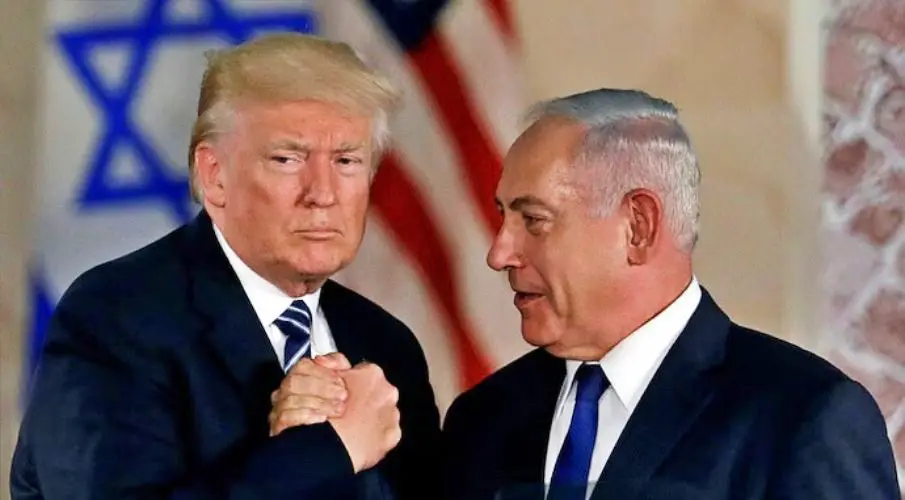
Benjamin Netanyahu steps before the public and rejects the accusation that he pushed Donald Trump into this war. No one was deceived, he says, Trump recognized the danger himself. Iran has moved its nuclear program underground and is working on missiles that could also reach the United States. No persuasion was necessary. This account comes at a moment when pressure is growing. In Washington, a senior official resigns together with Joe Kent, director of the National Counterterrorism Center, and holds Israel partly responsible for the escalation. At the same time, the attack on the South Pars gas field triggers a new wave of Iranian strikes on energy facilities in the region. The situation is visibly intensifying, not only militarily, but politically as well.
Netanyahu: “I want to end these opening remarks with another false report, namely the claim that Israel somehow dragged the United States into a conflict with Iran. Does anyone really believe that you can tell President Trump what to do? Come on.”
Netanyahu tries to broaden the frame. He speaks about American soldiers, about losses, about families affected, and calls the price high. At the same time, he downplays economic concerns. The rising energy prices are only temporary. He also expresses confidence regarding the Strait of Hormuz, saying the United States will reopen it. Between these statements, a tension emerges that cannot be smoothed over. Because while Netanyahu emphasizes a common line, other voices show a different picture.
“I did. I told him: Don’t do it. And he won’t do it. Occasionally he does something, and if I don’t like it, then we won’t do it anymore afterward.”
Donald Trump says: “I told him: Don’t do it.” Netanyahu says: Israel acted independently. Two statements that stand side by side and cannot be reconciled. The attack on South Pars, the centerpiece of Iran’s energy supply, not only triggered a military response, but also revealed that Washington and Jerusalem are no longer acting in lockstep. Shortly after the strike, Iran attacked energy facilities in other states of the region. Prices continued to rise, partners in the Gulf demanded that Trump restrain Netanyahu. A military step turned into a political stress test.
In the Oval Office, alongside Japan’s prime minister Sanae Takaichi, Trump explains that the attack was neither approved nor supported. They get along well, he says, it is coordinated, but sometimes Netanyahu does things he does not like. Then they will not do that anymore. At the same time, Netanyahu declares in Jerusalem that Israel acted independently, but adds that he accepted Trump’s request to refrain from further attacks on the gas field for now. Then comes the sentence that defines the hierarchy: “He is the leader. I am his ally. America is the leader.”
“I don’t think two leaders have ever been as coordinated as Trump and I.
Trump is the leader, and I am his ally.”
This account is beginning to crack. Immediately after the attack, Trump said the United States had known nothing. At the same time, people with insight into the processes report that Washington had indeed been informed and that targets are coordinated between both sides. Between public presentation and internal coordination lies a gap that is not getting smaller.
Substantively as well, the goals are diverging. Tulsi Gabbard makes clear before the intelligence committee that the United States is setting different priorities than the Israeli government. While Washington focuses on missile programs, naval forces and nuclear infrastructure, Israel goes further. The targeted killings within the Iranian leadership and the prospect of regime change show that Netanyahu sees the war as an opportunity to fundamentally reshape the order in Tehran.
Trump has moved away from that. At the beginning, he spoke of giving Iranians the opportunity to shake off the existing system. Later, he sounds more cautious. Without weapons, an uprising is hardly possible, he says, referring to the Basij militias. When asked whether he supports Netanyahu’s line, he answers briefly: “I think Bibi understands that as well.”
The relationship between the two has been considered close for years. Netanyahu has repeatedly portrayed Trump as a reliable partner. Trump has given him more room for maneuver than many of his predecessors. It is precisely this room for maneuver that is now showing its limits. Israel can go further militarily, backed by a population that supports the war more strongly. In the United States, pressure is growing. Rising energy prices, economic uncertainty and an election year are changing the situation. Even within the Republicans, it is being pointed out that the consequences of this war are being felt in everyday life.
Joel Rubin, a former State Department official under Barack Obama, sees the differences so far as limited. But he points to the decisive question: when will this war end and who will make that decision. It will not be made in Jerusalem, but in Washington. That is exactly where the differences could become visible. The attack on the gas field has revealed more than a military strategy. It shows that coordination does not mean that both sides pursue the same goal. And that even close allies in a war can begin to move in different directions.
Updates – Kaizen News Brief
All current curated daily updates can be found in the Kaizen News Brief.
To the Kaizen News Brief In English


