
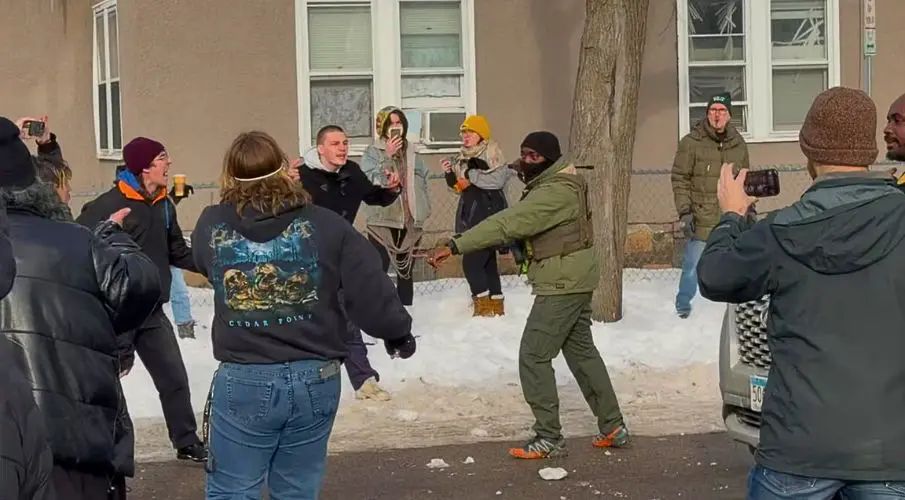
In recent days, we have repeatedly reported on ICE operations, including in Minneapolis. We will not repeat all of the shocking footage here again. Long before you could see the people, the noise was already there. Whistles, shouts, the dull sound of footsteps in the snow. On a residential street in Minneapolis, more than seventy people stood tightly packed on the sidewalk, phones raised, voices loud. Opposite them were several ICE vehicles, a small number of agents, visibly under pressure. What began as a targeted traffic stop escalated within minutes into an open confrontation, captured in images that we have already shown here over the past few days.

An ICE agent forced a demonstrator to the ground. A woman tried to intervene, and the agent raised his baton. The mood tipped for good. Anger, screams, whistles. A supervisor radioed the Hennepin County police. In a later released audio recording, he can be heard speaking of “60 to 70 agitators” who were allegedly attacking his agents. Shortly afterward, sheriff’s deputies arrived, positioned themselves on the edge of the scene, and watched as ICE and protesters moved along the street. A car with a smashed window stood in the background. Then ICE agents fired several so-called pepper balls into the street. People staggered back coughing, searching for water to rinse their burning eyes.
Local authorities later contradicted ICE’s account. The Sheriff’s Office publicly stated that it had not witnessed any attacks on agents and had not observed any injuries. At the same time, the office emphasized that it does not participate in civil immigration enforcement. The images, however, tell of a different climate: one in which federal agents wield batons and chemical irritants against residents, while elected officials film the scene and are themselves affected.
The trigger for the escalation is the so-called Operation Metro Surge, launched by the Department of Homeland Security at the beginning of December. Minneapolis and Saint Paul have since been the focus of intensified ICE activity. Many residents openly explain why they are intervening: out of solidarity with the Somali community and other migrant groups they believe are being deliberately targeted, not least because of derogatory statements by the president. Minnesota is home to the largest Somali community in the United States, around 80,000 people. Most of them are American citizens.

The fear is palpable. Cafes and shops, usually full of life, remain empty. People no longer leave their homes. A Somali American resident describes how even citizens fear being mistaken for someone else and detained. He speaks of days without grocery shopping, of sleepless nights. The arrest of a 20-year-old Somali man born in the United States during his lunch break has intensified that fear. He later said he repeatedly told the agents he was a U.S. citizen and tried to show them his identification. No one looked. A pattern we know. Only after a lawyer could be arranged for him was he released. City leaders apologized. Police called the incident embarrassing.
Civil rights organizations speak of a system. ICE claims it is targeting serious criminals. A blatant lie. At the same time, legal migrants and U.S. citizens are being detained, sometimes with force, sometimes without clear justification. We have documented this repeatedly. Local politicians warn of conditions they compare to secret police from the Third Reich. A state representative who was hit twice by chemical irritants during the operation said openly that they would not remain silent and would not back down. Neighbors matter. Their rights are not negotiable. At the same time, there is also support for the hardline approach. Several Republican-led counties cooperate with ICE. The agency itself speaks of rising assaults on its agents and calls on politicians, the media, and activists to “turn down the temperature.” But this is precisely where the rupture lies. For many in Minneapolis, it is not criticism that is escalating, but the presence of armed federal agents in residential neighborhoods, the ignoring of identification, the looking away from obvious errors, one violation of the law following the next.
In this city, resistance is not forming out of ideology, but out of everyday life. Restaurant owners, teachers, nurses, neighbors organize rapid response groups, film operations, blow whistles, document what happens. Since the president’s recent remarks, hundreds more have signed up. They learn their rights. They learn how to observe without becoming targets themselves. And they learn that public attention has an effect. Activists report that ICE operations are abandoned once too many eyes are watching.
Minneapolis thus stands as an example of a country in conflict. Between state power and civic resistance. Between enforcement and dignity. Between the lie of security and the reality of fear. How this ends, no one knows. But one thing is clear: this city has begun to resist, for its neighbors, for society. And one thing more is certain: Christmas 2025 will be different. ICE is gearing up for the holidays, and we ourselves know that Christmas will also be a busy time for us. But violations of human rights do not stop for Christmas, and even during this time, one must be there for the victims of ICE.
Updates – Kaizen News Brief
All current curated daily updates can be found in the Kaizen News Brief.
To the Kaizen News Brief In English


Minneapolis ist mir sehr sympathisch 👏👏👏