
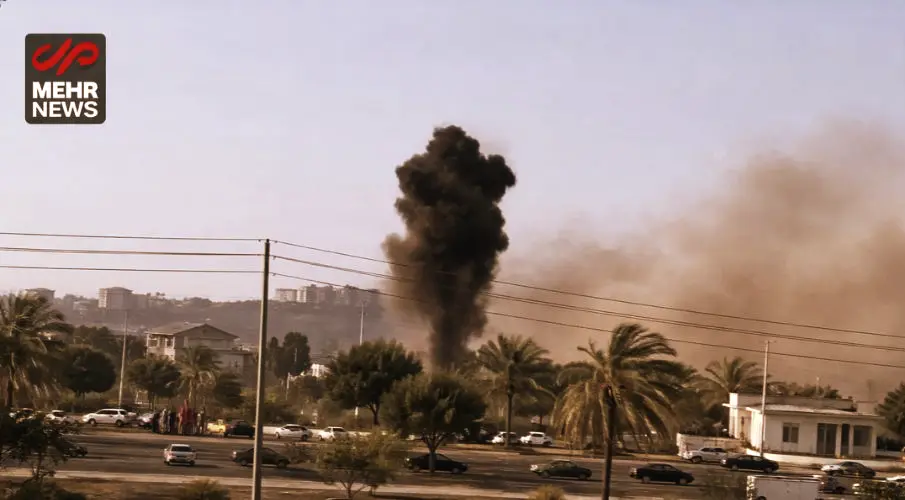
A newly surfaced video from the southern Iranian city of Minab shifts responsibility for one of the deadliest incidents of this war. The footage shows the impact of a US Tomahawk cruise missile on a facility of the Revolutionary Guards, directly adjacent to the Shajarah-Tayyebeh elementary school. 175 people are said to have been killed there, many of them children. For the first time, it is visually documented that the United States struck in precisely this area.
The impact in the immediate vicinity of the school
The video was published by the semi-official agency Mehr News and subsequently independently verified by the New York Times. The newspaper compared - as we did and two other collectives, including Bellingcat - visible details: a worn footpath, piles of debris, the position of the buildings. Cross-checked with satellite images taken a few days after the attacks. Additional verified videos from the immediate neighborhood support the authenticity of the sequence.

What can be seen is the cruise missile striking a building within the naval base operated by the Islamic Revolutionary Guards. After impact, smoke and debris shoot out of the structure. Screams can be heard in the background. As the camera pans to the right, dense clouds of dust and smoke are already rising from the area of the elementary school. This suggests that the school had been hit shortly before. A reconstructed timeline indicates that both impacts occurred almost simultaneously.
We went one step further: 116 meters - and the sea behind it
Our investigation produces a precise number: 116 meters.
We verified the coordinates ourselves. The Shajarah-Tayyebeh elementary school is located at 27.109778, 57.084670. A building in the military complex directly to the south at 27.109089, 57.085525. The straight-line distance between the two points is 116 meters. There is no urban space between the school and the target. No empty buffer. The buildings stand close together. A path across a soccer field is enough to move from one roof to the other.

116 meters in a city is not a distance one can overlook. Especially not in a military strike using a programmed precision weapon. A Tomahawk is launched with fixed coordinates. The target area is assessed in advance. Buildings in the immediate surroundings are visible - they are factored into the planning. At this distance, the school lies within the immediate target environment. It is not on the edge of the city, not several blocks away, but practically next to the complex.

The number is unambiguous. And it leads to a clear question: How was the risk to the neighboring school building assessed at a distance of 116 meters? In the video, the cruise missile enters the target from the upper right side of the frame. It comes in steeply, not flat. That is the visible final phase. The material shows nothing more. If the camera is oriented as the comparison with road and terrain suggests, this final approach indicates a direction from an eastern to southeastern axis relative to the impact site. That describes the last second of flight - not the entire route, not the launch location.
Southeast of Minab lies the Gulf of Oman. Open water, transition to the Strait of Hormuz. In this sea area, at the exact time of the attacks, US naval units were operating, including the USS Abraham Lincoln. Tomahawk cruise missiles are launched from ships or submarines of the US Navy. There are no indications of other states with Tomahawk-capable ships in this area. According to the US military, Iranian naval units there had largely been neutralized. This does not mean that a specific ship can be identified from the video. It only means that the visible final direction is consistent with the geographic location of the sea and the known US presence. What remains decisive is the distance on the ground.
US President Donald Trump had stated in response to a journalist’s question that the United States had not bombed the school. "No. In my opinion and from what I have seen, that was done by Iran," he said. Iran was very inaccurate with its weapons. Defense Secretary Pete Hegseth, standing beside him, stated that the Pentagon was investigating the incident - however, the only side deliberately targeting civilians was Iran. The problem with this account lies in the weapon type. The projectile visible in the video was clearly identified as a Tomahawk. According to publicly known information, neither the Israeli nor the Iranian military possesses this system. The Tomahawk is a guided missile used exclusively by the US armed forces. Since February 28, the beginning of the joint US-Israeli operation against Iran, dozens of these missiles have been fired from US Navy warships.
US Central Command itself released footage of multiple Tomahawk launches from naval vessels and stated that these were filmed on February 28 - precisely the day the base in Minab and the neighboring school were struck. General Dan Caine, Chairman of the Joint Chiefs of Staff, confirmed at a press conference that US forces were conducting strikes in southern Iran at that time. A map he presented showed that an area including Minab was targeted in the first one hundred hours of the operation.
"The initial maritime strikes were carried out by Tomahawks unleashed from the US Navy," Caine said on March 2 at the Pentagon. The Navy had struck targets along Iran’s southern flank. Minab lies near the Strait of Hormuz, a strategic chokepoint where the USS Abraham Lincoln and its strike group were, according to the general, exerting pressure on Iranian naval capacity. The Tomahawk is considered a precision-guided long-range weapon. The US Department of Defense describes it as long-range and highly accurate. Before launch, an exact flight plan is programmed, after which the missile guides itself to the target. It is about six meters long, has a wingspan of approximately two and a half meters, and in its standard variant carries a warhead with an explosive power of around 300 pounds of TNT. Its range is about 1,000 miles.

External experts reach the same conclusion. Trevor Ball, former US Army explosive ordnance disposal specialist, identified the missile in the video as a Tomahawk. So did Chris Cobb-Smith, head of the security and logistics firm Chiron Resources. Both see clear characteristics of this system in the proportions and flight profile. Satellite analyses also show that multiple buildings within the naval base were damaged by precise impacts. The object struck in the video is described as a medical clinic on the base. Visible weapon fragments are not yet available - independent journalists were unable to reach the site. That is precisely what complicates a full reconstruction. We will try again tomorrow. Yet the pattern of video material, satellite data, calculations, and official US statements produces a consistent picture: On February 28, US Tomahawks struck in the Minab area.
As early as June, a US submarine had fired more than two dozen Tomahawks at a nuclear facility in Isfahan as part of the so-called Twelve-Day War. There as well, the weapon was considered an instrument of precise, preplanned strikes. In Minab, the Revolutionary Guards naval base and the Shajarah-Tayyebeh elementary school lie close together. The new video does not show a direct impact on the school building. It does, however, show a US weapon striking precisely in the area from which smoke is rising over the school at the same time. This refutes the claim that it was an Iranian misfire. The question is no longer whether the United States struck in Minab. That is documented. What remains open is what exactly happened in those minutes - and whether the programming of a weapon described as highly precise took into account the proximity of a school where 175 people died.
It does not matter what one thinks of the regime in Tehran. It was and is inhumane. It does not matter what one knows or assumes about its nuclear program. Neither changes a simple fact: A later launch would have kept these children alive.
We assume that an intelligence service of the CIA’s caliber in 2026 is capable of incorporating the timetable of an elementary school into its target planning. That is a minimum expectation of an organization that claims to operate with precision. When children die in this way, there is an obligation to clarify. As a condition for any further reporting on this war. That is why we will again attempt tomorrow to reach the site in Minab.
Updates – Kaizen News Brief
All current curated daily updates can be found in the Kaizen News Brief.
To the Kaizen News Brief In English


