
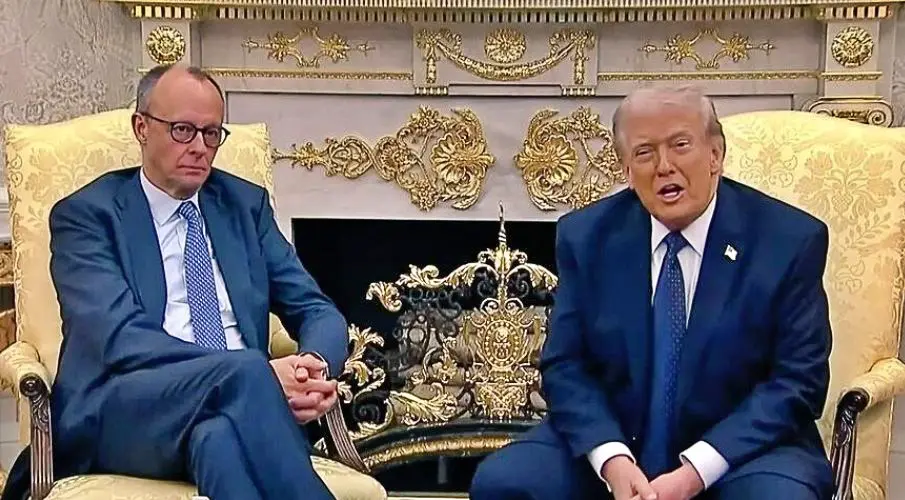
Friedrich Merz sits in the Oval Office and speaks with Donald Trump about the time afterward. Not during the war, but about what comes once the Iranian regime has fallen. That is the real message from the meeting between the German chancellor and the American president - not the friendly gestures or the jokes about tariffs, but this sober acknowledgment: Germany wants to help shape what follows in the ruins of today’s Iran. Merz brings a clear position: Germany and America agree that the regime in Tehran must go. But then the real work begins. What will a new government look like? Who will have influence there? What role will European countries play in stabilization? These are no longer theoretical questions. They are concrete.
Merz to Trump: “We agree on the removal of this terrible regime in Tehran. We will talk about the day after.”
What Merz does not say out loud, but makes unmistakably clear: Germany’s interest is European. The chancellor warns of rising oil and gas prices that would hit both economies hard. Diplomacy in moments like this operates on several levels at once. One supports the American line, but one also thinks about gas stations in Germany. At the same time, Germany is arming itself as it has not in decades. Defense spending is shooting upward. This year it will amount to about 127 billion dollars. Britain is spending 84 billion, France 70 billion. Germany surpasses both, even though it is not a nuclear power like its neighbors. Only conventional arms, but in quantities that shift Europe’s balance of power.
Trump: “How should we treat Germany - with regard to tariffs - ? I think we should hit them very, very hard.”
In Paris, this is being watched with growing unease. Not because the French fear German tanks rolling along the Rhine. That is long past. But the fear is older and runs deeper: If Germany invests so much more money in its military than everyone else, the weight shifts. The French defense industry finds fewer buyers. European defense policy takes on a German accent. The autonomy Macron always spoke of suddenly looks like German dominance.
Leading French politicians speak of Germany’s military buildup as a security threat, not as good news. At the same time, the Alternative for Germany, a right wing party that is close to Russia, is growing in Germany. For countries like Poland and France, which have experienced German military power in its worst form, this is a nightmarish combination: far more money for defense and a problematic political force in the country that could one day govern. Merz himself has set out to build Europe’s largest and best army. That is an honest, if somewhat unrealistic, declaration in light of Russian aggression and American disengagement. Many European leaders support it. But they do so with an uneasy thought in the back of their minds.
The numbers say a great deal: Germany wants to devote 3.5 percent of its gross domestic product to defense - by 2029 that could amount to 189 billion dollars annually. Britain wants to reach 2.5 percent by 2027. France 2.3 percent by 2028. The gaps are widening, not shrinking. Nathalie Tocci of the Institute of International Affairs in Rome has outlined a path out of this dilemma: joint European debt issuance for defense, joint production. Then no country can dominate alone, and armaments cannot be used against European neighbors. It sounds intelligent, but it presupposes that Germany trusts its partners - and that the partners trust Germany.
Max Bergmann of the Center for Strategic and International Studies puts it plainly: The big question is whether Germany is rearming for Europe or for itself. At the moment it looks like the latter. Merz in the Oval Office and the defense billions at home - they are two sides of the same coin. Germany wants to be capable of action again, on Iran and everywhere else. But carrying out this exertion of power without awakening old fears in Europe, that is the art Merz must now learn. The new German willingness to act meets old European memories. How this ends is not written.
Updates – Kaizen News Brief
All current curated daily updates can be found in the Kaizen News Brief.
To the Kaizen News Brief In English


