
Anyone walking through Tehran today without a headscarf is no longer stopped. No warnings, no fines, no intervention. Young women like Sahar, who does research at a university, take advantage of this - outside the campus she deliberately walks with her hair uncovered. On the streets, it is palpable that the system is faltering, at least in its ability to enforce its rules. Women on motorcycles, nighttime concerts, discreet alcohol sales - all of this has increased. But the facade is deceptive: The laws remain in place. The hijab mandate has not been abolished, only suspended. At any moment, the rollback can be ordered with a simple gesture.
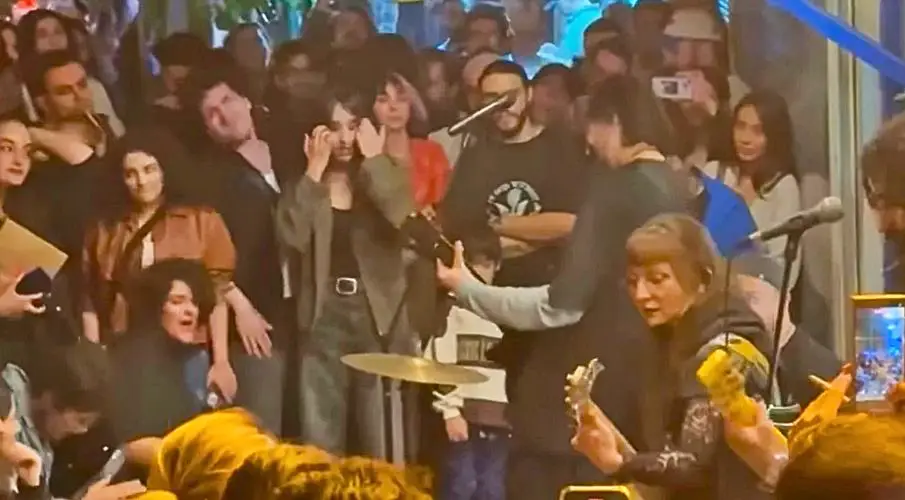
Rock music is banned in Iran - scenes like this would have been unthinkable just a few years ago. A rock band plays “Seven Nation Army” on an open street while men and women gather, dance, and celebrate freely. For now, no one intervenes. Since the protests following the death of Mahsa Jina Amini, the regime has struggled to fully reimpose strict hijab enforcement and to suppress public expressions like these. The current protests are not a spontaneous phenomenon.
This aligns with the president’s claim that the government is listening to the people. But the fact that a man like Masud Pezeschkian could take this step does not mean the regime has softened. On the contrary. The security apparatus is operating more harshly than ever. Nobel Peace Prize laureate Narges Mohammadi, already imprisoned for years, was brutally beaten at a memorial event in Mashhad and arrested again. In the same year, at least 1,922 people were executed in Iran - twice as many as the previous record in 2015. Most of these death sentences involve drug offenses. Political executions are rare, but present - as in the case of the rapper Tataloo, who was sentenced to death for alleged blasphemy.

In 2023, Narges Mohammadi received the Nobel Peace Prize for her work defending women’s rights in Iran
At the same time, a wave of espionage paranoia is sweeping the country. After Israel’s 12-day offensive in June, around 21,000 people were arrested, according to official figures - for alleged links to foreign intelligence services. Afghan migrants are particularly targeted. About 1.7 million Afghans were deported this year, often by force. The state systematically cracks down on groups it considers weak or suspicious - while simultaneously signaling relaxation to the outside world.

Despite the ban, more and more young women in Iran are riding motorcycles - and the police are doing nothing about it.
The economic situation intensifies everything. Inflation officially stands at over 40 percent per year - but investigations point to around 60 percent. Unemployment hits women particularly hard, and trust in the labor market is low. In Tehran, water has been cut off in several districts for the first time - fear of drought is real. Water scarcity, mismanagement, climate crisis, and decades of exploitation are leading to what experts describe as “water bankruptcy.” Former environmental official Kaveh Madani, an internationally respected expert, was pressured by the Revolutionary Guards after criticizing the regime’s agricultural policy. He left the country shortly after a photo of him holding a glass of wine abroad was published and turned into a political weapon.
No hijab, and women dancing in Iran! The government is easing morality controls - at least in Tehran. In the face of external conflicts and economic problems, the leadership is currently hesitant to confront the youth
Added to this is the real threat of war. The population knows: During the last Israeli airstrike, there was no warning, no bunkers, no civilian protection infrastructure. Only parking garages where people hid. While the regime seeks to procure missiles and air defense systems from Russia - such as S-400s and Su-35s - protecting the population remains a secondary concern. Moscow is delivering reluctantly, preoccupied with its own war. Tehran’s hope: If a ceasefire comes in Ukraine, Russia will again become an arms exporter - and Iran a customer. But that could also accelerate another Israeli attack.
Iran is standing still - and at the same time under extreme tension. The opening appears on the surface like progress, but is often just an expression of loss of control. And while one hand lets go, the other tightens its grip. Those looking at the country from the outside see contradictions. Those living inside it feel above all uncertainty.
Updates – Kaizen News Brief
All current curated daily updates can be found in the Kaizen News Brief.
To the Kaizen News Brief In English


Stell ich mir schwierig vor, unter solchen Bedingungen zu leben