
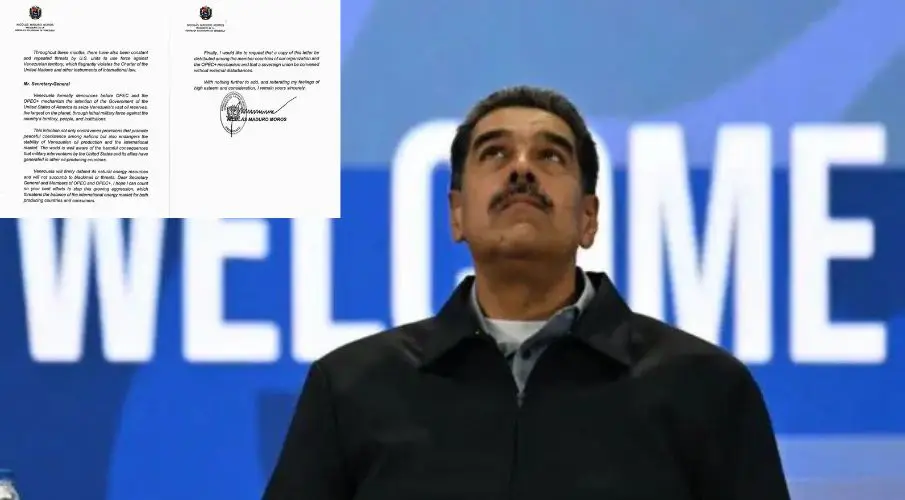
Nicolás Maduro has sent a letter that reads like a warning cry from a country that senses something tightening around it. Addressed to the UN Secretary General and to all states of OPEC and OPEC+, he describes months of threats from the United States, up to the open suggestion of a possible military strike. For Maduro it is clear that Washington is not only exerting pressure but is deliberately trying to gain access to Venezuela’s vast oil reserves. In his letter he speaks of the danger that the United States could intervene “with deadly force” against the country, its population and its institutions.

The tone of the letter is not diplomatic, it is alarmed. Maduro recalls how military actions by Western states have thrown entire regions off balance and brought markets to their knees. He warns that an attack on Venezuela would not only shake Latin America but the global energy market. The OPEC countries know exactly how quickly a conflict can send prices skyrocketing, interrupt supply chains and expose the fragility of a system that actually needs stability. At the same time Maduro asks the OPEC states for unified support. He wants his letter to be officially distributed so that everyone understands how serious the situation is. Behind every sentence is the concern that a conflict could erupt that no one will be able to contain again.

But one thing must be stated clearly and it would be dishonest to ignore it. Those who criticize Maduro are right. And yet one cannot apply and break international law at will. Maduro is not a statesman who deserves trust. Under his leadership opponents were persecuted, media intimidated and millions driven into misery. No one has to approve of his policies to understand the dimension of this moment. Precisely because his record is so damaging, it would be fatal to interpret rules based on sympathies. Even a president whose course one rejects is entitled to the protection of the territorial integrity of his country.
When a major power threatens violence, no one should act as if that is unproblematic simply because the affected leader is a poor head of government. International law loses its meaning the moment it is suspended at will. And anyone who allows a state to be put under military pressure because of its resources opens doors that cannot be closed later. That is why Maduro’s letter is more than the complaint of a weakened president. It shows that the situation has become dangerous. The United States has built up massive pressure in recent months as troop presence in the Caribbean grows. At the same time contradictory messages are coming out of Washington. There is talk of anti drug operations while the president himself makes political decisions that have little to do with that objective.
Venezuela responds with a letter that is not a diplomatic ritual but an attempt to remind the world which rules should actually apply. Maduro ends with the request that his letter be distributed to all OPEC states without interference. A sentence that shows how much trust in international mechanisms has eroded. In the end one message remains that reaches far beyond Caracas. Anyone interested in stability, whether for economic, political or simply human reasons, cannot sugarcoat this conflict. The situation is serious. And it affects far more than the man who signed the letter.
Investigative journalism requires courage – and your support.
Support our work against right-wing populism, disinformation, and violations of human and environmental rights. Every contribution goes directly into our daily reporting – we operate without advertising, without subscriptions, without corporations, without political parties. Our journalism is meant to remain freely accessible. For everyone.
Independent – Critical – For Everyone
Thank you for making our independent work possible.
Updates – Kaizen News Brief
All current curated daily updates can be found in the Kaizen News Brief.
To the Kaizen News Brief In English


Danke Rainer.
Du sprichst mir aus der Seele.
Maduro ist ein Diktator, keine Frage.
Das Land, die Bevölkerung leiden unter ihm.
Aber dennoch hat gemäß UN Charta und Völkerrecht kein anderer Staat das Recht dort militärisch zu intervenieren und einzumarschieren.
Denn dabei ginge es nicht um die Sicherung der USA.
Dazu ist Venezuela zu weit weg, militärisch nicht ausgestattet. Außerdem hat Venezuela sicher kein Interesse einen Krieg mit den USA anzufangen.
Aber leider wird Maduro keine Hilfe ethalten.
Die EU schweigt.
Der Westen schweigt
Die Opec Staaten hsnen Deals mit Trump und werden Venezuela nicht zur Hilfe kommen.
Es sieht auch für die Souveränität von Venezuela schlecht aus.
Denn Keiner wird die USA aufhalten.
Das kann nur von Innen, durch Gerichte Senatoren, Repräsentanten etfolgen.
Aber außer paar Lippenbekenntnissen sehe ich da noch nicht, dass das aufgehalten wird.
danke dir