
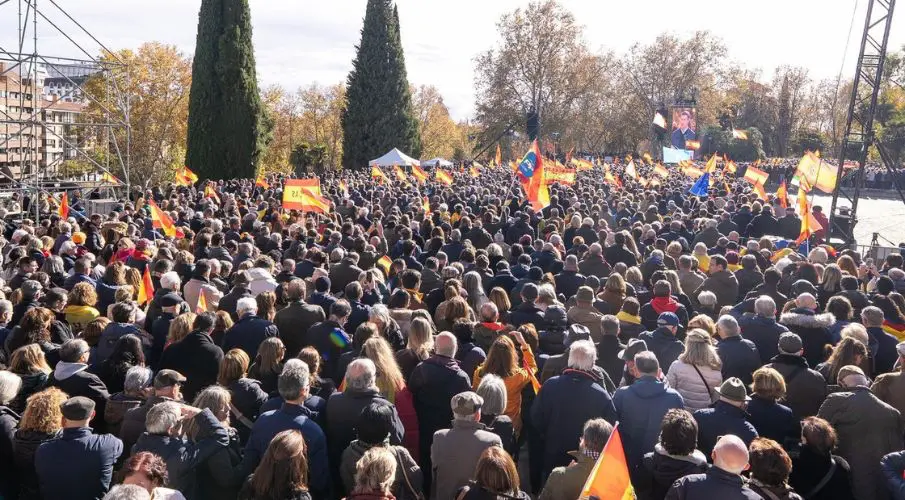
Around the Temple of Debod, thousands of people stood shoulder to shoulder this weekend. Families, older couples, students, working people, veterans of democracy - a cross-section of the country that has lost its patience. They shouted “We want democracy, not the mafia” and demanded that Pedro Sánchez step down. The investigation into former minister José Luis Ábalos, who is now in pretrial detention over the suspected mask fraud, has opened a wound that can no longer be covered up. The demonstrators accuse the prime minister of having turned his cabinet into a system of favors, silence and closed doors.

The police deployed in large numbers, but the situation was anything but calm. Many images show officers pushing back protesters, handing out blows, people falling to the ground. These were not chaotic rioters but angry citizens who no longer want to be fobbed off with explanations. The protesters’ statements were similar: they feel deceived and lied to, while the government acts as if the scandal were only a minor slip. But Ábalos is no small figure - he was a minister, later a parliamentary manager, a man at the center of power. The fact that he is now in prison shows how deep the cracks in the government structure have become.
The chairman of the Partido Popular, Alberto Núñez Feijóo, stepped before the crowd and described Sánchez’s style of governing as “political, economic, institutional, social and moral corruption”. The audience reacted immediately, as if someone had spoken an uncomfortable truth for the first time. The scandal surrounding the mask deals during the pandemic is no longer seen as an isolated case but as a system that has taken shape over years. And although the PSOE leadership expelled Ábalos from the party, he remained in parliament - a step that further fueled the anger of many demonstrators.
Madrid wirkte an diesem Tag wie eine Stadt, die sich neu sortiert. Menschen standen auf Mauern, hielten Plakate in die Luft, umringten Journalisten diskutierten laut und ohne Scheu. Das Vertrauen in die Regierung scheint für viele gebrochen. Ob diese Proteste die politische Landschaft Spaniens verändern werden, kann niemand sagen. Aber eines ist klar: Ein großer Teil des Landes hat genug. Auch die aktuellen Proteste speisen sich aus dieser alten Wunde. Für viele Spanier ist die Amnestie, die Sánchez 2023 den katalanischen Separatisten zusagte, nie wirklich verarbeitet worden – sie gilt bis heute als Symbol für einen politischen Deal, der zu weit ging. Die damals versprochenen Autonomie-Zusagen und die Art, wie Sánchez seine Regierung rettete, sitzen tief und tauchen in den aktuellen Demonstrationen immer wieder als Mit-Auslöser auf. Selbst Menschen, die weder konservativ noch separatistisch sind, empfinden diese Entscheidungen bis heute als Bruch des Gleichgewichts im Staat – und sehen in den jetzigen Protesten eine Gelegenheit, genau diesen Unmut erneut öffentlich zu machen.
In the end it becomes clear that the protests did not emerge out of nowhere. They draw on months of growing dissatisfaction, on a climate of political exhaustion, on the rejection of the amnesty and the distrust toward the deals Sánchez struck to stay in power. But the moment that brought everything together and pushed it into the streets was the arrest of José Luis Ábalos. For many Spaniards it was not an isolated scandal but the visible proof of a system that has fallen out of balance. The fact that a longtime confidant of the prime minister was led away in handcuffs gave the criticism a force that reached into parts of the center, the left, and the independents. Ábalos was the spark ignited in a country that has long been experiencing a political drought.
At the same time, many of the demonstrators emphasize that they are protesting against decisions made by Sánchez, not to hand the government over to Vox and the PP. But this is exactly the worry that hangs over everything. The prospect that political exhaustion could ultimately benefit the very forces that most aggressively polarize the democracy troubles many far beyond party lines. Vox and the PP are ahead in several polls, and the possibility of a joint government is more real than ever. For broad segments of the population such an alliance would be a step backward that would severely affect civil rights, equality, migration, and Spain's European role. In conversations on the streets of Madrid this fear is palpable: even people who have been criticizing Sánchez for months say openly that they do not want a return of a bloc that worsened the Catalonia crisis, cut social programs, and used the justice system for political purposes.
Investigative journalism requires courage – and your support.
Support our work against right-wing populism, disinformation, and violations of human and environmental rights. Every contribution goes directly into our daily reporting – we operate without advertising, without subscriptions, without corporations, without political parties. Our journalism is meant to remain freely accessible. For everyone.
Independent – Critical – For Everyone
Thank you for making our independent work possible.
Updates – Kaizen News Brief
All current curated daily updates can be found in the Kaizen News Brief.
To the Kaizen News Brief In English


Und hier mit Spahn…was passiert? Nichts.
👍