
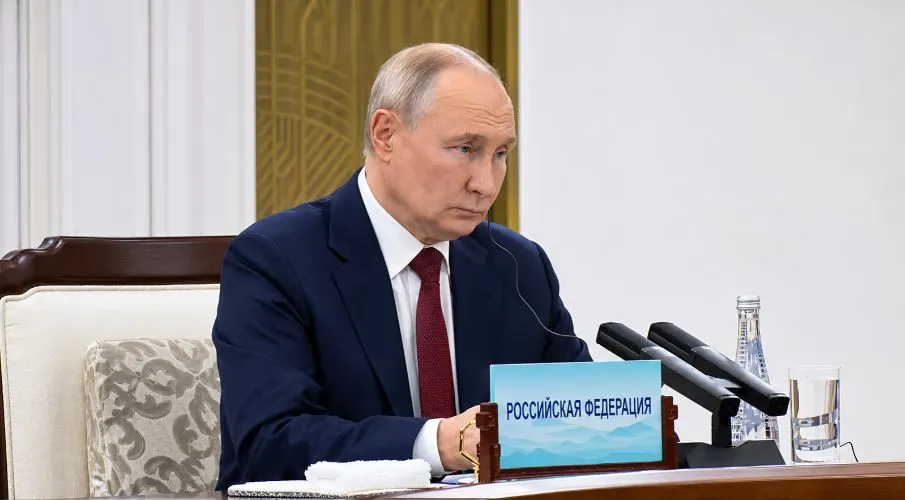
In Shenzhen, Vladimir Putin talked about peace. In Berlin, Jared Kushner announced that Russia was comfortable with NATO-like security guarantees for Ukraine. Between those two statements stands the Crimean Bridge, whose roadway was severely damaged in Ukrainian attacks. Part of the road structure and one of the bridge's arches collapsed. The railroad tracks were hit as well. While diplomats discuss how to protect a country after the war, that country's army is trying to destroy the attacker's supply routes.

Kushner, a "special envoy" of the American administration, described Moscow's position on Thursday as "comfortable" with such guarantees. He provided no binding Russian commitment or details on how those guarantees would be enforced. His colleague Steve Witkoff reported that Trump had discussed a peaceful end to the war during the three-way meeting with Putin and Xi Jinping. The rather dismal summit produced no discernible breakthrough. After his meeting with Putin, Trump joined the talks in Berlin by phone, Kushner said.

There, Volodymyr Zelenskyy sat down with representatives of more than 40 European countries and supporters of Ukraine. Kushner and Witkoff discussed preparations for further negotiations with them. Washington wanted to strengthen coordination with Kyiv and Europe and reach a common position on the conditions for a lasting peace, Kushner wrote. The participation of European countries in future security arrangements was also up for discussion. Ukraine demands protection against another Russian invasion. Moscow wants to keep NATO away from its borders.

In Shenzhen, Putin said he had no fundamental objection to Europe's participation in negotiations. However, it first had to be established what position the Europeans would bring to the table. The Kremlin had invited them to Moscow through diplomatic channels to clarify their position. Putin gave no date. Spokesman Dmitry Peskov declined to say which government representatives had even been invited. Europe may be allowed to have a say, provided it first comes to Moscow to explain what it intends to say.

Meanwhile, Ukraine demonstrated its military capabilities at the Crimean Bridge. For the third time in four days, it attacked the 19-kilometer-long connection to the peninsula illegally annexed by Russia in 2014. Following the overnight attack, rail traffic was initially suspended before resuming in the afternoon. The roadway had already been closed after earlier strikes. Zelenskyy described an operation carried out in seven stages. Ukrainian Neptune missiles reportedly damaged the tracks. Russia would now have to transport fuel and ammunition over land, where Ukrainian drones were waiting for the shipments, Ukraine's Defense Ministry said.
Putin confirmed extensive damage to the roadway and promised to rebuild it. The attacks would be answered, he said. He described the bridge as a civilian structure and claimed he had prohibited its use for transporting weapons and ammunition. In reality, the bridge has been important for supplying Russian troops for years. Even an order from the president cannot change that retroactively.
The airstrikes continued. Russian authorities reported four civilians killed in Ukrainian attacks. Moscow said it had intercepted 53 drones over ten regions. Ukrainian authorities reported Russian attacks involving 98 drones and anti-ship missiles. Two people were killed and at least 23 injured, including a 12-year-old boy. The Dutch and Austrian diplomatic missions in Kyiv also sustained minor damage.

Read our related articles: Three Nuclear Powers, One Summit of Shame: Trump, Xi, and Putin Talk About World Peace While People Die and Those in Power Protect Themselves From Prosecution
Russia's army is trying to crush Ukraine's defenses through sheer numerical superiority. At the same time, Moscow is deliberately targeting the power supply to expose the population to freezing temperatures ahead of winter. Ukraine is responding to this war with attacks on Russian oil refineries and militarily important supply routes. Prince Harry, meanwhile, spoke of a deep divide between the Trump administration's Ukraine policy and the position of the American public. Following the Democrats' victories in the midterm elections, Congress could once again challenge Trump's severe restrictions on support for Kyiv.
Jared Kushner announces that Russia is comfortable with NATO-like security guarantees. No corresponding binding commitment from Moscow exists. Meanwhile, Putin threatens retaliation for the attacks on the Crimean Bridge as his forces continue shelling Ukrainian cities. In Berlin, officials are negotiating how to protect Ukraine after a possible peace whose terms nobody has yet agreed to in any binding way. A date for the next round of negotiations has not even been set. Particularly disturbing is the casual ease with which unsubstantiated Russian willingness to negotiate is already being presented as diplomatic progress. The reality of this Thursday can be measured in the dead. They never heard about Kushner's supposed breakthrough.

While Kushner talks about Russia's alleged willingness to accept security guarantees, the Berlin summit has now adopted a joint statement (see below, English/German). Ukraine is to receive legally binding security guarantees following a ceasefire. The proposed measures include a European-led international protection force and U.S.-led monitoring of the ceasefire. The allies also reaffirmed their commitment to providing 70 billion euros in military support for 2026 and at least an equivalent amount in 2027. On top of that comes 90 billion euros from an EU loan through the end of 2027. Russia is to face further sanctions.
German Chancellor Friedrich Merz explicitly rejected a repeat of the Yalta Conference, where Europe's political power arrangements were negotiated in 1945. "A Yalta-style format will not bring peace," he declared. Europe would not allow itself to be carved up among the great powers a second time. French President Emmanuel Macron called for the question of Ukraine's NATO membership to be reopened. European countries also agreed to participate in the next negotiations through a joint seven-member delegation. The striking fact of this evening: In Shenzhen, Trump and Putin talked about Ukraine, while in Berlin, Europe first had to insist on being included in talks about its own security.
Friedrich Merz had a sobering description for the meeting of the three presidents in Shenzhen: It had apparently been little more than a "photo op." While Trump embraces Putin as a friend and Xi talks about world peace, the German chancellor is calling for negotiations on neutral ground, possibly in the United Arab Emirates. Zelenskyy demands talks involving Ukraine and Europe. The memory of Yalta is apparently more vivid in Berlin than in Washington. In 1945, the victorious powers decided Europe's political future. In 2026, the president of a country under attack once again had to insist that his country's fate not be negotiated without him. History rarely repeats itself word for word. Sometimes the seating arrangement is enough.
Updates – Kaizen News Brief
Alle aktuellen ausgesuchten Tagesmeldungen findet ihr in den Kaizen Kurznachrichten.
To the Kaizen News Brief In English


Putin will die Ukraine, komplett und die Identität der Ukrainer auslöschen.
Von dem Ziel weicht er nicht einen Millimeter ab.
Alles andere ist Show.
Für Trump, der nicht merkt, wie er vorgeführt wird.
Für die Dealmaker Kushner und Wittkoff, die nur Dollarzeichen in den Augen haben.
Für die EU und die NATO, um Aufruhr, Diskussionen zu fördern und um damit Zeit zu schinden.
Putin hat Zeit.
Kanonenfuttersoldaten aus Nordkorea und zum Teil aus afrikanischen Ländern.
So lange Trump Präsident ist, muss Putin sich nicht sorgen.
2 weitere lange Jahre.
Und Russlands „Garantien“ sind nicht das Papier wert auf dem sie stehen.
Man denke z.B an das Budapester Memorandum.
Aber das geht in viele Köpfe nicht rein.