
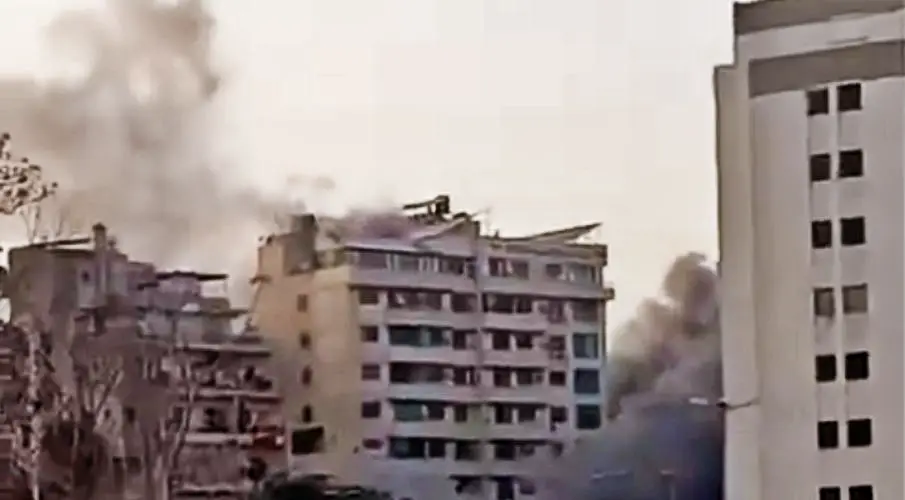
The front lines of this war no longer run only between Iran and Israel. While rockets strike over Beirut, drones hit military bases in Iraq and commercial ships in the Persian Gulf are damaged, diplomacy, the economy, and security are coming under pressure at the same time. The conflict, which began at the end of February with American-Israeli attacks on Iran, is drawing more and more states into it. In Beirut an Israeli airstrike hit a building in the center of the city, only a few meters from government buildings, the UN complex, and foreign embassies. The Israeli army had previously called on residents to leave a radius of around 300 meters because a Hezbollah facility is believed to be nearby. After an initial strike, a drone carried out a warning strike to drive people off the street before another attack followed. At the same time Israel began a new wave of strikes against targets in the south of the Lebanese capital.
Beirut - The city has been under constant bombardment for days
The conflict is also spreading into Iraq. In Erbil a military base and its infrastructure were hit by drones. British and American soldiers are stationed there. According to British Brigadier Guy Foden, several US soldiers were injured. British Lieutenant General Nick Perry said British soldiers were not affected, but the American wounded required medical treatment.
In Erbil a military base and its infrastructure were hit by drones, as can be seen in the background
The situation is also escalating at sea. At least 19 commercial ships have been damaged since the fighting began. The Strait of Hormuz is now considered one of the most dangerous shipping routes in the world. At the same time diplomats are trying to contain the conflict. UN Secretary-General António Guterres warned that the American-Israeli attacks and the Iranian counterstrikes had inflicted “immense suffering” on the region and brought it to a point where it could break apart. The weakest would be hit first and hardest. A way out is only possible through de-escalation and negotiations, Guterres said during a visit to Ankara.

At the United Nations Security Council an open dispute also erupted over Iran’s nuclear program. The United States pushed for a meeting on the sanctions against Iran that were reinstated last September. Ten members of the council supported the meeting. Russia and China opposed it, while Pakistan and Somalia abstained. Moscow’s UN ambassador Vasily Nebenzya accused Washington of using alleged nuclear weapons plans by Tehran to justify another military offensive. The American ambassador Mike Waltz countered that Iran is the only country without nuclear weapons that enriches uranium to a purity of up to 60 percent.
While the Security Council argues, diplomatic tensions are intensifying. Switzerland, which has served for decades as an intermediary between Washington and Tehran, has temporarily closed its embassy in Tehran. All ten staff members, including the ambassador, were taken out of the country because of growing security risks. The Swiss government said, however, that it would continue to serve as the protecting power and keep communication channels between the United States and Iran open.
Domestic pressure on President Donald Trump is also growing in the United States. Democratic Senator Tammy Baldwin is demanding public hearings in Congress. Defense Secretary Pete Hegseth and Secretary of State Marco Rubio are expected to explain why the government decided on the attack on Iran. Baldwin described the conflict as “illegal” and as a war without a clear strategy.
The economic consequences are now also becoming visible. Analysts at Goldman Sachs assume that the war could slow growth in the United States while at the same time increasing inflation and unemployment. Rising energy prices are already driving up the cost of gasoline, electricity, and food. The bank expects that the American central bank will have to postpone its planned interest rate cuts. If the oil price rises permanently above 110 dollars, inflation could increase significantly.
Washington itself is also reacting to the economic risks. The White House is examining whether parts of the so called Jones Act should be temporarily suspended. The law from the 1920s requires companies to transport goods between American ports only with ships under the US flag. Press Secretary Karoline Leavitt said that a suspension could help bring energy products and agricultural goods to American ports more quickly.

At the same time other fault lines are reaching a new level of tension. The Turkish foreign minister condemned the Israeli attacks in Lebanon and spoke of a humanitarian crisis. Ankara accuses Israel of expanding its military operations from the Gaza Strip into Lebanon. Even sports are not unaffected by the political situation. Donald Trump said it might not be “appropriate” for the Iranian national football team to participate in the upcoming World Cup. The team is welcome, he wrote, but he doubts that participation would be responsible given the security situation. Iranian authorities had previously said that participation would hardly be possible under the current circumstances anyway.
Uncertainty is also growing beyond the front lines. The FBI warned American police authorities about possible Iranian drone attacks on targets in the United States, particularly in California. The governor of the state, Gavin Newsom, said there is currently no immediate threat. While military attacks, diplomatic conflicts, and economic consequences are escalating at the same time, it is becoming increasingly clear how far this war already reaches. It is hitting cities in Lebanon, military bases in Iraq, commercial ships in the Persian Gulf, and political institutions in New York and Washington at the same time. Every new report from Beirut, Erbil, or the United Nations Security Council shows that this conflict has long become more than a regional war. It is reshaping power relations, trade routes, and political relationships simultaneously.
Updates – Kaizen News Brief
All current curated daily updates can be found in the Kaizen News Brief.
To the Kaizen News Brief In English


Die jetzigen Akteure der USA müssten von den eigenen Amerikanern einfach abgesetzt und gefangen werden. Mit neuen Leuten könnte die Diplomatie wieder in Gang kommen und der Krieg in Bahnen gelenkt werden um die ärgsten Schäden in den Griff zu bekommen. Ich weiß es ist ein Traum aber anders wird es nicht gehen. Es sei denn der 3. Weltkrieg nimmt Fahrt auf
… da ist viel wahres dran