
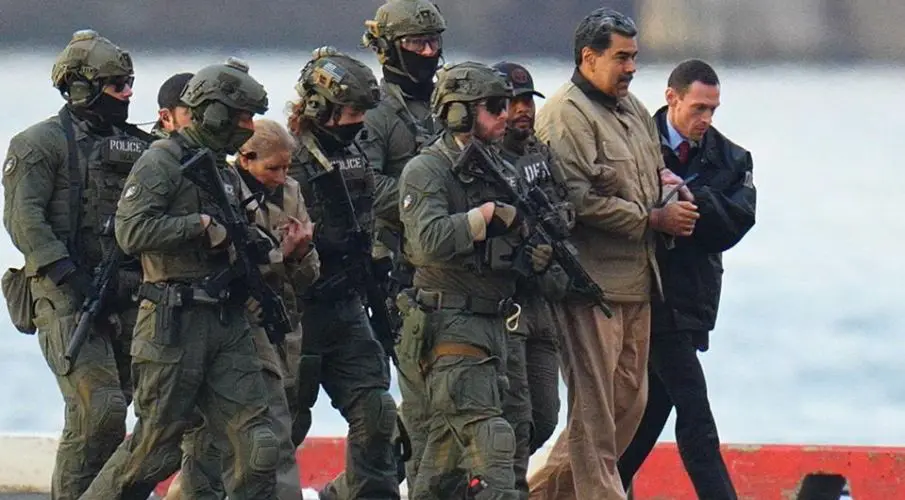
The US government has quietly retreated from a central allegation with which it politically and legally prepared the seizure of Venezuela’s president Nicolás Maduro. In a revised indictment, the Department of Justice has abandoned the claim that the so-called Cartel de los Soles was a real, clearly organized drug organization under Maduro’s leadership. What for years was presented as a concrete cartel now officially appears as what experts have long said it was: a term from Venezuelan usage, a designation for corruption within the power apparatus, not an organization with membership cards, hierarchy, and command structure. We always criticized this central point because it was not true, and our investigations also proved that. See our article: The new battlefield – Government documents in our possession confirm Trump’s fake war against Venezuela – It is only about oil and hard dollars

The original narrative goes back to an indictment from 2020 that portrayed Maduro as the leader of an international cocaine cartel. This portrayal was later politically reused. In the summer of 2025, the Treasury Department declared the term a terrorist organization, and in the fall the State Department followed on the instruction of Marco Rubio. The message was clear: this was said to be a tangible enemy, a foe with a name, leadership, and criminal agenda. Experts on organized crime in Latin America already contradicted this at the time. They pointed out that Cartel de los Soles has been used since the 1990s as a journalistic shorthand for corrupt military officers and officials, not as the designation of a concrete organization.
After Maduro’s capture, the tone changed. In the newly drafted indictment, there is no longer talk of a cartel but of a patronage system, of a web of bribery, protection, and mutual dependencies. Drug money, it now says, flows through a system that is tolerated or steered by those at the top of power. Evidence for this: none. The term Cartel de los Soles appears only at the margins, as a collective label for this practice, named after the sun insignia on the uniforms of high-ranking officers. Maduro is still accused of involvement in drug dealings, but the idea of a cartel led by him has disappeared.
This retreat casts a harsh light on the political use of criminal law. While courts demand evidence, political designations often suffice with assertions. That is precisely the rupture we have pointed out. The new indictment corresponds to reality, they say, while the old terror lists do not. That these designations remain in force to this day, even though their foundation has been abandoned in court-ready proceedings, raises doubts about their credibility. The attack on Venezuela took place under the premise of the old indictment, which has now dissolved into thin air.
It is striking that leading representatives of the administration nevertheless continue to cling to the old rhetoric. Marco Rubio publicly spoke of a real cartel even hours after the new indictment was released and declared that its leader was now in US custody. At the same time, the name is absent from key reports by US drug enforcement agencies, from their internal systems, and from United Nations records. Neither the annual threat assessment of the Drug Enforcement Administration nor the World Drug Report lists such a cartel.
An additional problematic point appears in the new indictment. For the first time, the leader of the Venezuelan prison gang Tren de Aragua is named as an alleged co-conspirator of Maduro. The connection remains thin. It rests on phone calls in which protection for drug shipments was offered. Security analysts dispute the claim that this gang controls major cocaine flows. They see the inclusion of the name more as an adaptation to political statements from the White House than as a robust legal construction. Here too, our investigations show that this is a product of imagination, and even the National Intelligence Council memo of April 7, 2025 contradicts it.

National Intelligence Council Memo of April 7, 2025, the declassified intelligence document on the question of the links between the Maduro regime and TdA. NIC Report (April 2025): Declassified assessment of the National Intelligence Council stating that the Maduro regime "probably does not have a policy of cooperating with TdA (Tren de Aragua) or directing TdA operations in the United States" and that many cells "operate independently." Siehe unseren Artikel: Das neue Schlachtfeld – Uns vorliegende Regierungsunterlagen bestätigen Trumps Fake-Krieg gegen Venezuela – Es geht nur um Öl und harte Dollar
The decisive legal breach lies in the fact that a military operation with deadly consequences was carried out to force criminal jurisdiction, and that the underlying indictment was subsequently weakened. Military force was justified ex ante with a construction that ex post is no longer maintained by the authorities themselves. Such conduct fundamentally violates Article 2 paragraph 4 of the Charter of the United Nations, which prohibits any use of force against the territorial integrity or political independence of a state, as well as the general prohibition of intervention under customary international law. A justification under Article 51 of the UN Charter is excluded, since neither an armed attack by Venezuela against the United States existed nor any current, immediate military threat can be claimed.
The use of military means to enforce a criminal proceeding is not provided for under international law. If deaths occur in the process, the principles of international humanitarian law are additionally implicated, in particular the principle of distinction and proportionality as set out in the Geneva Conventions of 1949 and the relevant customary international law. The death of uninvolved civilians in the course of a measure primarily aimed at arrest cannot be legally justified. Added to this is the violation of Venezuela’s state sovereignty and the prohibition on the forcible abduction of persons from the territory of a foreign state. Subsequent criminal prosecution before US courts cannot heal these violations, since domestic law cannot suspend constraints of international law. This also applies with regard to the personal immunity of a sitting head of state under the principle of immunitas ratione personae, which persists vis-à-vis foreign states and cannot be unilaterally set aside by political nonrecognition. Even if domestic courts affirm their jurisdiction by invoking the Ker-Frisbie doctrine, the international law unlawfulness of the arrest remains unaffected. The International Court of Justice has clarified in Nicaragua v. United States and in DR Congo v. Uganda that military use of force and interference with a state’s sovereignty are unlawful under international law even when politically or security justified.

The European Court of Human Rights held in Al-Skeini that states remain bound by minimum human rights standards when acting militarily outside their territory. The subsequent weakening of the indictment therefore does not confirm the lawfulness of the operation but reveals that military force was applied without a sustainable legal basis. Force with irreversible consequences cannot be legitimized after the fact. Such conduct sets a dangerous precedent in which power replaces law and core protective mechanisms of the international legal order are effectively hollowed out.
Thus emerges the picture of a proceeding that was corrected on the main point, while its political doping still lives on and is doomed to fail. The abandonment of the cartel allegation is now more an act of legal self-defense. It shows how quickly an image is created to justify military and foreign policy steps, and how quietly it disappears when it does not withstand judicial scrutiny. What remains is a power struggle in which language was turned into a weapon and terms were elevated to facts as long as they were useful.
Updates – Kaizen News Brief
All current curated daily updates can be found in the Kaizen News Brief.
To the Kaizen News Brief In English


Nur wenige werden sagen was Sache ist. Sie wollen nicht ihre Zollabkommen gefärden und sie wissen wie überlegen die orangen Trupen sind. Der möchtegern Chef hält sich nicht an Abkommen. Das hat er immer wieder bewiesen
Ja stimmt, und er wird sich nie an irgendwelche Abkommen halten. Seine Deals sind nur zu seinem Nutzen und mir graut vor weiteren, siehe Grönland.
…und deshalb muss man sich jetzt dagegenstellen
trump braucht europa mehr als umgekehrt. sein halbes militär würde ohne europa zusammenbrechen und im pharmabereich kannst du die usa so unter druck setzen, dass trump die perrücke wegfliegt
Nur es want Keiner.
Alle ducken sich weg
leider, leider, leider
Es ging immer nur um Öl und die anderen Ressourcen.
Maduro war da nur das Sahnehäubchen.
Etwas für seine MAGA.
Und eine gute Ablenkung von den Epstein Files, die noch immer nicht trotz richterlicher Anordnung, nicht veröffentlicht sind.
Trumps Regime droht ganz offen nach diesem Völkerrechtsbruch und der Entführung anderen Ländern, sogar NATO Partnern ganz offen und unverhohlen.
Aber für Merz ist das „alles komplex“.
Wenn er mit dem Lesen eines Absatzes der UN Charta überfordert ist und es als zu komplex betrachtet, dann ist er noch unfähiger als erwartet.
Wadepuhl ist genau so ein Feigling und stellt sich nicht klar hinter Greenland, das nur am Rande.
Für ihre Feigheit nutzen alle die gleiche Ausrede. „Maduro ist ein Diktator, der sein Land unterdrückt und systematisch in den Ruin getrieben hat“
Ja, das ist unstrittig. Nicht erst seit vorgestern.
Aber es ist ein souveränes Land, ein Stastschef.
Und die USA hatte weder vom Kongress, noch von der UN oder der NATO ein Mandat.
Ein internationaler Haftbefehl gegen Maduro liegt auch nicht vor.
Und die Un Charta gilt nun einmal für Alle.
Sonst könnte man ja auch Erdogan entführen, oder Kim…..
👍
…der wird alles vermarkten ws nur geht aus venezuela