
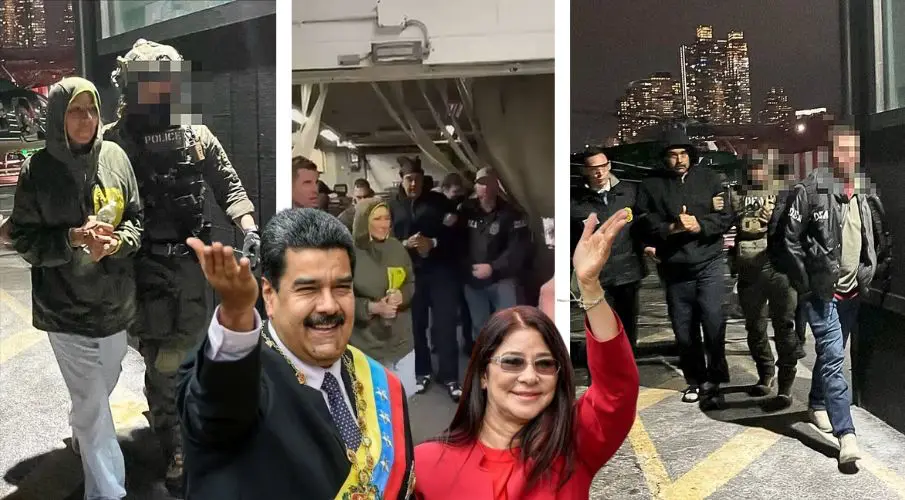
The criminal prosecution of Nicolás Maduro and his wife Cilia Flores before a federal court of the United States is not an ordinary criminal case. It stands at the intersection of domestic criminal law, international law, and international human rights guarantees – and it is inseparably linked to the manner in which the defendants were brought into US jurisdiction. Any legal assessment that ignores this path necessarily remains incomplete.
The starting point for US justice is its own federal criminal law. The indictment against Maduro is based on provisions of Title 21 of the United States Code, in particular sections 959 and 963, which cover manufacture, importation, and conspiracy related to narcotics, as well as the offense of so called narco terrorism under 21 U.S.C. section 960a. These norms are explicitly extraterritorial and claim application when, in the view of US authorities, drug trafficking targets the American market or affects the security of the United States. Subject matter jurisdiction of the federal courts arises from 18 U.S.C. section 3231, which grants them exclusive competence for federal crimes. For Flores, the allegation concerns participation in the drug conspiracy; no independent official act is attributed to her.
From the perspective of international law, extraterritorial criminal prosecution is not per se excluded. It is regularly justified by the so called effects principle, which allows a state to prosecute acts whose effects extend to its territory. This principle is recognized, but it reaches its limits where it collides with the territorial sovereignty of another state and is not based on extradition or legal assistance, but on forcible transfer.
The decisive point of conflict is the question of immunity. Under well established customary international law, sitting heads of state enjoy personal immunity, immunitas ratione personae. It comprehensively protects against arrest, prosecution, and detention by foreign states, regardless of whether official or private acts are concerned. This immunity does not serve the personal benefit of the office holder, but the functioning of state relations.
The United States deny this immunity by reference to their political decision not to recognize Maduro’s presidency. In the US legal order, recognition of a foreign head of state is considered an act of the executive branch to which the courts are bound. If a person is not regarded by the government as a legitimate head of state, the claim to personal immunity before US courts also falls away under this logic. This position finds points of contact in case law relating to the Foreign Sovereign Immunities Act, 28 U.S.C. section 1604 et seq., even though that statute primarily concerns states. Critically, however, a rule of protection under international law is effectively made dependent on a unilateral foreign policy decision.
For Cilia Flores, the immunity question is different. As the spouse of a head of state, she does not enjoy personal immunity. At most, functional immunity, immunitas ratione materiae, could be considered if her conduct were to be classified as sovereign. The indictment, however, accuses her of participation in a private criminal network. Under prevailing international law doctrine, any immunity protection falls away in such cases, as organized crime is not considered legitimate exercise of state authority.
Irrespective of these issues, the proceedings cannot be viewed in isolation from the manner of arrest. Unlike classic extradition scenarios, the transfer did not occur within the framework of judicial cooperation, but through a militarily led operation on Venezuelan territory. According to consistent reports and documented images, armed US units were deployed, military facilities were attacked, civilian infrastructure was damaged, and according to currently known information at least around 40 people were killed, including civilians.
This situation directly implicates the prohibition of the use of force under Article 2 paragraph 4 of the Charter of the United Nations, which prohibits any use of military force against the territorial integrity or political independence of a state. This prohibition applies regardless of whether a state is considered democratic, authoritarian, or illegitimate. A military operation to arrest individual persons regularly constitutes an infringement of the sovereign rights of the affected state.
Justification under the right of self defense pursuant to Article 51 of the UN Charter appears hardly sustainable in legal terms. Drug trafficking, even on a significant scale, is not considered an armed attack under the prevailing view. Nor does the classification of criminal organizations as terrorist automatically legitimize military force on foreign territory, as long as there is no immediate, acute military threat.
The question of fatalities weighs particularly heavily. Should civilian casualties be confirmed, international humanitarian law would additionally be implicated, in particular the principles of distinction and proportionality as derived from the Geneva Conventions and customary law. These principles apply even to military operations outside classic armed conflicts. The death of uninvolved persons in the course of a measure serving the enforcement of criminal proceedings raises serious doubts as to its legality.
The destruction of state facilities that had no direct connection to the arrest of the accused is also hardly justifiable under international law. Military force used solely to compel criminal jurisdiction moves outside what international law recognizes as permissible use of force.
These deficits under international law indirectly feed back into the US criminal proceedings. American jurisprudence traditionally follows the Ker Frisbie doctrine, according to which a court’s jurisdiction exists even if the defendant was brought into jurisdiction in violation of international law, as decided in Ker v. Illinois (1886) and Frisbie v. Collins (1952). This doctrine, however, originates from a time before today’s density of international human rights protection and is increasingly subject to criticism.
At the level of human rights law, the International Covenant on Civil and Political Rights and the Convention Against Torture are particularly relevant, both of which the United States have ratified. Article 9 of the ICCPR protects against arbitrary arrest, Article 14 guarantees a fair and public hearing before an independent tribunal. These rights apply without restriction, regardless of political position or public attribution. For Flores, it must additionally be examined whether her arrest and treatment comply with the guarantees of Article 7 ICCPR, which prohibits inhuman or degrading treatment.
Finally, the foreseeable duration of pretrial detention is problematic. Under US law, it may be ordered in cases of flight risk or danger. From a human rights perspective, however, excessively long pretrial detention without a prompt main hearing can violate Article 9 paragraph 3 ICCPR. Given the complexity of the proceedings, this point is of considerable importance. Therefore, the scheduling on January 5, 2026 before the United States District Court for the Southern District of New York is only the logical consequence and not a rapid legal prejudgment.
In overall assessment, the prosecution of Maduro and Flores formally operates within US federal law, but rests on a military seizure that deeply infringed Venezuela’s sovereign rights, caused fatalities, and destroyed civilian property. The rejection of immunity is based on political non recognition, extraterritorial prosecution on a broadly interpreted effects principle, and the manner of transfer is neutralized by internal US case law. Whether this construction withstands the standards of international law and international human rights remains open. The case is therefore more than a criminal proceeding. It is a striking point of moral boundary drawing for the limits of national criminal jurisdiction in an international order increasingly shaped by questions of power.
Updates – Kaizen News Brief
All current curated daily updates can be found in the Kaizen News Brief.
To the Kaizen News Brief In English


Danke für die gründlich recherchierte plausible Einschätzung!