
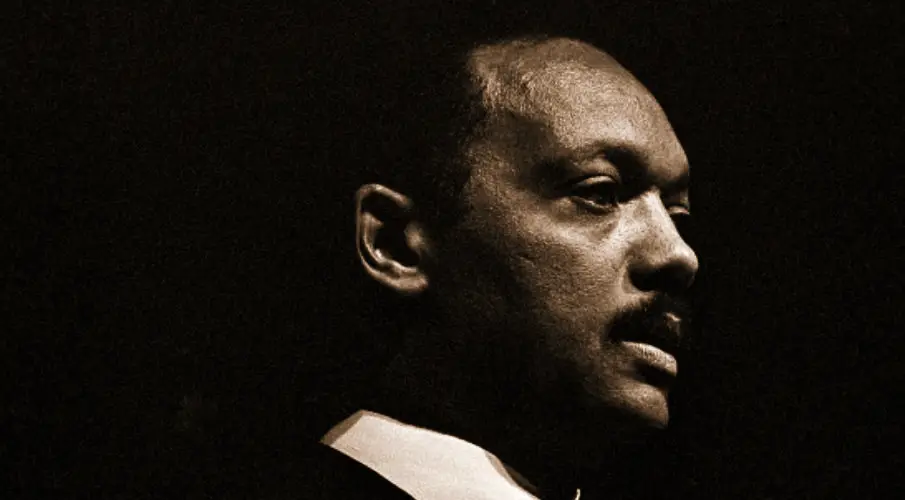
He wanted to become president. He wanted to be the successor to Martin Luther King. He wanted to transform the Democratic Party into what he called the Rainbow Coalition - an alliance of the poor, the forgotten, the left behind, across all skin colors. None of it happened the way he imagined. And yet Jesse Jackson was for decades one of the loudest, most uncomfortable and most influential voices in American politics. On Tuesday, February 17, 2026, he died at the age of 84 in his home in Chicago. His family announced that he passed away peacefully in his sleep. They did not name an exact cause of death. It was known that Jackson had been battling since the fall with a rare and particularly severe neurological disorder, progressive supranuclear palsy. In 2017, he had made public that he had been diagnosed with Parkinson’s disease.

Jesse Louis Burns - that was his birth name - was born on October 8, 1941, in Greenville, South Carolina, the illegitimate child of a 16-year-old mother and a married man who lived next door and did not take responsibility for the boy. The humiliation of that origin never fully left Jackson. He grew up in a strictly segregated small town, was mocked by classmates because of his background, learned early what the two drinking fountains in the bakery where he worked on Saturdays meant, and what it meant to move to the back of the bus with his mother.
His stepfather, Charles Jackson, adopted him only fourteen years after marrying his mother. Until then, Jesse lived partly with his grandmother, in a narrow wooden house around the corner. Anyone who survives such a childhood without breaking develops either an unusual resilience or an insatiable longing for recognition. Jackson developed both. He was a good student, an outstanding athlete, and he could speak - better than most. "He could talk a hole through a billy goat’s skull," a childhood friend recalled. A teacher described him as someone who from the beginning had a high opinion of himself and showed it. That never changed. For the rest of his life.
In 1959 he left Greenville with a football scholarship to the University of Illinois. He hoped to escape the Jim Crow system of the South and instead discovered that racism has no geographic center. Words that no one in South Carolina had ever said to his face he now heard from fellow students in the supposedly liberal North. After one year he transferred to North Carolina Agricultural and Technical State University in Greensboro - a historically Black college - shortly after in February 1960 four students had sat down at a Woolworth lunch counter there and triggered a nationwide movement.
In 1963 Jesse Jackson leads a crowd with his call "I am somebody!" and unites them in a powerful chant.
Jackson initially hesitated to join the protests. When he did, he quickly became a leading figure. In June 1963 he led a march into downtown, was arrested, and while still in jail wrote a letter modeled on Martin Luther King’s famous "Letter from Birmingham Jail" - a step that shows how early Jackson understood that he wanted to tell history himself, not merely be part of it.

Martin Luther King Jr. was arrested on April 12, 1963, in Birmingham, Alabama, after violating a ban on demonstrations. During that imprisonment he wrote the famous "Letter from Birmingham Jail," dated April 16, 1963.
He married his fellow student Jacqueline Lavinia Brown on New Year’s Eve 1962. The couple had five children. After graduating in 1964, he enrolled at Chicago Theological Seminary - and dropped out six months before finishing because the times did not allow monastic withdrawal. The images from Selma, Alabama, where Black demonstrators were beaten on the Edmund Pettus Bridge, had shaken him. He climbed onto a table in the seminary cafeteria and urged fellow students and professors to travel with him to Alabama. Around twenty students and a third of the faculty followed him.

Jesse Jackson and Jacqueline Jackson were married on December 31, 1962. Until his death on February 17, 2026, they had been married for more than 63 years
In Selma he met Martin Luther King. And those who knew him say that this moment decided everything. King became his role model, his intellectual reference point, his father figure. Jackson became the youngest staff member of the Southern Christian Leadership Conference and took over in Chicago the leadership of Operation Breadbasket - a program that used boycotts to pressure white companies to hire Black employees and contract Black suppliers. He quickly became known. He quickly clashed with his superiors. He was hardly controllable.

Then came Memphis. April 1968. King was on the balcony of the Lorraine Motel when a shot rang out. Jackson was one of the men who rushed toward him. What happened in the hours afterward remains disputed to this day. April 4, 1968: The last photograph of Martin Luther King Jr. shows him and also Jesse Jackson on the balcony of Room 306 of the Lorraine Motel in Memphis, surrounded by close associates - moments before the fatal shot was fired.
Jackson returned to Chicago that same night, in the turtleneck sweater he had worn in Memphis - and that carried bloodstains. The next morning he sat on television and said he carried the blood of Martin Luther King on his chest. Before the city council he declared that he had been the last to speak with King, that he had held his dying head in his hands. Other witnesses, including King’s closest confidants, disputed this. Ralph David Abernathy, King’s successor at the head of the SCLC, Ralph Abernathy and Hosea Williams said Jackson had constructed his proximity to King’s death in order to push himself to the forefront.
It was a scandal that clung to him for years. And it was also characteristic of him: He recognized an opportunity to tell a story that made him the center - and he seized it, without hesitation, without regard for what others would think. That made him great. That made him impossible. After his break with the SCLC in 1971, Jackson became freer, more idiosyncratic, omnipresent. He appeared everywhere: in South Africa, in Haiti, in the Middle East, in Silicon Valley. In 1984 he secured the release of U.S. Navy officer Robert Goodman, who was being held captive in Lebanon, through personal diplomacy - a spectacular appearance that established him as a serious international actor.
In the same year he ran for the Democratic presidential nomination. It was only the second time that a Black candidate from a major party had taken this step - after Shirley Chisholm in 1972. Jackson gathered 3.2 million votes in the primaries, won in several Southern states thanks to massive Black voter turnout, and ultimately lost to Walter Mondale.
In 1984 Jesse Jackson stepped to the podium at the Democratic Party convention in San Francisco. His approximately fifty-minute passionate speech became the emotional high point of a campaign that ultimately was lost to Ronald Reagan.
Three weeks after the start of his campaign, in an informal conversation with Black journalists, he had referred to New York as "Hymietown" - an antisemitic slur that appeared in an analysis by the Washington Post and triggered a storm. His initial refusal to clearly distance himself from Louis Farrakhan intensified the damage. They were mistakes that left real losses, even if Jackson never fully admitted them.
In 1988 he was better prepared. He won on Super Tuesday in sixteen of twenty-one primaries and caucuses. He received nearly seven million votes - 29 percent of all primary votes. The party leadership feared him and desperately searched for alternatives. In the end Michael Dukakis prevailed. Jackson fought for the vice presidential nomination and was passed over.
Jesse Jackson in Atlanta on July 20, 1988 at the Democratic National Convention.
What remained was the speech. The speech in Atlanta, which to this day counts among the most impressive political speeches in the history of the United States. Jackson spoke of his own poverty, his origin, his grandmother who sewed a quilt from rags, and he addressed directly the people who are counted out, written off, forgotten. "If my name is on the nomination ballot," he said, "yours is on it too." And he closed with the call he never shook afterward: "Keep hope alive!"
He was never president. He was never senator. He was never mayor. The only election he ever won was a symbolic and unpaid Senate seat in the District of Columbia that had no legislative powers whatsoever. Critics accused him of wanting to speak rather than govern. Marion Barry, then mayor of Washington, is quoted as saying: "Jesse wants to lead nothing but his mouth." It was mean. It was also not entirely wrong.
Jackson was a phenomenon of the public stage. He understood television, he understood symbols, he understood sharpening and escalation. What he did not understand - or did not want - was the patient, often tedious work of everyday politics, the compromises, the lost battles behind closed doors, the logic of institutions. The historian Clayborne Carson of Stanford University said Jackson was caught between two eras: too late for the moral clarity of the King era, too early for the political breakthrough that Obama ultimately achieved.
And yet, Carson said, Jackson built a crucial bridge. The voting rights gains of the 1960s would have evaporated without someone who transformed them into political capital. Jackson did that - through years of voter registration, through his candidacies, through his speeches that showed Black Americans that a place at the highest tables of the country was imaginable.
The personal shadows remained. In 2001 it became known that in 1999 he had fathered a daughter with an employee of his organization. In 2008 an open microphone became his downfall: disparaging remarks about Barack Obama, whose historic candidacy he publicly supported, were broadcast. His own son, then Congressman Jesse Jackson Jr., publicly rebuked him. A few years later Jesse Jr. went to prison for misusing campaign funds.

Jackson remained active, even as his mobility declined, even as his voice grew weaker. In 2021 he allowed himself to be arrested in Washington at a protest against voting restrictions - at 79 years old. In 2023 he officially stepped down from leading the Rainbow PUSH Coalition. In 2025 he joined a boycott of Target after the company rolled back its diversity program.
Until the end he was the same man: uncomfortable, loud, sometimes unpredictable, always convinced that he was right. America never fully liked him. It never fully rejected him. It needed him - as a mirror, as a warning voice, as someone who named the gaps between what the country promised and what it delivered. His vision of a coalition of the poor and forgotten was never truly adopted by the Democratic Party. And yet a direct thread runs from his speeches of the 1980s to the movements that followed - and to the question America still has not answered, how to sew from so many different scraps an actual common quilt.

Jesse Jackson has died. The question lives on.
Updates – Kaizen News Brief
All current curated daily updates can be found in the Kaizen News Brief.
To the Kaizen News Brief In English


Danke für den Bericht.
Einiges war mir bekannt, Vieles nicht.
Jesse Jackson.
Ein Narzisst
Ein Kämpfer für die Rechte von Schwarzen
Ein loses Mundwerk, aber auch ein Redner.
Ein Mann der die schwarze Bevölkerung an die Wahlurnen brachte.
Er war weder perfekt, noch glorreich.
Er war, wie er war.
Die USA brauchten so Jemanden.
Und sein Tod ist ein Verlust.
gerne, ein bewegtes wichtiges leben der amerika fehlen wird