
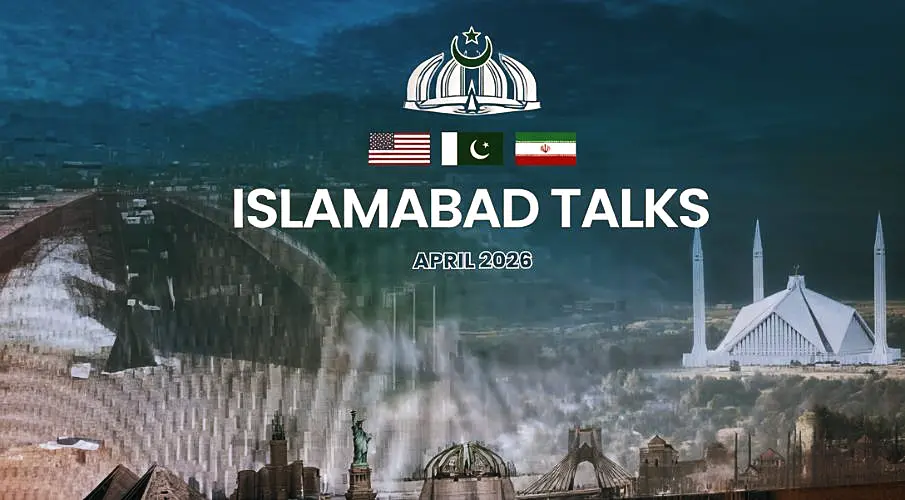
Update 20:30 Uhr MEZ: Update 8:30 PM CET: Islamabad – The negotiations between the United States and Iran in Pakistan have reached a “stalemate” over control of the Strait of Hormuz.
Islamabad – JD Vance and Mohammad Bagher Ghalibaf are sitting in Islamabad. Whether in the same room or in separate ones, only those present know. A Pakistani government official said only that the talks had begun and were going well. Nothing more. The White House confirmed that delegations from the United States, Iran, and Pakistan are holding direct talks. It is the first time since the Islamic Revolution in 1979 that American and Iranian leaders are speaking directly at such a high level. Back then, in 2013, Barack Obama called newly elected Iranian President Hassan Rouhani – that remains the highest contact between the two countries to date. What is happening today in Islamabad goes beyond that.

Vance is leading the American side, accompanied by Steve Witkoff, Trump’s special envoy, and Jared Kushner, Trump’s son-in-law. They are joined by Andrew Baker, the vice president’s national security adviser, and Michael Vance, special adviser for Asian affairs. The White House also sent a number of specialists, with additional experts supporting the team from Washington. On the other side sits Ghalibaf, Iran’s parliament speaker, who traveled to Islamabad with deep skepticism. Iran’s Foreign Minister Abbas Araghchi had made it clear before the talks: they are coming with deep mistrust, triggered by two attacks that took place in the middle of previous negotiations.
Vance himself was never a convinced defender of this war. He supported it reluctantly, without any visible enthusiasm. He brings little diplomatic experience, and neither do Witkoff and Kushner. They are men who grew up in a world of dealmaking – whether that is enough in a conflict of this depth remains an open question.
Trump himself said in a phone interview with NewsNation that he does not know how the talks will go. When asked about the outcome, he replied: No idea. He will soon see whether Iran is serious. At the same time, he posted on social media that the United States had begun clearing the Strait of Hormuz – as a favor to the world, which lacks the courage to do so itself. He confirmed that the United States knows where mines have been placed and that the military is bringing in equipment to clear them.
What is on the table is substantial. Iran’s nuclear program comes first – especially the status of enriched uranium after the strikes on Iranian nuclear facilities last year. The UN nuclear agency has not been granted access since then. There is also the missile program, which Israel in particular has viewed as a threat for years, as well as Iran’s support for armed groups in the region – Hezbollah in Lebanon, the Houthi rebels in Yemen, Hamas in Gaza. Newly added is the Strait of Hormuz, through which 20 percent of the world’s oil supply flows and which Iran has effectively blocked since the beginning of the war.
Iran has clearly laid out its conditions. It wants compensation for war damage, the release of frozen assets, a lasting ceasefire in Iran and across the entire region, a mechanism to open the Strait of Hormuz, the withdrawal of American forces from the region, and the lifting of long-standing sanctions. Iran’s First Vice President Mohammad Reza Aref said a deal is possible – but only if Washington represents American rather than Israeli interests.
Updates – Kaizen News Brief
All current curated daily updates can be found in the Kaizen News Brief.
To the Kaizen News Brief In English


Die USA wissen wo die Minen sind?
Dann wären schon längst Schife unterwegs.
Trumps „Wissen“ gegen ein Entgelt.
Die Positionen liegen so weit auseinander.
Die USA schickt Dealmaker und ejnen unerfahrenen Vice.
Natürlich weiß Yrump haargenau, was besprochen wird.
Lächerlich zu behaupten, er wisse es nicht.
Vermutlich wird der Tag heute mit der typischen Verlautbarung „es waren sehr konstruktive Gespräche“ enden.
Trump wird wieder irgendeinen Unsinn posten.
Und die Welt wartet