
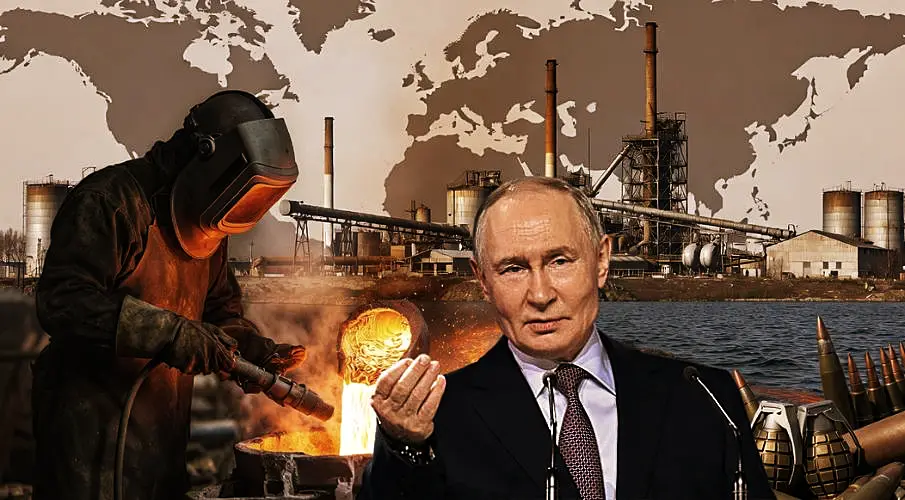
On the windy west coast of Ireland stands a facility that hardly anyone in Europe knows, and whose significance can hardly be overstated. Aughinish Alumina in County Limerick is the largest alumina refinery in the European Union. This is where bauxite is processed into alumina, without which aluminum cannot be produced. Aluminum, in turn, is not just any industrial metal. It is used in aircraft, drones, missiles, vehicles and weapons systems. It is light, durable, corrosion resistant and highly relevant militarily. That is precisely why the European Commission has called on member states themselves to stockpile alumina as a strategically important material. All the more serious is what new investigations now reveal. Because a large share of Irish exports does not end up in European reserves, but in Russia. And there the trail continues into the supply chains of those companies that keep Putin’s war against Ukraine running.
Supply chain: Irish alumina for Russia’s defense industry
The processes are alarming in their simplicity. Bauxite from Guinea and the Brazilian Amazon is shipped to Ireland. In Aughinish, the ore is processed with heat, pressure and caustic soda into alumina. This alumina is then delivered to Russian aluminum smelters owned by the company Rusal. Rusal is one of the largest aluminum producers in the world and is central in Russia for defense, transport, construction and the electrical industry. Since 2023, more than half of the alumina exports from Aughinish have gone to Russian smelters. Particularly important were the plants in Krasnoyarsk and Sayanogorsk in Siberia. In 2024 alone, the Irish refinery is said to have delivered around half of its entire annual production, worth about 400 million dollars, to these two locations. That corresponded to almost 40 percent of all alumina imports of these plants.

At this point at the latest, this is no longer just any commercial transaction, but a political decision with consequences. Because in Russia, alumina becomes aluminum. And this aluminum, according to leaked transaction data, ends up with a Moscow trading company called Aluminium Sales Company, or ASK. Since the start of the full scale invasion until April 2025, this company is said to have purchased aluminum worth more than 640 million dollars from Rusal’s trading arm. At the same time, ASK generated about one third of its revenue in the same period from aluminum sales for Russian defense contracts. That is around 337 million dollars. The customer list for 2024 included more than 40 companies sanctioned by the EU, many of them from the Rostec environment. These companies produce air defense missiles, missile systems, long range bombers and other military equipment. This is therefore not about a theoretical proximity to the defense industry. It is about a documented supply of a chain that ultimately leads to weapons.
These weapons have long left their mark in Ukraine. They hit apartment blocks in Mariupol, they struck the children’s hospital Okhmatdyt in Kyiv, they destroyed residential buildings in the west of the country. Thousands of civilians have been killed, cities devastated, infrastructure torn apart. The fact that European alumina appears in this chain is therefore not a minor side aspect of the war, but a tangible political contradiction. While Brussels publicly invokes support for Ukraine and calls on member states to take strategic precautions, a key raw material from the EU continues to flow into the very industry Russia needs for its war.
Legally, this is still permitted. That is part of the scandal. In February 2025, the European Union banned aluminum imports from Russia to reduce Moscow’s revenues. However, it did not prohibit the export of alumina to Russia. Yet that exact demand existed. Latvia had argued that an export ban would weaken Russia’s war machine. The EU nevertheless did not draw this line. Aughinish itself points out that it strictly complies with all applicable EU laws, sanctions, export controls and trade rules. The company also emphasizes that alumina and aluminum are basic materials for broad civilian needs and indispensable for numerous industries. That is formally correct, but it does not answer the decisive question. Namely what it means politically when a material of this strategic importance is delivered to a country that demonstrably also uses it for its military production.
The European Commission did not comment on this. The Irish Department of Foreign Affairs and Trade merely emphasized that alumina is not a sanctioned good and its export to Russia is therefore not restricted. At the same time, it referred to Ireland’s ongoing support for Ukraine. This is also the tone of a policy that hides behind the existing legal framework, even though the political and moral reality has long moved beyond it. Former Ukrainian defense official Oleksandr V. Danylyuk sees in this an open contradiction to the stated goals of NATO and the EU. Anyone supplying Russia with alumina produced in the EU could directly undermine the deterrence of Russia and the support for Ukraine. Pavlo Shkurenko of the Kyiv School of Economics Institute also warns. Europe’s entanglement with the Russian metals sector poses significant risks, not only for Ukraine, but also for Europe itself. Because the expansion of the Russian military industry points to more than just the current war.

The role of Rusal is particularly sensitive. The company itself has been spared EU sanctions, even though its founder and long time major shareholder Oleg Deripaska has long been sanctioned. Deripaska is considered a close ally of Vladimir Putin. As early as 2018, the United States briefly sanctioned Rusal, which sent shockwaves through the global aluminum industry and drove prices sharply higher. Shortly afterward, the company was removed from the sanctions list after Deripaska reduced his stake. This experience still resonates today. It shows how reluctant Western states are to intervene in the metals market when the consequences for their own industries appear too great. European policy still moves on this narrow path. It wants to harm Russia, but not hit itself too hard. The result is a gap through which material continues to flow.
In Ireland, the issue has been known for years. As early as 2022, questions were raised in parliament about why Russia was buying so much alumina from the country, even though such exports could support the attack on Ukraine. Thomas Pringle called it hypocrisy at the time. If the plant was to be protected, the state should consider taking it over and removing it from oligarch control. Patrick O’Donovan countered that the facility was not part of any Russian empire, but a significant employer and supplier for European industries. Even later, the response from Dublin remained essentially the same. As long as EU law allows exports, there is no immediate need for action.
At the same time, Aughinish is indeed strategically important for Europe. The plant produces about one third of the EU’s alumina. That is precisely what makes the situation so uncomfortable. Because the more important the facility is for European industry, the greater the political hesitation to fundamentally address the Russian ownership structure and export practices. Former Irish ambassador to the United States Daniel Mulhall once described the plant as one of the few strategic assets Europe even has in Ireland. That is exactly why the obvious question arises as to why such a facility continues to be owned by a Russian company whose products flow into the supply of sanctioned defense enterprises.

The material trail itself shows how international this structure is. The bauxite comes from mines in Guinea owned by Rusal, as well as from a Rusal mine in the Brazilian Amazon. The largest shareholder there is the commodity group Glencore, which also holds ten percent of Rusal’s parent company EN+. After arrival in Ireland, the refining into alumina follows. Then it is shipped to Russia. At that point, public documentation initially ends. Because Rusal does not mention in its public records that aluminum from its smelters goes to companies that in turn supply the Russian defense industry. Only leaked transaction data makes visible how close this chain actually is.
It is not possible to reconstruct the path down to a single weapon component. Alumina is mixed with material from other sources in the smelting process. An individual Irish delivery therefore cannot be assigned precisely to a specific missile or drone. But that does not change the overall picture. If, over years, large quantities of alumina from Ireland go to those Russian smelters that then supply aluminum to a trader who in turn serves dozens of sanctioned defense companies, then the connection is not speculative, but substantiated. It is exactly the kind of supply chain in which responsibility is fragmented and distributed across multiple stages until everyone at the end can say they only sold a basic material.
This very logic is what makes it politically so dangerous. Because it allows European governments to present themselves at the same time as supporters of Ukraine and to let a material continue to flow that Russia can use militarily. It allows companies to point to compliance with the law, even though the political effect of their deliveries has long been visible. And it allows a war to be carried along by completely ordinary industrial processes. From Guinea to Ireland. From Ireland to Siberia. From Siberia to a trader in Moscow. From there to factories supplying missiles, air defense systems and bombers. This is not an abstract world of trade. This is a direct connection between European production and Russian war capability.
At the end, a simple and uncomfortable truth remains. Europe knows how important alumina is. Europe knows that aluminum is needed for weapons. Europe knows that Russia secures its defense production not only with money, but also with raw materials. And Europe now also knows that a refinery in Ireland supplies a significant share of its material to Russian smelters whose aluminum feeds sanctioned weapons manufacturers. Yet to this day, the political step to stop these exports is missing. Not because the facts are missing. But because the will to bear the economic consequences of such a decision is missing.
The real question is therefore no longer whether this supply chain exists. It exists. The question is how long the European Union still wants to claim that it supports Ukraine with full determination while at the same time a strategic raw material from its own territory flows into the supply of Putin’s war industry.
Updates – Kaizen News Brief
All current curated daily updates can be found in the Kaizen News Brief.
To the Kaizen News Brief In English


Wenn es um lnvestoren und Arbeitsplaetze geht, aendern Regierungen dann doch schnell die Prioritaeten und die Geschichten drum herum zur Erklaerung…