
The Iranian leadership has drawn a clear red line. If the islands off Iran’s southern coast are attacked, parliament speaker Mohammad Bagher Qalibaf warned, Tehran will “abandon any restraint.” In his message he also made clear whom he would hold responsible: U.S. President Donald Trump. Should attacks occur, Qalibaf wrote, Trump will “be responsible for the blood of American soldiers.”
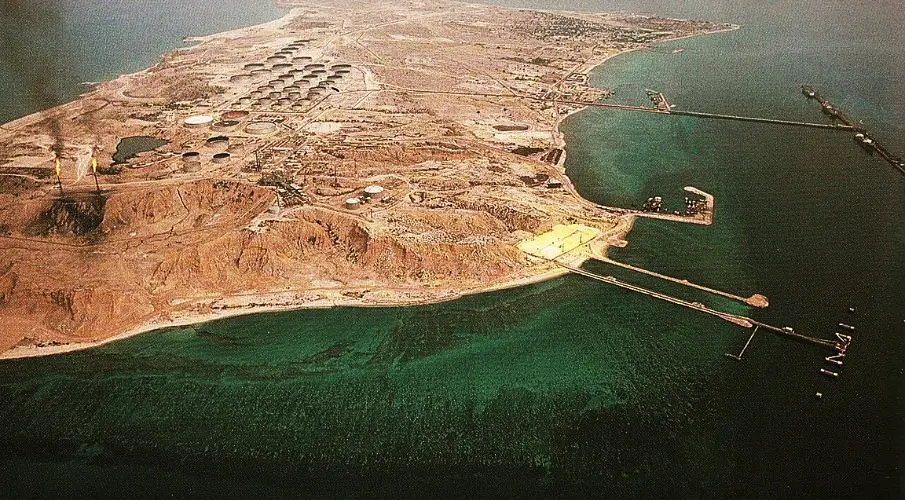
The words are spoken in a war that has continued to expand since February 28. What on the map looks like small dots actually determines money, energy and military control in the Persian Gulf. The islands off Iran’s coast are not a marginal detail of the conflict. They are a sensitive nerve of the entire region. The island of Kharg is particularly in focus. Located only about 33 kilometers off the Iranian coast, it is the most important transshipment point for Iranian oil. Nearly all export volumes of the country pass through this small coral island. Since the beginning of the war, about 13.7 million barrels of oil have been shipped from there according to analyses by TankerTrackers.com. Satellite images still showed tankers loading at the island’s terminals on Wednesday.
Oil remains the most important source of revenue for the Iranian state. A large share of the deliveries goes to China. Whoever controls Kharg therefore controls the financial circulation of the country. The island is full of enormous storage tanks in the south, alongside housing complexes for thousands of workers. Between refineries and depots gazelles run across the grounds - an unusual sight at one of the most sensitive energy points in the region.
Kharg Island is the central lifeline of the Iranian economy. Without this island the country would hardly be able to function. In this regard it does not matter who governs in Tehran. It is the main hub of the Iranian economy. If Iran loses Kharg, the country loses the basis for state revenues, military financing and political stability. A direct attack on Kharg would immediately stop most Iranian oil exports. The consequence would not only be an economic shock for Iran but also a massive military reaction. The Strait of Hormuz in particular could then become the scene of new attacks. Energy installations throughout the region would also be at risk. If Trump considers this, it could be a mistake with hardly foreseeable consequences.

The war has already reached Kharg. Donald Trump declared in a nighttime statement that U.S. forces had destroyed “all military targets” on the island. He spoke of one of the strongest bombardments in the recent history of the Middle East. At the same time the president said he had deliberately refrained from attacking the island’s oil infrastructure. However, if Iran were to obstruct shipping through the Strait of Hormuz, that decision could be changed at any time.
The U.S. strikes on Kharg so far have officially targeted military facilities, not the island’s oil terminals
Shortly before that Trump had reacted irritably to another question in a radio interview. A journalist wanted to know whether the United States was considering taking the island itself. Trump evaded the question. Whether he plans it or not, he said, he would certainly not explain publicly. “Who asks such a question - and which idiot would answer it?” Kharg, however, is only one part of the strategic island arc off the Iranian coast. Farther west lie Abu Musa as well as the two Tunb islands - Greater Tunb and Lesser Tunb. These three tiny pieces of land have for decades been among the most dangerous points of dispute in the Persian Gulf.
Iranian troops occupied the islands in November 1971 shortly after Great Britain ended its military presence in the Gulf. Only a few days later several sheikhdoms joined together to form the United Arab Emirates. The Emirates still consider the islands their territory to this day. Iran, however, holds them under military occupation and has stationed garrisons there. The dispute has never been resolved and belongs to the permanent tensions between Iran and the Gulf states allied with the United States. In a larger war these islands could immediately become military outposts - or targets.

Even larger is Qeshm, the largest island in the Persian Gulf. It lies near the Strait of Hormuz and has about 150,000 inhabitants. Its location makes it an important point for trade, infrastructure and military monitoring of the strait. Iran claims that the United States attacked a desalination plant on Qeshm on March 8. Washington has not confirmed this account so far. However Iranian foreign minister Abbas Araghchi warned that attacks on civilian infrastructure would have “dangerous consequences.” The plant supplies about 30 villages with drinking water.
The reaction followed quickly. Only one day later Bahrain reported damage to one of its own desalination plants. According to the interior ministry it was hit by an Iranian drone. Water supply remained stable, but the attack showed how quickly civilian infrastructure across the entire Gulf region can become a target.
Meanwhile the military presence around Iran continues to grow. The United States has moved about 2,500 Marines as well as amphibious warships toward the Middle East. The 31st Marine Expeditionary Unit, normally stationed in the Pacific, is on its way to the region. Such units are not trained only for landing operations. They are also used to protect embassies, evacuate civilians or provide rapid military reinforcements. See our article: Missiles, Marines and Million-Dollar Bounties: How America Expands the War - Images of a Desperate City
The ships are still several days away from the waters off Iran. Their deployment nevertheless shows that Washington is preparing for a longer escalation. At the same time the war is expanding beyond the region. Saudi Arabia reported on Friday that it had intercepted 65 Iranian drones as well as one ballistic missile. Many of the attacks targeted the oil rich eastern province of the country. Two migrant workers were killed in the process. In Qatar more than 5,000 reports of falling debris have been registered since the beginning of the war. Fragments from intercepted missiles and drones landed at more than 600 locations in the country. One of the most important American military bases is also located there: Al Udeid.
The economic consequences are already visible. The price of oil has once again risen above the mark of 100 dollars per barrel. Brent oil was recently trading above 103 dollars. U.S. crude cost just under 99 dollars. Since the beginning of the month prices have risen by more than 40 percent. The stock markets are reacting nervously. The S&P 500 index lost 0.6 percent on Friday, the Nasdaq almost one percent. Investors are watching developments in the Persian Gulf in particular. As long as the war continues the energy market remains the most sensitive link in the global economy.
All these developments show why the small islands off Iran’s coast have suddenly moved to the center of world politics. They are not only military positions. They are transshipment points for energy, control points for one of the most important sea passages in the world and the symbol of a decades long power struggle in the Gulf. Whoever attacks them does not only attack a piece of land. He attacks the economic lifeline of an entire state - and risks that the war will spread far beyond Iran.
Updates – Kaizen News Brief
All current curated daily updates can be found in the Kaizen News Brief.
To the Kaizen News Brief In English


