
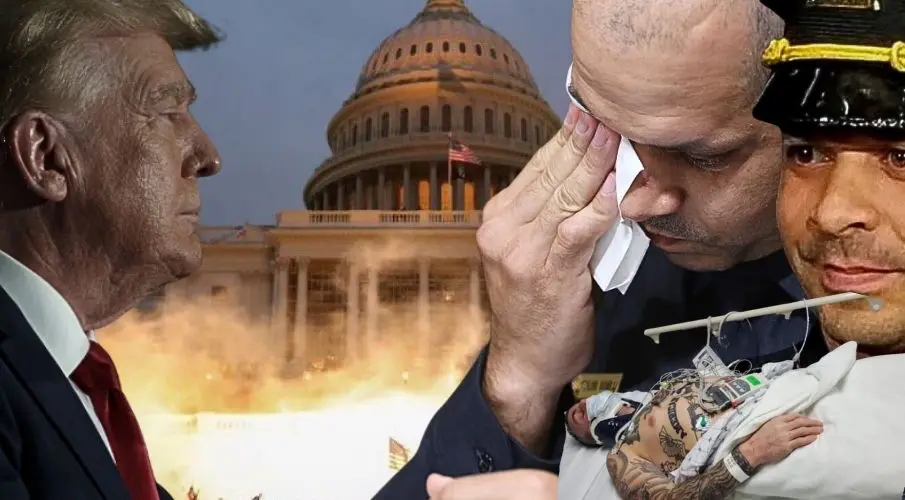
The view of January 6, 2021 changes fundamentally when it is not seen from the distance of political headlines, but from the perspective of those who were trapped inside the violence. While supporters of Donald Trump attempted to overrun the heart of American democracy, police officers were also fighting for their lives as, inside the building, the certification of Joe Biden’s election victory was violently interrupted. We deliberately chose not to show the familiar faces of the Capitol attack in this article. Not out of negligence, but out of principle. Out of respect for the police officers who fought for their lives that day, who lost their lives, and for the victims of the violence. Above all, because those who attacked the Capitol do not deserve further attention. Their actions are documented, their images omnipresent. What matters are not their faces, but the voices of those who held the line, were injured, and paid a price that cannot be relativized.

Around 4 p.m., the fighting had shifted to the narrow Lower West Terrace Tunnel, an approximately three meter wide passage beneath the future inauguration stage. Hundreds of rioters pressed in from outside, while a thin line of exhausted officers tried to hold the final access point. Sergeant Aquilino Gonell described the scene as a desperate attempt to prevent a final breach. Officers stood shoulder to shoulder, four or five abreast, bracing their bodies against the pressure of a crowd that chanted and pushed in rhythm. The struggle became increasingly physical, words disappeared, fists, shields, metal poles and pepper spray took over. Some officers had already lost their shields and called for replacements, while they continued to stand, injured, bleeding and barely able to go on.

Several accounts paint a picture of almost total confinement. Detective Phuson Nguyen described how demonstrators counted and pushed in rhythm until shoving turned into outright fighting. Officer Daniel Hodges described being pressed against a metal frame, his arms pinned, without freedom of movement, while an attacker repeatedly struck him with a stolen shield. Other officers spoke of facing new groups every few minutes as their own strength faded. Officer Jesse Leasure recalled a moment when someone handed him a pitchfork, fearing it might be used against the police. At the same time, some attackers tried to talk to the officers, saying they did not want to hurt them, while in the same moment punches and kicks followed.

The violence escalated further when individual officers were pulled from the line. Officer Michael Fanone was dragged into the crowd, heard someone shout that they had one, lost his badge, radio and ammunition. He described attackers trying to take his weapon, chants calling to kill him with his own gun. He was shocked with a Taser multiple times. In the midst of the assault, he thought of his four daughters and that he might not make it out alive. Detective Nguyen was also targeted, his gas mask torn off, his face directly sprayed, the mask then snapped back into place, trapping the gas inside. He fell, struggled for air and panicked, while other officers could barely help because they too were under attack.

Again and again, the statements describe moments when consciousness began to fade. Officers spoke of oxygen deprivation, burning lungs, the feeling of being about to collapse or be dragged outside. Sergeant Gonell recalled thinking he would die there, trampled at that entrance. Hodges described how an attacker grabbed his gas mask, slammed his head against a door, finally tore the mask away and left him exposed to gas and spray. Another man stuffed his cellphone into his mouth to free both hands. Leasure spoke of smoke, of colleagues on the verge of collapse, of the moment someone asked whether anyone needed a break, and the realization that there was no room for one.

In this situation, individual shouts struck a nerve. When Fanone yelled that he had kids, some in the crowd intervened and shielded him long enough for fellow officers to pull him back. Other officers screamed for help, knowing that any further loss of ground could mean death. Repeatedly, colleagues managed to extract injured officers from the line while others stayed and fended off new attackers. It was a grinding, hours long fight, driven not by strategy but by sheer endurance.

Away from the tunnel, Capitol Police officer Brian Sicknick was directly sprayed with chemicals on the West Front. The night before, he had written to his brother that hell might break loose the next day. That afternoon, he wrote again, exhausted and injured, saying he had been sprayed with pepper spray at least twice. Hours later, at 8:21 p.m., he texted that he smelled of sweat, marijuana, pepper spray and tear gas. Shortly afterward, he collapsed in a division office, began slurring his words and lost consciousness. He was taken to the hospital and placed on life support. Despite the efforts of his colleagues, he died that same evening. His body was kept alive for another day so his family could say goodbye.

The events of January 6, 2021 were not merely a political episode, but a physical collapse of order at a place that was meant to provide protection. The voices of the police officers tell no heroic story, but a sequence of decisions made under extreme pressure, marked by fear, exhaustion and the effort to protect others while everything around them spiraled out of control. What happened in the tunnel that afternoon was not a symbolic protest, but raw violence whose consequences cannot be explained away. The death of Brian Sicknick stands at the end of this chain, not as a footnote, but as a reminder that this day had real victims long after the chants had faded. Only one voice has not fallen silent to this day: Donald Trump. But placing him at the end of this article would feel more like a reward. Therefore, we choose to end with the words of Aquilino Gonell, spoken on April 12, 2025, an immigrant and former sergeant of the Capitol Police in Washington, D.C., which I leave without comment, because everything has been said.

“For my efforts doing my duty as a Capitol Police sergeant, I was beaten and struck by raging rioters all over my body with multiple weapons until I was covered in my own blood. My hand, foot and shoulder were wounded. I thought I was going to die and never make it home to see my wife and young son.
Over the last four years, it’s been devastating to me to hear Donald Trump repeat his promise to pardon insurrectionists on the first day he’s back in office. “It will be my great honor to pardon the peaceful protesters, or as I often call them, the hostages,” he said in a speech last year. But all of us who were there and anyone who watched on TV know that those who stormed the Capitol were not peaceful protesters. Pardoning them would be an outrageous mistake, one that could mean about 800 convicted criminals will be back on the street.
It could also put me in danger, as I’ve continued to testify in court and I’ve given victim statements in cases against dozens of the rioters who assaulted me and my fellow officers. I was one of the fortunate ones that day; nine people wound up dead as a result of the rampage.
Two protesters had fatal medical episodes, one rioter overdosed during the uproar and another was fatally shot by a policeman while forcing her way into the House Chamber. One of my colleagues, 42-year-old Officer Brian Sicknick, suffered two strokes after the trauma of fighting off multiple protesters who sprayed him with a chemical irritant. He didn’t survive.
Four D.C. policemen harmed in the riots later died by suicide.
My friend Harry Dunn, the first law enforcement member to prominently condemn the brazen uprising, testified about our primitive hand-to-hand fighting against improvised weaponry like flagpoles, metal bike racks and projectiles, with officers bleeding, blinded and coughing from bear spray. Harry, who was called racial slurs, has since retired his blue uniform. My co-worker Michael Fanone was beaten, burned and electrically shocked. He suffered a heart attack, concussion and traumatic brain injury that caused him to also leave his position at the Metropolitan Police. While physically recovering, he’s been the target of constant harassment from Trump supporters and has struggled to find steady work. Steven Sund, who was the Capitol Police chief, has been scapegoated and resigned under pressure.
I required multiple surgeries, years of rehab and treatment for recurrences of the post-traumatic stress disorder I was diagnosed with in the Army. I was vilified and called “a traitor,” as Mr. Trump and some of his fellow Republicans called the riot a “day of love” and a “peaceful protest” by “warriors,” “patriots,” “political prisoners” and “mistreated hostages.”
Although I left the Capitol Police force, I remain haunted by that day. Now Mr. Trump’s promised actions could erase the justice we’ve risked everything for.
I never wanted to be a whistle-blower or a troublemaker. I grew up poor in the Dominican Republic, came to this country legally at age 12 and became the first in my family to finish high school and college. I lived in Brooklyn, just a few miles from where Mr. Trump grew up in Queens, yet the metaphoric distance between us was vast. My dad was a taxi driver who could give me only $100 to help pay for college. Mr. Trump’s father was a real estate developer who bequeathed him at least $413 million over the years. While Mr. Trump escaped the Vietnam draft with a medical exemption for bone spurs and never served in the military, I finished my degree with the help of the G.I. Bill after I enlisted and served in the Middle East. What I experienced defending the Capitol against rioters was worse than the combat I saw in Iraq.
What helped me was bearing witness. In the four years since the riot, about 1,561 defendants have been federally charged with Jan. 6 crimes, many of them serious felonies ranging from unlawfully entering restricted grounds with weapons to seditious conspiracy. Approximately 590 defendants have been charged with assault on a federal officer and 169 have been charged with crimes involving serious bodily harm to a police officer, including assault using a deadly or dangerous weapon; the weapons included swords, axes, knives, Taser-like devices, baseball bats, hockey sticks and reinforced knuckle gloves. More than 300 pleaded guilty to felonies and more than 200 were found guilty at trial.
Releasing those who assaulted us from blame would be a desecration of justice. If Mr. Trump wants to heal our divided nation, he’ll let their convictions stand.
Although I don’t blame all Trump supporters - some of my own relatives support him — I do detest what MAGA extremism did to me and my team on Jan. 6. I resent the ongoing whitewashing of the barbarity and the collective amnesia of right-wing politicians who aren’t willing to hold Mr. Trump accountable. I can’t bear to hear Republicans describe themselves as the “law and order” party.
Mr. Trump is returning to the presidency at 78, while I had to leave the career I’d worked for my whole life at 42 as a result of injuries suffered while doing my job. I sometimes wonder why I risked my life to defend our elected officials from a mob inspired by Mr. Trump, only to see him return to power stronger than ever. It’s hard to witness a rich white man get rewarded for treachery while I’m punished for fulfilling my duty. Maybe that’s why so many people don’t do the right thing, because it’s hard and it hurts.
When Mr. Trump recently proclaimed that members of the House Jan. 6 committee should go to jail, Representative Jamie Raskin responded, “In America, we jail people only for having committed criminal offenses that they are found guilty of by a unanimous jury of their peers. We don’t jail people for doing their jobs and living up to their constitutional oaths of office.”
It gave me hope when Mr. Raskin further reminded everyone that Mr. Trump was impeached for his role in inspiring a violent insurrection against the Constitution. I admire Republicans like Liz Cheney and Adam Kinzinger who put fairness before party, despite being censured and threatened for their work on the committee.
At least I get to hear my son call me his hero, as we remember the people who put everything on the line to protect our democracy and continue to tell the truth about Jan. 6.”
Bravo, Sir! Thank you for your service and commitment to the rule of law. Things Trump will never understand."
Aquilino Gonell
Updates – Kaizen News Brief
All current curated daily updates can be found in the Kaizen News Brief.
To the Kaizen News Brief In English


Ich saß fassungslos am Fernseher, als ich die Bilder sah.
Ich weinte.
Und dann war da der grinsende Trump.
Der keine Nationalgarde rief, keinen Notstand ausrief.
Er grinste und befeuerte seine Anhänger.
Ich dachte nur, wie kann ein noch amtierender Präsident bei dieser Attacke einfach nur grinst.
Während der Berichterstattung, war (außer von den Kriminellen) die einhellige Stimmung absolutes Enttsetzen.
Der Ruf nach Strafverfolgung war laut.
Trump stand in der Schusslinie.
Aber schon eine Woche später, relativierten sich die „Aussagen“.
Es wurde immer öfter von Antifa, einer Aktion des FBI im Auftrag der Demokraten, eines friedlichen Protestmarsch der nur durch die Aggression der Polizei aus dem Ruder lief geredet.
MAGA sieht keine, wirklich keine Straftat am 6. Januar 2021.
Außer, dass eine Demonstrantin „kaltblütig von der Polizei erschossen wurde“
Die Gehirnwäsche hat binnen kürzester Zeit gewirkt.
MAGA Sekte par excellence
Die Demokraten haben es versäumt diese Attacke schnell und effective zu verfolgen.
Inklusive Trump.
Es kam alles erst zu spät ins Rollen und lief mit Trumps Neuwahl ins Leere.
Meine Gedanken gelten den Betroffenen und deren Familien.
Die jetzt dank Trumps Begnadigungen in Angst und Schrecken vor Racheakten leben müssen.
Menschen, die die Demokratie, das Leben der Menschen im Capitol und ihr eigenes Leben verteidigt haben.