
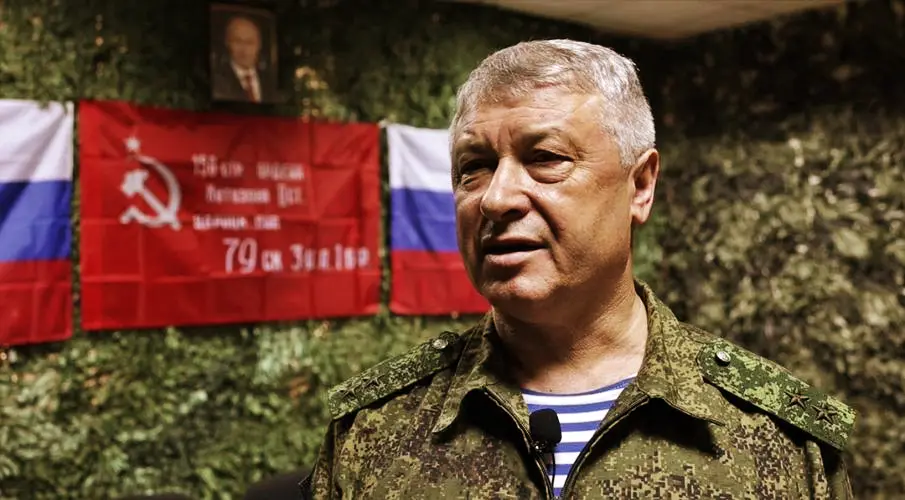
Several shots in a residential building in northwest Moscow. Lieutenant General Vladimir Alexeyev, 64 years old, first deputy chief of the Russian military intelligence service GRU, is taken to a hospital seriously injured. The attacker escapes. Investigators secure evidence on Volokolamskoye Highway, evaluate surveillance cameras and question residents. Officially, proceedings for attempted murder are underway. From the Kremlin it is said that President Vladimir Putin is being kept continuously informed, and there is hope that the general will survive. The Moscow prosecutor’s office stated that Alexeyev was shot multiple times by an unknown perpetrator in a residential building in the northwest of the capital. The attacker fled. “Investigative measures and operational search activities are being carried out to identify the person or persons involved in the crime,” said Investigative Committee spokesperson Svetlana Petrenko.
The attacker is said to have waited for Alexeyev and fired several times at him before fleeing. A manhunt has been launched in Moscow
Alexeyev is not just any officer. He is considered number two in the GRU and has played a central role in recent years. His career began with the Soviet airborne troops, later he transferred to military intelligence. Since 2011 at the latest, he has been part of the leadership. In Russia, he was awarded the title Hero of Russia for his role in the military operation in Syria. Internationally, his name has been on sanctions lists for years. After the Salisbury nerve agent attack in 2018, the GRU came under scrutiny by European governments, and Alexeyev was also sanctioned by the European Union and the United Kingdom. The United States listed him in connection with Russian influence and cyber operations.
In 2022 he took part in negotiations during the siege of Mariupol, when the last defenders left the Azovstal steel plant. At the time, he promised compliance with the Geneva Convention and humane detention conditions for captured Ukrainian soldiers. His signature stands under the document that was signed in Mariupol. In return, Ukraine handed over three Russian prisoners of war, medically treated, provided with food and water. It was a rare moment in which even in a bitter war, rules were supposed to apply.

The page is part of the agreement from Mariupol. At the top are the names of the soldiers concerned - among them Shajworonok V.A., Serbow R.W., Ananyev J.B., Tkatschenko P.P., Dubow S.O., Deyneko W.M., Smirnov E.O., Maximov O.O., and Lieutenant Gaiduk D. Added by hand were Kowalenko S.N. and Krawtschuk D.O., each with unit details. Below that it becomes decisive. It states that the signatory commits to complying with the Geneva Convention relative to the Treatment of Prisoners of War and to ensuring its observance under all circumstances. No qualification, no room for interpretation. It explicitly concerns compliance with all articles and norms.
Yet reports of mistreatment, denied medical care and deliberate undernourishment of captured Azov fighters caused this promise to collapse. The Ukrainian military intelligence service HUR lists Alexeyev as jointly responsible for preparing target coordinates in attacks on civilian infrastructure as well as for organizing the so called referendum in the Kherson region. These allegations come from Kyiv; from the Russian side they are disputed or not commented on.
Doch Berichte über Misshandlungen, verweigerte medizinische Hilfe und gezielte Unterernährung gefangener Asow-Kämpfer ließen dieses Versprechen zerfallen. Der ukrainische Militärnachrichtendienst HUR führt Alexejew als Mitverantwortlichen für die Vorbereitung von Zielkoordinaten bei Angriffen auf zivile Infrastruktur sowie für die Organisation des sogenannten Referendums in der Region Cherson. Diese Vorwürfe stammen aus Kiew, von russischer Seite werden sie bestritten oder nicht kommentiert.

While in Mariupol there was still talk at the time of compliance with the Geneva Convention, the dead were already lying in the streets of the city. There were no public burials, no gatherings, no possibility to say goodbye. The shelling was too intense. Emergency services collected the bodies, loaded them onto trucks and buried them in narrow trenches on the outskirts of the city, in frozen ground. The mass trenches of March 2022 became a visible sign of the siege.

Images show indications of mass graves outside Mariupol
The officer, born in the Vinnytsia Oblast, also surfaced in 2023 in connection with the uprising of the Wagner Group. He is said to have made contact with Yevgeny Prigozhin when his units marched toward Moscow. His superior Igor Kostyukov now leads the Russian delegation in talks with Ukrainian and US representatives. Another round of negotiations recently ended without a breakthrough.
In Moscow, the attack is immediately classified politically. Foreign Minister Sergey Lavrov speaks of a “terrorist act” aimed at “disrupting the negotiation process.” Officially, investigations are ongoing, the perpetrator remains at large. The assassination attempt joins a series of attacks on high ranking Russian military officials. In 2024, General Igor Kirillov was killed in an explosion in Moscow, at the end of 2025 General Fanil Sarwarov died from an explosive device placed under a vehicle. Several of these cases are attributed in Moscow to Ukrainian services, even if Kyiv does not officially comment on every single incident.
The war is heading into its fifth year. With it, the number of open accounts is growing. In Ukraine, there is conviction that no one who was involved in attacks on cities, in the destruction of civilian infrastructure or in the mistreatment of prisoners will permanently find safety. “No war criminal will feel safe anywhere on this planet. Retribution will reach everyone,” it is said from Kyiv.
Above all stands the promise of Mariupol - given under signature, broken in reality. Whether Vladimir Alexeyev survives the attack or not, his name remains linked to these events.
Updates – Kaizen News Brief
All current curated daily updates can be found in the Kaizen News Brief.
To the Kaizen News Brief In English


Das Russland unterschriebene Verträge bricht ist belegt.
Warum sollte also das Wort/die Unterschrift eines GRU Generals da die Ausnahme bilden?
Wer ihn letztlich an(oder schon er) schossen hat?
Russland wird einen Täter aus der Ukraine präsentieren.
Das ist so sicher, wie das Amen in der Kirche.
An echter Aufklärung ist man höchstens intern interessiert.
Es sei denn, er wurde „unbequem“ und wurde vom GRU selber attackiert.
Wäre bicht das erste Mal
Aber das gebrochene Versprechen von Mariupol steht stellvertretend für all die gebrochenen Versprechen, Zusagen und Verträge durch Russland.
Das reicht zurück bis zu der Vereinbarung auf absolute Souveränität der Ukraine, für due Übergabe der Atomwaffen.
Hätte die Ukraine sie mal behalten.
Russland hätte sie nicht angegriffen.
👍