
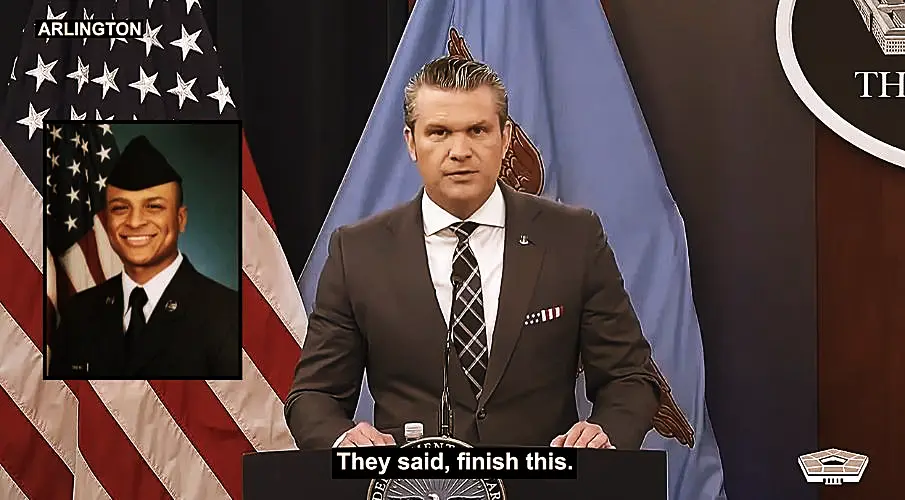
Pete Hegseth’s statement leaves no room for doubt. He stands at the podium and speaks of conversations with families of fallen soldiers. Tears, embraces, strength. And then this sentence, clear and without hesitation: they had all told him the same thing. “Finish this. Honor their sacrifice. Do not waver. Do not stop until the mission is done.” A sentence that is more than a description. It is a justification. A moral charge placed on a war that is already under pressure. If the parents of the dead are supposedly demanding that the fighting continue, then a political decision becomes duty. Then doubt grows quieter.
Only one of these fathers says: that is not what he said.
Charles Simmons loses his son Tyler H. Simmons, 28 years old, Staff Sergeant in the U.S. Air Force. He stands in Dover, sees the coffin, speaks with Hegseth, speaks with Donald Trump. And he contradicts. Calmly, clearly, without evasion. This conversation did not happen that way. No “finish this.” No call to continue the war. When asked directly, he says: no.

U.S. Air Force Tech. Sgt. Tyler H. Simmons. (U.S. Air Force)
What remains is an open contradiction between what is publicly stated and what was actually said. Simmons describes a different conversation. One that has nothing to do with slogans. He speaks about his son, about his path, about his plans. And he says a single sentence that marks the difference. He hopes that the decisions were necessary. Nothing more. No declaration. No political mandate. That uncertainty does not appear in Hegseth’s version.

Instead, a closed picture emerges. All families, the same message, the same will. But this picture begins to crack as soon as one looks more closely. Another observer who overheard conversations between Trump and other families also reports that he did not hear such a sentence. Eugene Vindman, himself a veteran, says openly that grieving relatives in that moment do not speak about military objectives. They try to understand what has happened. Investigations now show the same picture. No one had even remotely said this sentence to Hegseth.
And this is exactly where the decisive point lies.
From a room full of grief, a political message is invented. From individual conversations, a unified line is constructed. From uncertainty, determination is made. The sentence “finish this” sounds like a plea that is repeated again and again, even though at least three of those to whom it is attributed clearly reject it. At the same time, the war continues. The government speaks of success while the situation expands. The Strait of Hormuz is blocked, energy prices are rising. Joe Kent resigns and declares that there was no immediate threat. Pressure is increasing, the questions are multiplying.
And exactly at this moment, a sentence appears that makes everything easier.
If the families of the dead supposedly say to continue, then criticism becomes more difficult. Then the decision itself is no longer up for debate, but loyalty to the fallen. That is exactly what makes this sentence so powerful. And that is exactly why it is crucial whether it is true. It was not.
There is a certain kind of person. At some point, they decide that reality is a shadow. Correctable. Renamable. The Secretary of Defense who calls himself Secretary of War. He decided that himself. Trump decided it. Without Congress. Without the inconvenient detour through those institutions that were once created so that a single person would not decide alone what things are called. So still Secretary of Defense, because without Congress, no Secretary of War.
Grieving families. People who have lost the most that can be lost - and who now suddenly carry words they never spoke. Three families. At least. They contradict. One asks oneself: what kind of inner architecture is required to put words into the mouths of the grieving, to step up to the microphone and do so while wearing the face of a man to whom nothing is lacking?
No conscience. That would be too simple.
Conscience presupposes that one can still measure the distance between what one does and what one should do. That distance has not faded here. It has disappeared. Without a trace. As if it had never existed.
That is the real story. Not the lie - lies are old, history knows them by heart. The real news is the ease. The complete, carefree ease with which a man renames a war, takes words from the grieving and looks as if it were all just bookkeeping. Normally, the moral abyss hides. It has the decency to disguise itself. This one does not. This one stands openly there. With a microphone. And with the calm face of a man who has learned that no one will stop him - as long as he appears determined enough. He does. That is the worst part.
The images show that Hegseth said it. Simmons shows that it was not said that way. Between them lies an abyss greater than an inaccuracy. It is the moment in which it is decided whether words describe - or whether they create something that never existed.
Simmons remembers the last conversation with his son. One day before the deployment. “He told me how much he loves me.” That is the sentence that remains.
Everything else came later.
Updates – Kaizen News Brief
All current curated daily updates can be found in the Kaizen News Brief.
To the Kaizen News Brief In English


