
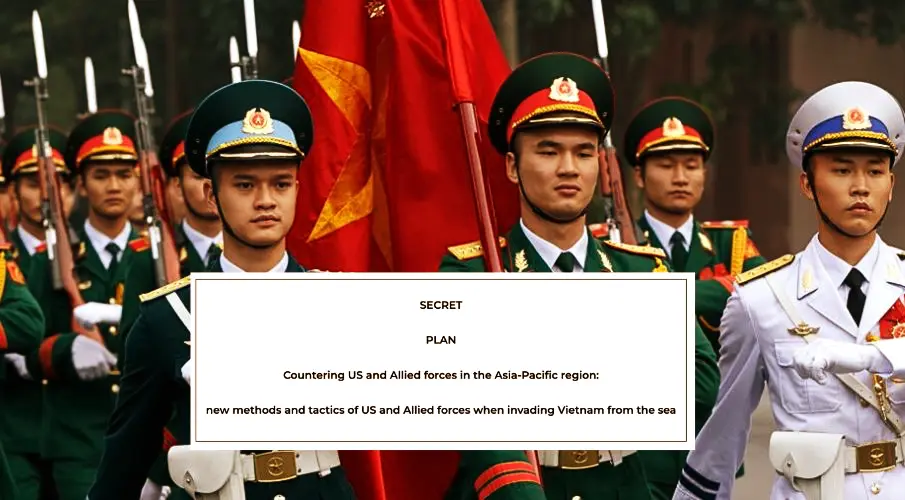
An internal document from Vietnam’s Ministry of Defense shows how deeply mistrust toward the United States still runs – even a year after relations were formally upgraded to the highest diplomatic level. In the paper, completed as early as the summer of 2024, the military prepares for a possible American course of action that is explicitly described as aggressive. Particularly striking is the fear of externally driven destabilization of the country, a so-called color revolution, as Vietnam has observed in other states. This fear runs through several internal analyses and is not presented as a fringe view, but as a broad consensus within party, government, and military.

The rapprochement with Washington, celebrated under Joe Biden as a strategic partnership, is read internally as a double game. On the one hand, Vietnam benefits economically and diplomatically; on the other, the United States is still suspected of aiming to force political and social change in order to gradually undermine the socialist system. It is notable that China is described in the papers as a rival, but not as an existential threat. Vietnamese hardliners see the greater danger precisely in Washington, also because of the long memory of the war and more recent experiences, such as cut aid programs to clean up the legacy of American warfare. Under the new party chief To Lam, Vietnam has expanded its contacts with the United States, including economically, even to prestigious projects with direct links to Trump’s family. At the same time, American military actions and the Trump administration’s handling of the sovereignty of other states have revived old fears.

September 10, 2023, Joe Biden in Hanoi on a state visit, when the United States and Vietnam officially upgraded their relations to a “Comprehensive Strategic Partnership”
While Vietnam publicly celebrated the fiftieth anniversary of national reunification, the military leadership worked in the background on a scenario that seems hardly imaginable in Western capitals. The plan, classified as “top secret,” by the Vietnamese Navy titled “The 2nd U.S. Invasion Plan” describes the United States not as a partner, but as an aggressive power that attacks states as soon as they move outside its geopolitical orbit. The document dates from August 2024, was drafted by the Ministry of Defense, signed by Vice Admiral Tran Thanh Nghiem, and certified by Rear Admiral Vu Van Nam.

From the very first pages, the plan makes clear how Hanoi perceives Washington. The United States is described as “belligerent,” as a power that systematically uses military force to sanction political deviation. While it states that there is currently “only a low risk of a war against Vietnam,” precisely because of the “warlike nature of the United States” one must remain vigilant to prevent the U.S. and its allies from “constructing a pretext to launch a war of aggression against our country.” It states verbatim that Washington could “exploit Vietnam’s geographic and natural conditions, especially its long coastlines and vast maritime areas, with the superior strength of its navy to conduct military operations against our country.”

The plan leaves no doubt that Hanoi does not view the U.S. Indo-Pacific strategy as a protective umbrella, but as a threat. Military planners reject any role for Vietnam in a containment strategy against China. Washington’s rhetoric of “freedom” and “democracy” is not understood in the document as values-based foreign policy, but as a tactical instrument to secure American dominance. The United States wants to use Vietnam as an “important link” in its strategy, while simultaneously enforcing its concepts of human rights, religion, and political order to gradually change the socialist system. If this fails, the conclusion goes, diplomatic, economic, and ultimately military means would be employed.
Particularly noteworthy is how openly the document addresses President Trump. He is not seen as a stabilizing factor, but as an actor who expands military power, fuels an arms race, and accelerates the export of American weapons technology. In the analysis of different U.S. administrations, a red thread is drawn: from the “Pivot to Asia” under Obama, through a more aggressive, market-oriented militarization under Trump, to a systematically expanded alliance structure under Biden that increasingly draws NATO states into the Asia-Pacific region.
The second part of the plan goes far beyond political assessments. It lists U.S. military capabilities in the region in detail, including bomber rotations with B-2 and B-52 aircraft, MQ-4C drones, missile deployments in the Philippines, carrier strike groups, nuclear submarines, destroyers, and amphibious landing units. More than sixty percent of U.S. naval forces are concentrated in the Pacific. Vietnam monitors every exercise, every troop movement, every new base. The seriousness of the situation becomes even clearer in the scenarios of a possible invasion. The document describes a phased naval blockade, massive air and missile strikes, over-the-horizon amphibious landings, the use of Tomahawk cruise missiles, JDAM precision bombs, drone swarms, cyber and electromagnetic warfare. In a sentence that has received little attention in Western discourse, it even states that the United States could, in the event of failure, deploy “biochemical or tactical nuclear weapons.”
These plans explain why Hanoi understands political control and repression not as an exception, but as a security doctrine. Additional internal documents reviewed by Project88 explicitly describe U.S. intelligence services as actors working toward the overthrow of the Communist Party of Vietnam. Terms such as “Color Revolution” and “Peaceful Evolution” run through the state’s security strategy. Fear of an externally fueled overthrow is not a fringe opinion, but government policy. In contrast, China is not described in the plan as an existential danger. Despite territorial conflicts in the South China Sea, Beijing is considered a rival, not a threat to the party’s hold on power. In the internal threat hierarchy, Washington ranks at the very top: as an actor that pursues both military aggression and regime change.
The “2nd U.S. Invasion Plan” thus destroys a central assumption of Western policy. Vietnam is not a “swing state” between Washington and Beijing. Hanoi is not balancing, but has made a strategic decision. Publicly, diplomatic courtesy is maintained; internally, preparations are made for the worst-case scenario. The documents show how wide the gap is between public rhetoric and security reality – and how much U.S. strategy itself contributes to legitimizing authoritarian isolation, militarization, and repression in Vietnam.
Updates – Kaizen News Brief
All current curated daily updates can be found in the Kaizen News Brief.
To the Kaizen News Brief In English


Ganz von der Hand zu weisen sind die Befürchtungen nicht.
Die USA unter Trump sind kein verlässlicher Partner.
Es ist eine Macht die mit Drohungen und Erpressung arbeitet und auch vor militärischer Intervention -ohne Auftrag vom Kongress oder der UN- nicht zurück schreckt.
Die USA sehen China als größte Gefahr.
Deswegen wollen sie ihre Präsenz im Indo Pazifik stärken.
Militärbasen in „befreundeten Staaten“ errichten.
So wie auf den Philippinen.
Gleichzeitig reduzieren sie ihre Präsenz in Süd Korea.
Aber realistisch gesehen hat sich die USA vom Vietnam Trauma bis heute nicht erholt.
Der angeblich schnelle Einsatz entwickelte sich zur Katastrophe. Für alle beteiligten.
Viele der Vietnam Veteranen sind Republikaner, häufig auch MAGA.
Aber ob sie das mittragen würden?
Das würde die PTBS von tausenden Vietnam Veteranen triggern.
Aber es stimmt.
Im Westen bimmt man das gar bicht wahr.
Ohne Dich Rainer, hätte ich davon nichts gewusst.
Wahrscheinlich ist Vietnam einfach zu „uninteressant und unwichtig“