
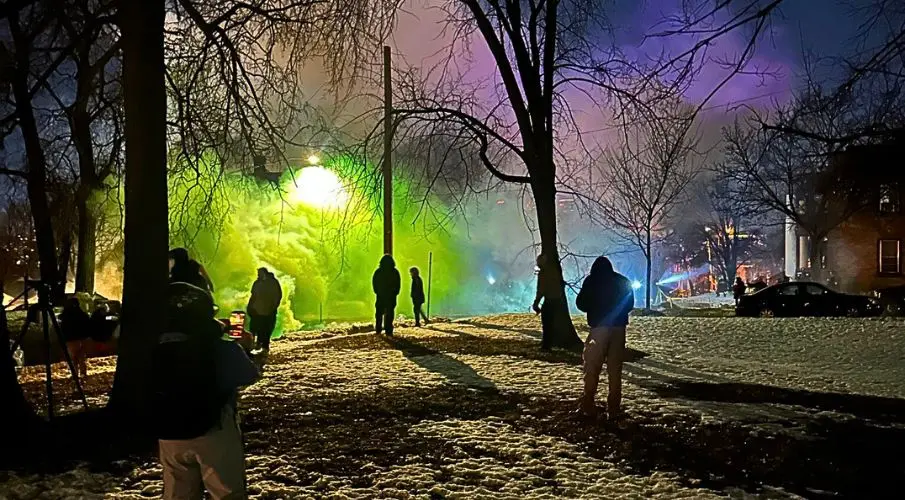
In Minneapolis, a substance appeared in recent days that initially left many people puzzled. Not the familiar white or gray clouds, but a dense, green-colored smoke that spread across streets and parks. Deployed by federal agents during operations against demonstrators, accompanied by a clear announcement: gas is being used. The color felt threatening, almost military. The question immediately arose whether something new, something more dangerous, was being deployed.
In fact, this is not a completely unknown substance, but smoke grenades produced by a U.S. manufacturer of police and military equipment. These grenades generate colored smoke primarily intended for marking or dispersal. In Minneapolis, they were used by units of Border Patrol and immigration authorities, repeatedly and deliberately, as footage and eyewitness accounts show. Particularly striking was their use by the regional Border Patrol chief, who announced on camera that gas would be deployed and shortly thereafter released the green smoke.
The smoke itself contains no secret substances, but it is anything but harmless. Its chemical composition includes compounds that are problematic from a toxicological perspective. These include potassium perchlorate, a substance that largely reacts during combustion but whose residues can still be relevant to health. In addition, there are traces of heavy metals such as lead and chromium. Both are considered toxic, can cause long-term damage with repeated exposure, and are suspected of causing cancer or impairing reproduction. The quantities in a single grenade are limited, but they are real and cannot be denied.

An interesting comparison can be made with the gas more commonly used during protests: classic tear gas. Experts who have studied the health effects of such agents for years point out that the green smoke grenade is not necessarily more toxic than conventional tear gas. In direct comparison, tear gas can even be more harmful, especially to the eyes, respiratory system, and skin. Nevertheless, it must be stated that the green smoke is also not a harmless mist, but a mixture that causes irritation and carries chemical risks.

There are no limits to color fascism - which color would the AfD prefer?
Color plays a particular role here. Green signals danger, poison, military force. This effect is intentional. The smoke does not only act on the body, but also on the mind. It creates fear, unrest, the feeling of being subjected to an especially aggressive measure. Experts speak of a strong psychological effect that can outweigh the actual chemical exposure. People retreat, panic, lose orientation, even before they fully understand what they are dealing with.
Also problematic is the lack of transparency. The manufacturers’ safety data sheets, which are supposed to provide information about risks and ingredients, are in some cases difficult to access or not available at all. Anyone who wants to know what exactly was inhaled has to search, retrieve archived documents, or rely on specialist knowledge. For people exposed to the smoke, there is no time for such questions in the moment itself.

The use of this green smoke thus fits into a broader pattern. It is not only about physical control, but about deterrence. About the visible display of state power. Even if the smoke is not more toxic than other agents, it remains a chemical control agent used against civilians. It contains substances that no one would willingly inhale. And it is deployed in residential areas, parks, and streets where not only demonstrators are present, but also residents, children, and bystanders. In the end, the color is secondary. What matters is that federal authorities in Minneapolis are using chemical irritants whose risks are known and whose effect is deliberately aimed at fear and displacement. The green smoke may appear at first glance to be a new level of escalation. In reality, it stands for something familiar: state violence, technically refined, visually charged, and politically intended.
Updates – Kaizen News Brief
All current curated daily updates can be found in the Kaizen News Brief.
To the Kaizen News Brief In English


Es stimmt, der grüne Rauch suggeriert Gefahr.
Man denkt sofort an hoch-toxische Substanzen.
Auch wenn das nicht zutrifft, bleibt eine reale Gefahr.
Für Demonstranten, für unbeteiligte Anwohner, für Kinder, für Kranke.
Der Rauch macht bicht an der Haustür halt.
Er zieht durch undichte Stellen. Er setzt sich auf Fensterrahmen, Türgriffe.
Er kontaminiert den Boden, da Tränengas und grüner Rauch exzessiv eingesetzt werden.
Was ist mit dem Urteil, dass Tränengas nicht so einfach eingesetzt werden darf?
War das nicht in Minnesota?
Oder doch Illinois.
Man kommt schon ganz durcheinander.
Falls es nicht Minnesota war, laufen da Klagen gegen den exzessiven Einsatz?
Es geht nur noch um Machtdemonstration.
Illegale Migranten sind nur die passende Ausrede.
So hält Man die MAGA bei der Stange, die das Alles frenetisch bejubeln.
Das war Illinois, aber es laufen klagen dagegen