
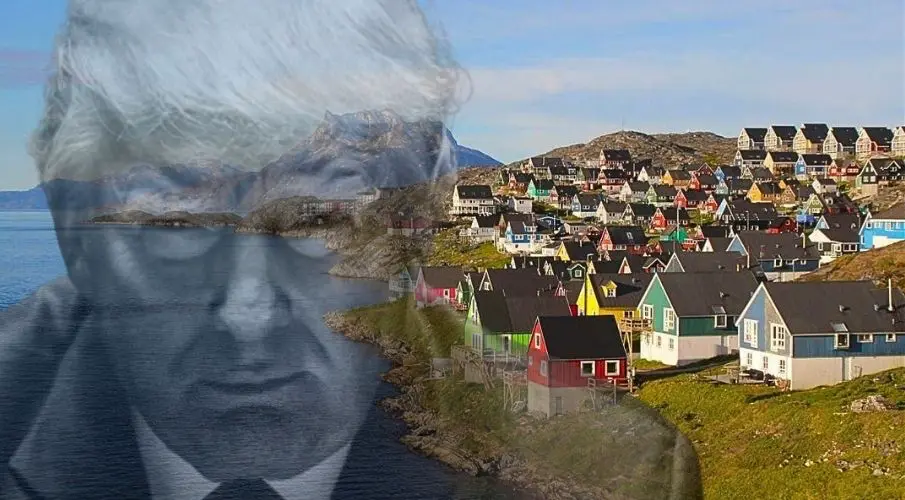
The meeting in the orbit of the White House was meant to calm the heated situation, but in the end it mainly brought clarity about the front lines. After talks with Vice President J.D. Vance and Secretary of State Marco Rubio, Denmark’s Foreign Minister Lars Løkke Rasmussen made clear that a fundamental disagreement with President Donald Trump remains. Washington is sticking to its demand for full U.S. control over Greenland, Copenhagen rejects it. The positions had not moved closer, Rasmussen said openly. Trump continues to claim that the island should be “taken over” and considers anything less insufficient.
Danish and Greenlandic government representatives met at the White House to speak with J.D. Vance and Secretary of State Marco Rubio about the future of Greenland, one really has to take this in. The background to the meeting are repeated threats by DT to take control of the territory.
In order to avoid immediate escalation, both sides agreed to establish a joint working group. It is to meet in the coming weeks and examine whether there is room for maneuver without crossing Denmark’s red lines. Whether this will become more than a diplomatic window of time is unclear. For Denmark, a sale or renunciation is out of the question. The island is largely self-governing, has around 56,000 residents, and continues to be supported economically and in security terms by Copenhagen.
Parallel to the talks, the military situation intensified. Several NATO states announced that they would send troops to Greenland. Germany is sending 13 reconnaissance soldiers for a multi-day mission, Sweden and Norway are also participating. The deployments are taking place at Denmark’s request and are part of a Danish-led exercise intended to demonstrate the region’s defensive capability. The aim is to show presence and underscore that security can be ensured without a change of ownership. We are currently considering traveling to Greenland for a few days in order to gain a much clearer picture on the ground. Whether this happens is still open and depends on several factors.

The United States needs Greenland for reasons of national security. It is of decisive importance for the Golden Shield we are building. NATO should take the lead in this so that we get it. IF WE DO NOT DO IT, RUSSIA OR CHINA WILL DO IT, AND THAT WILL NOT HAPPEN! Militarily, NATO would not be an effective force or deterrent without the enormous power of the United States, much of which was built during my first term and which I am now bringing to a new, even higher level - not even close! They know it, and I know it too. NATO becomes much stronger and more effective when Greenland is in the hands of the UNITED STATES.
Anything less than that is unacceptable. Thank you for your attention to this matter! President DJT
There is no real security policy compulsion to “own” Greenland. The United States has had contractually secured military rights in Greenland for decades, including bases as well as overflight and stationing rights. For deterrence, early warning, or missile defense, there is therefore no instrument missing that could only be achieved through sovereignty.
The claim that Russia or China would “take over” Greenland is fear rhetoric. Greenland is part of the Kingdom of Denmark, Denmark is a NATO member, and any military seizure by a third state would be a collective defense case. On the ground, there are no signs of such a “takeover”: the Greenlandic reality is not shaped by Russian or Chinese fleets that “appear” there and create facts. This picture does not exist.
The role of NATO is also misrepresented. NATO is not an instrument of ownership, but a defensive alliance of sovereign states. It does not carry out territorial takeovers and cannot do so legally. The idea that the alliance should help to “get” foreign territory contradicts its basic principle.
The reference to a “Golden Shield” remains politically undefined. There is no known, decided, or funded system that necessarily requires Greenland. That is nonsense, not a program.
Trump himself remained unmoved. He publicly declared that the United States needed Greenland for reasons of national security and again did not rule out the use of military means. He argued that Denmark could not adequately protect the island and referred to alleged ambitions of Russia and China. Denmark firmly rejected this. American ownership was “absolutely not necessary” for that, Rasmussen said. Greenland’s Foreign Minister Vivian Motzfeldt also made clear that cooperation is welcome, but claims of ownership are not.
Trump on Greenland: “Whether they like it or not … If we do not do it the easy way, we will do it the hard way.”
It is striking that Trump’s courting of Greenland’s population has had little effect. Economic promises from Washington have so far not generated broad support. Instead, concern is growing in Europe that the president is willing to override long-standing alliance principles. The idea that a NATO member could openly demand the takeover of another’s territory shakes trust within the alliance.
While diplomats try to lower the “temperature” and U.S. generals try to talk Trump out of his completely absurd intention, Europe is sending a different signal: Greenland is not up for negotiation, but part of a shared security order. The working group may enable talks, but the reality is different. As long as Washington insists on ownership and Copenhagen insists on sovereignty, the conflict remains unresolved - and the military presence on the icy island becomes the visible response to political demands that go far beyond any previous routine.
Updates – Kaizen News Brief
All current curated daily updates can be found in the Kaizen News Brief.
To the Kaizen News Brief In English


Diese Arbeitsgruppe ist eine lächerliche Farce.
Europa will Diplomatie und Diskussion auf Augenhöhe.
So tickt Trump nicht.
Für ihn ist die Arbeitsgruppe nurmehr eine Delegation, die seinen Deal verhandelt.
Wie Putin.
Maximalforderungen.
Europa eiert rum.
Hält den diplomatischen Weg für den einzigen.
Hat immer noch keiner gemerkt, dass Diplomatie bei Trump nichts, rein gar nichts bringt?
Er versteht, wie Putin, nur Stärke und Ansagen.
Kein diplomatisches Rumgeeiere.