
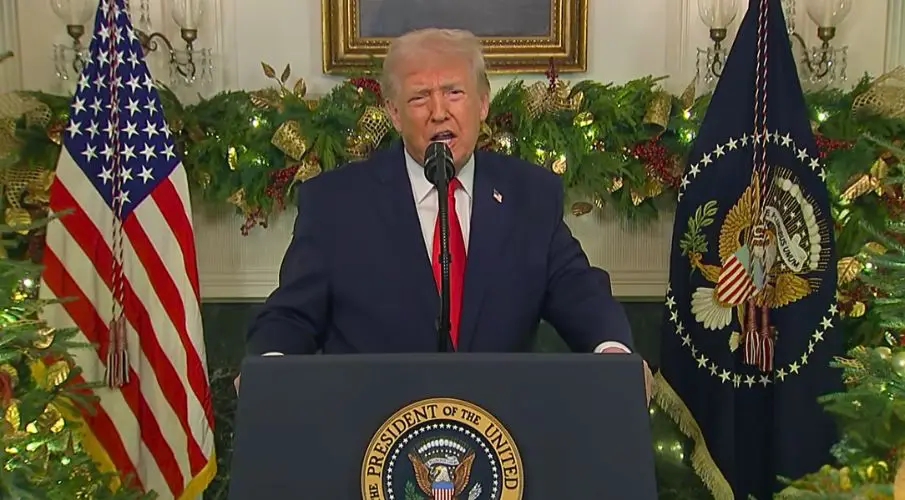
Donald Trump addressed the nation from the White House on Wednesday evening. On paper it was a speech to the nation. In its effect it was closer to a televised rally: fast, aggressive, full of self-praise, with long passages attacking Democrats and his predecessor Joe Biden. Trump described a country on the upswing and a population finally being relieved. Many Americans have long been saying the opposite, and the verifiable numbers contradict key claims.
“When the world looks at us next year, let them see a nation that is loyal to its citizens, faithful to its workers, secure in its identity, convinced of its destiny – and the envy of the entire world. We will be respected again, the way we once were.” (What exactly does he dream about at night? – Editorial note)

Trump presented the economic situation as a success story, but it was precisely there that he slid into statements that do not hold up. On gasoline prices he claimed a nationwide average of 2.50 dollars per gallon and even spoke of 1.99 dollars in some states. We are still looking. In fact, the national average this week was around 2.90 dollars, and no state averaged below 1.99. On energy he also threw out a number that sounds like it came from an AfD campaign office: households would be paying 3,000 dollars less in energy costs. He offered no evidence. At the same time he promised to open 1,600 new power plants within twelve months, an announcement that sounds more like confusion than a plan. Anyone familiar with power plant projects knows: permits, grid connections, construction timelines, skilled labor, materials – none of that disappears just because a president claims it does.
“I am proud to announce that more than 1,450,000 members of the armed forces will receive a special so-called Warrior Dividend. We are sending every soldier 1,776 dollars. And the checks are already on the way. Nobody understood that until 30 minutes ago.”
Then came the cash giveaway: checks for 1,776 dollars to more than 1.4 million soldiers before Christmas, which he called a Warrior Dividend. Trump suggested this would be made possible by tariff revenues. That is exactly where the show collides with constitutional reality: tariff revenues are not the president’s private cash register. Spending decisions are made by Congress. And even if one looks at the revenue side, the contradiction remains: Trump speaks of using tariff revenues simultaneously for checks, tax cuts, relief and compensation payments, in other words planning the same money multiple times. This fairy tale falls apart precisely in the details he left out of the speech. Yes, tariffs do bring in money. U.S. Customs authorities reported estimated revenues of more than 200 billion dollars in tariffs for the period from January 20 to December 15, significantly more than before. But Trump sells revenue as prosperity while many consumers feel the flip side through higher prices. Farmers alone have had to absorb losses of 44 billion.
His big numbers also appeared when he talked about investments, and there too the foundation wobbles. Trump claimed “18 trillion” in secured investments. The classification is simple: this figure is far above what even his own circle has previously added up, includes expressions of intent, old announcements and in part promises from abroad that seem hardly realistic in their scale. It is the familiar technique: say it big, document it small, move on before anyone asks.
400, 500, 600 🤣🤣🤣
On the labor market, reality also did not match the staging. Trump spoke as if the country were long past the worst. At the same time, the latest official data show that the unemployment rate rose in November to 4.6 percent, often rounded to 4.7, the highest level since 2021. And job growth has recently been thin. Other claims from the speech also collapse under basic plausibility checks. Trump once again bragged about alleged drug price reductions of 400, 500 or 600 percent. A reduction of 100 percent would already mean zero dollars. Anything beyond that is no longer exaggeration but mathematical nonsense. He also claimed that the Thanksgiving turkey was 33 percent cheaper, while reliable estimates point to far smaller declines and wholesale prices in some areas even rose. And he spoke of a return of industry in “record numbers,” even though spending on factory construction declined again after a previous peak.
“Look at MINNESOTA, where Somalis have taken over the economic structures of the state and have stolen billions and billions of dollars from Minnesota and, indeed, from the United States of America. We’re going to put an END to it!”
(Statements like these could also become reality in Germany if a great many media outlets do not fundamentally rethink their role, because investigative journalism in Germany has been hollowed out, defunded, and starved of resources. Harsh—but it is the reality.)
He openly pulled the political trick of his speech: tying the economy to migration. He said, in essence, that deportations would bring “more housing and more jobs for Americans.” That is what a scapegoat offer sounds like, reducing a complex problem to a single opponent. In the same breath he presented his deportation policy as crime fighting, even though independent analyses show that more than 75 percent of those affected have no prior criminal record. And while he promised “affordability,” he failed to provide concrete answers as to how rents would fall, health care costs would fall or everyday prices would fall. He merely announced that he would present “very aggressive” housing reforms next year, without naming a single detail. He probably does not know himself yet.
“We had men playing in women’s sports. Transgender for everybody.”
Then came the culture war, as if it were a mandatory part of every speech. Trump said: “We had men playing in women’s sports. Transgender for everybody.” That is not analysis, it is a provocation. He relies on outrage, not clarification, and he knows exactly that these sentences shift the debate away from numbers and toward reflexes. And something else was conspicuously missing: Trump mentioned Iran and Gaza and repeated his claim that he has ended eight wars since taking office. What barely appeared, by contrast, was the military escalation closer to “home”: according to publicly revealed information, the U.S. government has killed almost 100 people in operations against boats off the coast of Latin America. At the same time Trump threatens a naval blockade of Venezuelan oil exports, openly speaks about the goal of obtaining Venezuelan crude oil and floats the prospect of land attacks. In this speech, that appeared, if at all, only at the margins.
Why does he do it this way? Because the pressure is there. Approval is eroding, especially among those who are not party loyalists. In a recent poll, 57 percent reject Trump’s economic course, only 36 percent approve. His overall approval stands at 38 percent. And around 70 percent say that life in their area is not affordable. In the end, the core signal of the speech was not a plan but a tone: irritated, rushed, on the attack. Trump wanted to create the impression that everything will get better if people just keep waiting. At the same time he had to drown out reality because it is politically overrunning him right now. The facts that can be checked tell a different story than his daydreams. And that is precisely why, after this speech, the question presses itself that many in the country are no longer asking only quietly: does he actually believe this himself?
Updates – Kaizen News Brief
All current curated daily updates can be found in the Kaizen News Brief.
To the Kaizen News Brief In English


Die Frage ist nicht, ob Trump selber glaubt, was er sagt (ich behaupte, er versteht selber nicht, was er sagt. Trump hat den Verstand eines Vierjährigen, dem jegliches Wissen oder jegliche Kompetenz fehlt).Die Frage ist doch, weshalb immer noch ein beachtlicher Teil der amerikanischen Bevölkerung glaubt, was er sagt. Bereits in seiner ersten Amtszeit machte er gemäss dem «Fact Checker» der Washington Post 30’573 falsche oder irreführende Aussagen. Hat es ihm geschadet? Nein er wurde nochmals gewählt. Und er lügt munter weiter. Die Aufklärung all seiner Lügen ist zwar löblich, doch sie führt letztlich ins Leere. Weder seine Anhänger noch am wenigsten er selber sind zur Einsicht fähig noch willig. Noch auf dem Sterbebett wird Trump der Überzeugung sein, dass er der beste Präsident aller Zeiten gewesen sei. Ganz einfach, weil er hochgradig psychisch krank ist (wäre er nicht Präsident, würde er vermutlich in einer psychiatrischen Anstalt leben – ohne Aussicht auf Heilung).Heinz Rudolf Kunze sang in seinem Lied «Angst» von 1983 «Wie krank muss der sein, der sich heute für normal hält?». Trump und seine Anhänger halten sich alle für komplett normal.
Hi, da liegst du etwas falsch. Es geht hier nicht um löblich, sondern um Standkraft und normal und nur unsere Arbeit verhalf über 700 Leute in Freiheit zurückzukommen, und viele tolle menschen und ngos machen das, also ist die zahl der menschen die freikommen gewaltig – Gerichtsverfahren einfacher durchzubekommen, weil die Gerichte, ausser der supreme, die augen nach oben rollen beim namen trump. man gewinnt mittlerweile über 80% der Gerichtsfälle, und auch der supreme kann nicht mehr lange seine trumplinie durchziehen. man hat die maga die sich zwischen 30-38 % noch bewegt, ja die glauben es noch, aber auch da schwindet der Glaube. die erst amtszeit ist mit der zweiten nicht vergleichbar, da sorgte trump erst, das zB die drogen leicht in die usa kamen, jetzt führt er kriege deswegen, und was er mit ICE durchzieht hat jeglichen Rahmen von vorstellung gesprengt. die usa ist ein grosses land, deutschland zB ist so gross wie der Bundesstaat Montana, keine Zeitzonen usw… Es isr viel passiert nur wird es anders gemacht, und es braucht seine zeit, die rede hat ihm mehr als nur geschadet, und daher muss man dokumentieren und handeln
Ich habe irgendwie das Gefühl, dass ihm eingeredet wird, dass er alles richtig macht. Anders kann ich mir solche Aussagen nicht mehr erklären. Die Menschen in Amerika spüren doch am eigenen Leib, dass das, was Trump da redet, nicht der Realität entspricht. Noch drei Jahre Trump, hält dieses Land doch gar nicht aus…
da hast du einen wichtigen punkt angesprochen, die beten ihn an, weil dadurch die „anbeter“ auch macht bekommen, und die glauben auch noch daran, sekte
Warum muss ich unwillkürlich an die Reden von Sektenführern, wie Scientology, denken?
„Er, der unfehlbare und geniale Trump.
Nur er hat es geschafft die USA in eine großartige Zukunft zu führen.
Die USA wieder zum respektiertesten Land der Welt zu machen“
Ob er es glaubt, ist egal.
Wichtig ist, dass seine MAGA es glauben.
Und sie glauben ihm.
Halten ihn für den besten Präsidenten aller Zeiten.
Keinerlei Kritik, kein Hinterfragen.
Und Jeder weiß, wie Sekten ihre Macht mit Gehirnwäsche (Fox News etc) erhalten.
Wer kritisiert ist nicht mehr würdig, wird ausgeschlossen.
MAGA ist da genau so rigoros, wie andere Sekten.
Nur, wie stoppen?
Last sich der MAGA Kult auf, wenn Trump weg ist?
Ist die Demokratie dann schon aysgehölt, dass es egal ist?