
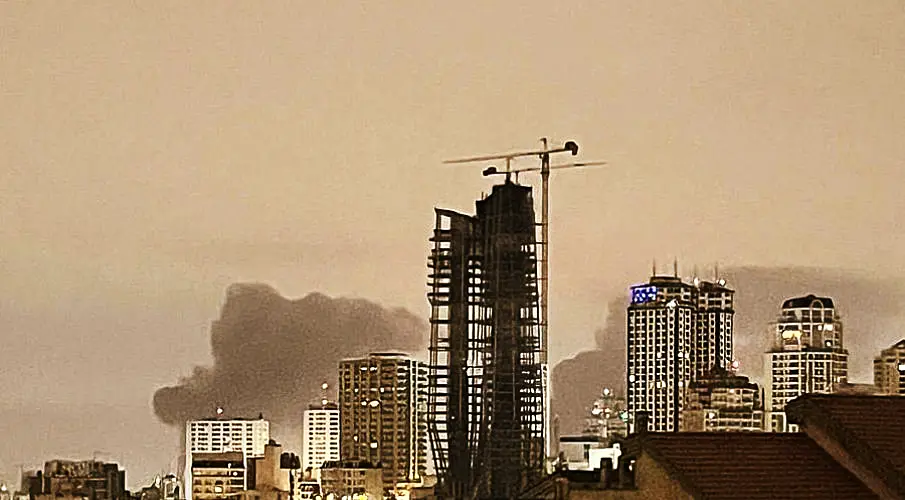
Tehran - More than two weeks of airstrikes. Thousands of targets destroyed. Senior military leaders and intelligence chiefs killed, even the top of the state eliminated. The system in Tehran is still standing. Weakened, yes. But stable. And harder than before.
That was not the expectation. But it is what remains.
U.S. intelligence assessments come to a clear conclusion. A collapse of the leadership is not to be expected in the short term. Really? For this kind of analysis, you just have to turn around once on the street here. Instead, power is consolidating more tightly on the inside. The Revolutionary Guards, who have for years overseen the military, the economy and the security apparatus, are taking even greater control. What remains is managed more tightly, more closed, more uncompromising.
Donald Trump was informed before the attacks began. That a military strike would not overthrow the leadership. That the Revolutionary Guards could instead become more entrenched. The decision was made anyway.
You have to leave it exactly as it is.
The price is high. At least twelve billion dollars on the American side, thirteen dead U.S. soldiers. Iran has lost central parts of its missile capabilities and its navy. But these losses have not loosened the system. They have hardened it.
The Strait of Hormuz - a space that is not open to everyone
Iran has not simply closed the Strait of Hormuz. Tehran allows passage - but not for everyone. States that are not considered direct adversaries get through. The United States and Israel do not. The sea route is no longer an open space, but a filtered corridor. Whoever sails does so under conditions set by Iran. Not standstill determines the situation, but selection. Iran decides who is allowed to trade and who is not. The global markets feel it anyway - uncertainty, rising prices, disrupted supply chains. The control is visibly coming from Tehran.
Qatar, Saudi Arabia, the United Arab Emirates, Bahrain and Kuwait have become targets of Iranian counterattacks. Missiles, drones, targeted strikes. Anger dominates in the capitals. A senior official from the region put it bluntly: this war was started, but others are bearing the consequences. That is a judgment. Instead of a short operation, a conflict is developing that drags on. Iran is not responding with a single blow, but with endurance. Targets are expanded, pressure is spread. At the same time Washington is trying to increase international pressure. Diplomats are expected worldwide to push for the Revolutionary Guards and Hezbollah to be designated as terrorist organizations. The political line remains contradictory. At times there is open talk of toppling the system, at others the focus is on weakening military capabilities. Israel’s government has also adjusted its goals - away from complete overthrow, toward weakening.
No one knows anymore what the end is supposed to be.
What happens inside while war is fought outside
The losers of this war are not the decision makers. That is known. It is the population. Surveillance has been massively expanded. Communication is restricted, access is cut, digital spaces are tightened. Anyone trying to get information out is working against a system designed to prevent exactly that. Internet access is no longer something taken for granted. It becomes a risk.

Satellite terminals are one of the few ways to bypass this control. That is exactly why they are in focus. Devices are brought into the country in parts, distributed, hidden. Using them means danger. Those who stand out disappear from public life. That is the reality behind the front lines. Not the rockets. This.
Mojtaba Khamenei, successor to his killed father Ali Khamenei, is not acting as a dominant sole decision maker. He is moving closer to the Revolutionary Guards. Power is being redistributed, but it remains within the same system. Those who carry weapons remain on the same side.

What the two of them might be thinking about all of this. Two cats looking out of an improvised window - and probably understanding more than many people. - Good morning from Tehran
In Tehran, people are taking to the streets. Supporters of the system show strength, speak of resistance, of endurance. At the same time there are voices hoping that this war could mark the end of the existing order. Both sides exist side by side, on the same streets, in the same city. The hope for an internal uprising remains unfulfilled so far. Protests could return - triggered by energy crises, water shortages, economic pressure. But the security forces have already shown how quickly and decisively such movements are stopped.
In the end, one finding remains, one that no one likes to talk about. Neither in Washington nor in Tel Aviv. The leadership has been hit, but it has not fallen. The structures have not dissolved, they have hardened. The war has changed the system. But it has not eliminated it. That is the story.
Updates – Kaizen News Brief
All current curated daily updates can be found in the Kaizen News Brief.
To the Kaizen News Brief In English


