
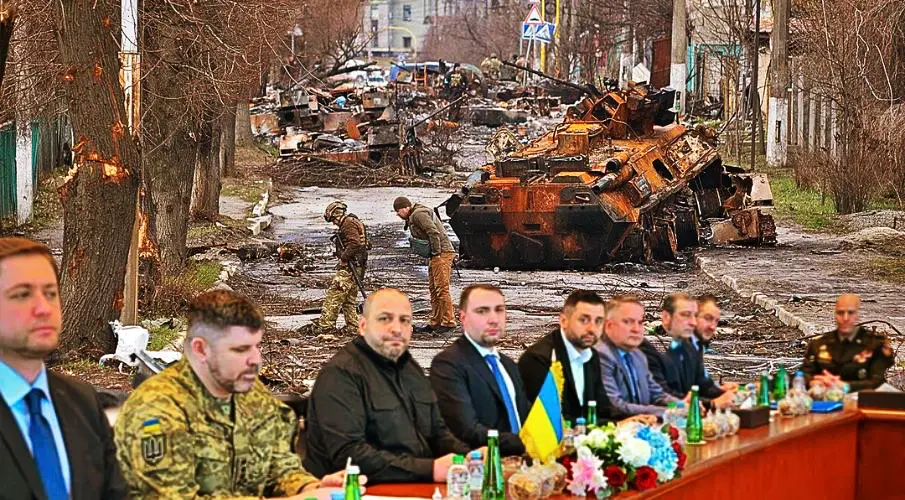
In Abu Dhabi, representatives of Russia and Ukraine have once again sat down at the same table, accompanied by the United States, while at the same time people in Ukraine were being buried under rubble, power plants were burning, and markets were turning into death traps. Two days of talks are scheduled, moderated by Washington, but the very first day of negotiations was already overshadowed by massive Russian attacks that put any hope for rapid progress into perspective.

The first day of the second round of Ukrainian-Russian peace talks under U.S. mediation has come to an end in Abu Dhabi. Nothing was publicly disclosed about any progress achieved or the lack thereof. On the following day, working groups are to continue their discussions at the same location. The question also arises to what extent these talks still make sense or whether they rather serve Putin as a means to gain time. For us personally, these talks have reached the end of reason.

Delegations from Moscow and Kyiv took part in the talks, supported by U.S. special envoys and high-ranking political emissaries from the White House environment. From the Ukrainian perspective, the talks were described as serious and factual, with a focus on concrete steps and implementable solutions.

At the same time, it remained unclear how much substance actually lies behind these formulations while the war continues unabated. Even as the talks were underway, Russian attacks struck civilian targets. In eastern Ukraine, several people were killed and others injured in a cluster munition attack on a market. In other regions, civilians died in residential areas, including elderly people whose homes were hit. The port city of Odesa was also attacked again, residential buildings were damaged, and people were rescued from the rubble. These attacks did not occur on the margins of the talks, but at their very center.

Unfortunately, this is not the first time Russia has acted in this way, and the world has meanwhile become so accustomed and numbed to it that such acts barely register as news anymore.
Particularly grave is the continued destruction of Ukraine’s energy infrastructure. During one of the coldest winter phases in years, power plants were attacked with missiles and drones, including facilities that supply hundreds of thousands of people with heat. In Kyiv, hundreds of repair teams worked around the clock while tens of thousands of apartments remained without heating. Energy sector workers are described as exhausted, replacements had to be organized while new attacks loomed.

Russia fired approximately 350 to 500 drones as well as around 65 missiles at Ukraine during the night. Europe must move from passive observation to active action. It is long overdue to leave behind the role of mere spectators. Sanctions must not only be imposed or announced – they must be consistently implemented and effectively monitored. We report repeatedly on how fragile, incomplete, and in part unprofessional these sanction mechanisms are being overseen.
This escalation stands in striking contrast to the diplomatic signals of recent weeks. Not long ago, there had been talk of a temporary suspension of attacks on the power grid. The interpretation of this pledge, however, remained vague. While Washington stated that Moscow had adhered to a brief pause, the Ukrainian side pointed out that new attacks had resumed after only a few days. The impression solidified that agreements were being interpreted differently or used tactically.
A simple question is followed by a remarkable shift. A journalist reminded Trump that he had announced a halt to Russian attacks during the cold spell. On that same night, Ukrainian cities were again massively attacked. Trump’s response: it had been from Sunday to Sunday. Russia had struck hard during the night but kept its word. Thus, an attack becomes not a breach, but a matter of interpretation.
From Moscow, there were hardly any public statements about the talks. Officially, it was said that the doors to a peaceful solution remained open. At the same time, the Kremlin made it unmistakably clear that military operations would continue as long as Ukraine did not agree to central demands. These continue to include the cession of territories beyond the regions already occupied. For Kyiv, this remains unacceptable. The talks also take place during a phase of strategic uncertainty, as a key nuclear arms control agreement between Russia and the United States is expiring in parallel. Whether it will be extended, renegotiated, or allowed to lapse without replacement remains open. Thus, hovering over the meetings in Abu Dhabi is not only the conventional war, but also the question of a new nuclear arms buildup.

International observers see no coincidence in the recent attacks, but rather part of a negotiation strategy. The destruction of energy supplies in winter hits the civilian population particularly hard and increases pressure on political leadership. At the same time, it allows Moscow to present short-term restraint as a concession while simultaneously building up military capacities for larger waves of attacks. Skepticism is also growing on the Ukrainian side. The hope of quickly gaining clarity in Abu Dhabi about Russia’s true intentions is mixed with the experience of recent months. Talks are held while missiles strike. Commitments are formulated while drones take off. Diplomacy and violence run in parallel, without slowing each other down.

Your help is indispensable: the search dogs looking for survivors while peace is being negotiated in Abu Dhabi – a peace that fails the test of reality and Putin.
Thus, Abu Dhabi remains a place of talks, not of relaxation. Two days are scheduled, but it is already clear that the central questions remain unresolved: the future of the occupied territories, binding security guarantees for Ukraine, and the question of whether negotiations can be more than background noise to a war that continues with full force. In Ukraine, meanwhile, every night in which the lights go out counts, and every morning in which rubble has to be cleared – regardless of what is said at the conference tables of the Emirates.
Updates – Kaizen News Brief
All current curated daily updates can be found in the Kaizen News Brief.
To the Kaizen News Brief In English


Wie kann man unter diesen Imständen überhaupt „Friedensverhandlungen“ führen.
Frieden setzt zuerst einen Waffenstillstand voraus.
Das lief selbst (mehr oder weniger) in Gaza so.
Aber Russland zeigt absolut keinen Friedenswillen.
Russland wird ausschließlich eine quasi komplette Kapitulation akzeptieren. Alles zu ihren Bedingungen.
Dass Putin kein Interesse hat sich diesbezüglich mit Europa zu unterhalten, hat er mehr wie deutlich gemacht.
Was verspricht sich Europa also von ihrem Stufenplan?
Das ist nichts weiter als Selbstberuhigung ohne Substanz.
Anstatt die Ukraine endlich adäquat zu unterstützen, Blick man auf Abu Dhabi.
Dabei dürfte selbst dem Naivesten klar sein, dass da kein Frieden bei rum kommt.
Putin droht hier, street da Krumen „der Hoffnung und Gesprächsbereitschaft“ und Europa wartet… wartet… wartet.
Seit Jahren fallen sie immer auf Putins „Angebote“ rein, denken, dass die Diplomatie es richten wird.
Hat bei Hitler schon nicht funktioniert.
Wird es bei Putin auch niemals.
Aber das wird ausgeblendet.
… ganz ehrlich, diese ganzen gespräche kannst du dir schekne und sanktionen müssen umgesetzt werden, aber nicht so, dass wir täglich über neue umgehungen berichten könnten, wenn wir dazu lust haben