
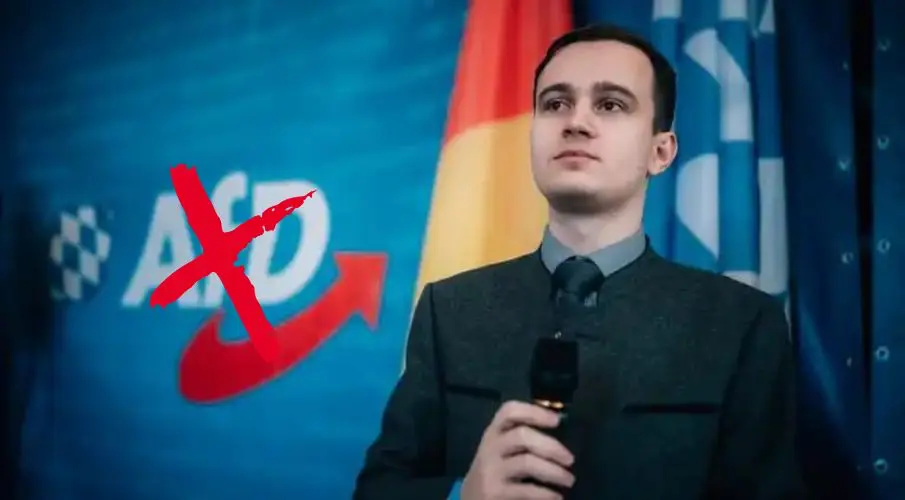
Monday evening in Bautzen. Once again, hundreds of people move through the streets, celebrating themselves as resistance, as a freedom movement, as peacemakers, as alleged heirs of a suppressed history. “Free Saxony” echoes back to itself, flanked by AfD comrades, Christian Abel also AfD completely losing his head in the brown frenzy, fueled by Telegram slogans, stupid placards reading “Our country first.” Anyone who listens closely here quickly realizes: the word freedom is being used, but not understood. Especially not when it collides with their own history. Because in Saxony, as in the entire German Democratic Republic, demonstrating for decades was not a basic right, but a risk. The constitutions of 1968 and 1974 promised freedom of expression and assembly only on paper. In reality, this right applied exclusively as long as it served the goals of the socialist order. Criticism of the state, the party, economic conditions, or political decisions was excluded. Anyone who objected automatically positioned themselves against the power of the SED.
Public assemblies had to be approved. Approval was granted only if they were state organized or clearly loyal: May Day demonstrations, FDJ marches, ritualized mass stagings. Any unapproved gathering with political content was considered hostile. Just a few people with banners could be classified as a political action. Violence was not required. Opinion was enough. Legally, almost every protest inevitably moved into the realm of a criminal offense. Central was Section 106 of the Criminal Code of the GDR, the so called anti state agitation. It criminalized any public criticism of the state order. Leaflets, chants, short speeches were sufficient. The penalty ranged up to five years in prison. In Saxony, this paragraph was applied regularly.
Added to this was Section 220, public disparagement. It was set even lower. Not even open system criticism was required. Irony, mockery, insinuations could be enough to attract attention. Especially at smaller protests, vigils, or church actions, this paragraph was frequently used. Anyone who publicly said something that could be interpreted as disrespectful toward the party, police, or state organizations risked charges. For demonstrations themselves, Section 214 was decisive, the so called unlawful assembly. Participation in a gathering allegedly endangering public order was already punishable. Violence played no role. Mere joint presence in public space was sufficient. This paragraph was systematically used in Saxony to break up protests and arrest participants, especially in Leipzig, Dresden, and Karl Marx City.
In addition, Section 219 came into play, unlawful contact. Anyone who had contact with Western media, passed on information, or informed foreign journalists committed an offense. Many Saxon activists were confronted with this accusation after demonstrations, even when the actual action had long ended. Above all of this stood the practice of the People’s Police and the State Security. Arrests without warrants, hours or days of detention, intimidation interrogations, pressure on employers, school expulsions, travel restrictions, threats of forced departure. Much happened below the level of court proceedings, but was existential for those affected. A protest meant a file, a note, surveillance. Freedom had consequences.
Regionally, the severity varied, not the principle. Leipzig was already a center of oppositional activity before 1989, so assemblies around churches were pursued particularly strictly. Dresden was considered a high risk area due to its proximity to the border and political sensitivity, many detainees ended up in the remand prison on Bautzner Street. In Karl Marx City, every protest had special symbolic power because it struck at the self image of the workers’ and peasants’ state. In the end, the record is clear: demonstrating in the GDR, including and especially in Saxony, was in practice a criminal offense. Not every participation ended in prison, but every one was a security operation, a risk to freedom, career, and social existence. The legal foundations were clearly named: Sections 106, 214, 220, and 219 of the GDR Criminal Code, supplemented by a practice that systematically suppressed freedom of expression.
Against this backdrop, today’s chants of a “free Saxony” sound hollow and downright ridiculous. Anyone who can demonstrate on Mondays without interference, be filmed by cameras, and be courted by anti-democratic politicians like the AfD figure Abel is not living under oppression. They are living in a country that guarantees precisely the freedoms that were missing back then. Anyone who seriously equates the two situations, or even turns them on their head, is instrumentalizing history. And above all, it shows one thing: they have learned absolutely nothing.
One well meant tip:
Why don’t you move to America. There, freedom of speech is famously upheld so highly that the best way to experience it is straight in the custody of Immigration and Customs Enforcement. If questions arise, please do not contact us, do not pass Go, no conversation, no legal counsel. Straight into ICE detention. There you can admire the flowers of freedom up close. Bars, neon light, concrete. That is what it feels like, see our investigative research with partially hidden camera, when people are stripped of their rights - completely legal, completely orderly, completely in the name of your values.
But if you believe there are not even more walking around freely, then let us turn to Strauf, Helmut Strauf, or when a political pro shares his many years of experience with all of us … …

It is a historic moment in German journalism. The Deutschland Kurier, that media platform which has perfected the quality level somewhere between a right wing parking lot leaflet and a beer coaster note, proudly presents: Helmut Strauf, 20 years old, federal board member of Generation Germany. A boy with the life experience of a hundred years. At least. Maybe even one hundred and twenty if you count the Playstation hours. Helmut sits in the studio. The shirt ironed. The hairstyle parted so precisely that even the Führer from the afterlife would send a WhatsApp voice message: “Bro, respect, but maybe a bit less pomade, yeah?” The look determined. The eyes empty. But hey, main thing is determined.
“Germany is at war, ready for battle,” Helmut proclaims with the authority of a man who has definitely already raised three children. Probably in Sims 4. “We must defend our country!” The interviewer’s eyes widen. Enthusiastic. Moved. As if Helmut had just solved the riddle of dark matter, as if he himself were surprised that sounds were still coming ou
Helmut belongs to Generation Germany, confidently baptized, stylishly packaged, content wise empty like a deposit bottle after return. “The fight for our country” is their motto. Just last week Helmut was still fighting with mommy for a longer curfew. Lost. But now? Now he wants to do big politics. Every morning he stands in front of the mirror. Practice makes perfect. “Blablabla… remigration… blablabla… our culture…” Nod. Hand gesture. Nod again. Perfect. Carry on.
“And very important,” Helmut says, as if he had just discovered the secret of Trump’s ballroom, “young people want community!” Yes. Nothing wrong with that. Absolutely nothing. “But they want the same language, the same culture, a shared heritage!” Huh? Wait a second. When I was young, I just wanted to kick the ball into the goal. Ali and Sandy were there. We swam. Nobody talked about “smallest common denominators.” Nobody! What did I do wrong? If only I had known that integration means first analyzing the ethnic composition of the swimming group!
“Millions of remigration,” Helmut now says. Proudly. As if it were an app with a massage function. The dreamland: only white people at the social services office. Without foreigners the country goes bankrupt, but Helmut does not know that. “Remigration” - and here his eyes light up like a child in front of the Reich tree. Wow. WOW. That is… that is vision! That is politics! That is… completely stupid, Helmut, but you do not understand anything anymore.
Math teacher 0077
Left wing nutcases disguise themselves as teachers. The Deutschland Kurier knows this. Secret information directly from Putin. Now it gets exciting. Because Helmut has an insider tip: “Left wing nutcases disguise themselves as teachers!” What? ALL teachers? Even the math teacher? Does “M” stand for math? The English teacher? Is James Bond just fiction? I need to know! I need to know my enemies! Is Mrs. Müller from elementary school sitting behind the desk in a Che Guevara shirt, indoctrinating fourth graders with fractions and restrictions on freedom of speech? “Do they want to reeducate our children!” Please Helmut, tell me. …. Nothing comes.
But here too we of course have a tip: Okay, a bit of remigration is in there as well, but pull this broken guy off the chair. Send him back to kindergarten and his circus troupe along with him. Let him build white sand sandcastles for a few more years. Maybe, yes maybe, he will become something one day. A human being with empathy. With reason. With more life experience than an average Labrador. Until then: Helmut Strauf, 20, Generation Germany, defender of the Occident, has spoken. And us? We shut the laptop, shake our heads in disbelief, and go back to what we have always done: go swimming with Ali and Sandy. Because THAT is real community.
PS: Helmut, if you are reading this: Mommy called. You are supposed to be home by nine.
Updates – Kaizen News Brief
All current curated daily updates can be found in the Kaizen News Brief.
To the Kaizen News Brief In English


Wunderbar geschrieben. Ich mußte zwischendurch laut lachen. Weiter so und danke für diese Aufhellung meines Tages.
Humor ist, wenn man trotzdem lacht – und mir bleibt das Lachen teils im Hals stecken, weil es so bitterernst ist.
Und der Preis für die Dümmsten der Dummen geht an Strauf und die AfD Anhänger.
Danke für den Artikel.
Beim letzten Absatz musste ich lachen (auch wenn alles bitterernst ist(