
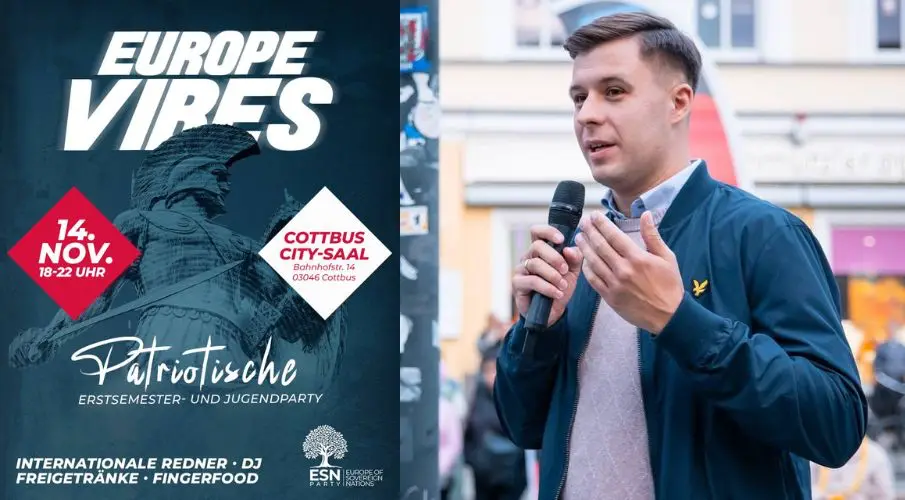
In Berlin, the same invitation has been circulating in some feeds for weeks: “Europe Vibes”, “first ESN student party”, champagne glasses, young faces, an EU lawmaker giving a greeting. Anyone who studies or is here for an exchange semester automatically thinks of what “ESN” has meant for years: Erasmus Student Network, international contacts, buddy programs, parties where Spanish, Polish, German and many others celebrate together. This is exactly the strategy behind the new “ESN student party” – only that it is not Erasmus behind it, but the European far-right party “Europe of Sovereign Nations” and a milieu in which the AfD plays a key role.


To understand how perfidious this trick is, it is worth looking at the original. The Erasmus Student Network has been an honorary student network since the late eighties that brings exchange programs to life: help with arrival, paperwork, finding housing, language evenings, city tours, excursions, parties. The groups at universities work closely with universities, student councils and international offices. Anyone going to an ESN party does not expect a hidden party headquarters but a diverse crowd that makes Europe tangible in daily life – with all its languages, biographies and conflicts, but without a recruitment campaign for any party.

t is precisely this trust that has now become a target. Under the same abbreviation “ESN”, the party “Europe of Sovereign Nations” has been appearing since 2024 – an alliance of right-wing and far-right parties from several EU countries, including the AfD. The party was founded after the European elections, sits with its own parliamentary group in the Parliament and sees itself as a rallying point for forces that want to reverse European integration and make national isolation their program. That it deliberately uses “ESN student party” for its “Europe Vibes” evenings is no coincidence. The name sounds like Erasmus, exchange and campus culture – but what is delivered is a stage for a party whose goal is to destroy precisely this open European idea.

The concrete process is always similar. In the invitations to the “ESN student party in Berlin”, there is talk of guests from Poland and the USA, of “Europe Vibes”, of an apparently international mix. At the same time, the greeting of an EU lawmaker is proudly announced: Dr. Alexander Sell, AfD politician and leading figure of the ESN party. Where previously students from different countries would have organized an Erasmus party in student self-administration, there now stands a far-right functionary with a microphone, using the opportunity to anchor his structure in the environment of first-year students, Erasmus students and young Berliners. Anyone who only reads “ESN” may not realize until inside the venue that they have ended up at a party event.

This interplay of appearance and reality becomes even more alarming when looking at which figures are currently being pushed forward in the AfD’s environment. Jean-Pascal Hohm, a state legislator from Brandenburg, is the new chairman of the AfD youth “Generation Germany”. He has been considered well-connected in the far-right spectrum for years, appears repeatedly in reports by the Brandenburg Office for the Protection of the Constitution and is cited there with ethnic-nationalist and anti-migration positions. He formulates his goal openly: a “migration turnaround” that ensures “Germany remains the homeland of Germans”. This line is clearly reflected in the imagery of his campaigns – and it is visibly aimed at young people.

Anyone scrolling through his social media channels or looking at his posters sees a consistent pattern. Sometimes Hohm warns of alleged “asylum fraud” that the Federal Office for Migration supposedly tolerates. Sometimes he demands “benefits in kind instead of basic income” for young Ukrainians whose number in Germany has “increased tenfold”. Then he claims that German cities are on the brink of collapse and must be saved by ending “mass migration”. On other materials, he says “the majority” no longer feels safe at Christmas markets and that “securing borders, protecting citizens” is the only answer. Added to this are slogans like “consistently combat leftist terror” or “stop exploitation of our social system”, garnished with the claim that every second basic-income recipient does not have a German passport.

Anyone checking these statements soberly quickly sees how selective and dishonest the use of numbers and terms is. Yes, roughly half of basic-income recipients currently do not have German citizenship. But among them are several hundred thousand people from Ukraine who fled a war of aggression, as well as refugees from Syria, Afghanistan or other war and crisis regions. Many of them are children, many others attend integration courses or work in jobs that alone are not enough to live on. Anyone talking about “exploiting our social system” deliberately hides these facts and turns a protective measure with which a wealthy country responds to war, flight and displacement into an alleged fraud against the “German taxpayer”.

Hohm proceeds similarly with issues like asylum and internal security. That administrative procedures are overloaded, that authorities react too slowly or make mistakes – all known and legitimately criticized. But turning bureaucratic shortcomings into “asylum fraud” and “capitulation to abuse” strikes at the fundamental right to asylum and portrays those seeking protection as perpetrators. When Hohm claims that cities and municipalities are on the verge of collapse because too many refugees are coming, he systematically ignores that these municipalities are also struggling with housing shortages, years of budget cuts and low wages. Problems that existed long before his time – and that cannot be solved by talking about “mass migration” and nurturing deportation fantasies.

This propaganda pattern makes the connection between the ESN party, the AfD and “Generation Germany” so dangerous. On one side, there are seemingly harmless student parties with international flags and Erasmus flair. On the other side, a youth organization whose chairman demands the abolition of humanitarian standards, portrays refugees as fraudsters and maintains the image of a threatened nation supposedly saved only through isolation. In between stand thousands of young people who are new to university, living in a big city for the first time, looking for connection – and who may not know in detail who Alexander Sell or Jean-Pascal Hohm are and what they stand for politically.
“Trump presents peace plan – The EU would rather continue wasting your tax money. 190 billion euros have already been sent to Kyiv. Up to 30 percent was embezzled: that is 50 billion euros for golden toilets and Zelenskyy’s corrupt regime” – (Alexander Sell, November 27, 2025) –
First-year students and exchange students are particularly vulnerable to this form of advertising. They do not know the scene, they see “ESN”, “Europe Vibes”, “student party” – and assume it is what they know from Erasmus events elsewhere. Anyone who then ends up at an event in Cottbus or Berlin where AfD officials suddenly speak, posters of “Generation Germany” appear or demands like “benefits in kind instead of basic income” are thrown into the room, is already part of a staging that was planned exactly like this. It is not about a nice evening, but about the feeling that this politics is “actually quite normal” and merely says what “everyone thinks”.


Wojciech Owsianny does not present himself the way he does by accident. His statements are deliberately sharpened, heavily simplified, and designed above all to emotionally pull in young people. This is not about explanation, but about impact. Images, isolated cases, and outrage replace context. Owsianny is active in the environment of the Polish Konfederacja party, specifically within Nowa Nadzieja, where he works regionally as a press spokesperson. This is organized political communication, not a matter of private opinion. In his framing, democracy appears as a disruptive factor rather than a foundation. His public presence reflects a far-right extremist milieu that builds reach through provocation and systematically avoids complexity.
That is why it is important to reveal the mechanism behind it. The name ESN is not used by accident, but deliberately hijacked. The far-right party uses the reputation of the Erasmus Student Network to borrow credibility and campus proximity it would never have on its own. And “Generation Germany” tries in parallel to create the image of a modern, dynamic youth movement with faces like Hohm – while in substance offering the same old, if not worse, mix of exclusion, enemy images and authoritarian answers. Anyone only looking at the surface sees hipster design and hears techno music. Anyone looking deeper sees a political dark strategy.

The consequence cannot be that students no longer dare to do anything or see every party as a trap. But it does require a minimum of attentiveness. Anyone invited to an “ESN party” should check whether it is the Erasmus Student Network at their university – with identifiable contacts, university email addresses, official social media channels. Is there no imprint but a party logo? Is an AfD EU lawmaker announced as a guest of honor? Do slogans appear that sound like a campaign rather than student engagement? Then it is clear which environment you are in – and everyone can decide whether they really want to give this environment their time and data.

The coffers of the far right are well stocked — war chests and propaganda funds in the most literal sense, filled by wealthy patrons and countless individual donors who appear to see the erosion of democracy as a worthwhile investment. Where hatred becomes a commodity and propaganda a business model, money is rarely in short supply. The infrastructure of resentment rests on professional networks, think tanks, and media platforms. Meanwhile, initiatives dedicated to education and democratic awareness are quietly being starved. Funding for projects that confront right-wing populism is being cut or eliminated altogether, as if one does not understand — or does not wish to understand — that defending democracy costs money and requires durable structures. Warm words from Berlin, however well intentioned, and solemn affirmations of commitment to the rule of law cannot replace actual budgets. The fatal asymmetry is plain to see. On one side stands a well-financed machine, sustained by affluent benefactors and a broad base of donors operating both openly and behind the scenes. On the other side struggle those who seek to inform and enlighten, forced to confront overwhelming power with shrinking resources. This is the true strength of the far right — not merely its rhetoric, but the capital behind it, the long reach of those who do not simply tolerate this ideology, but actively and fanatically promote it.
Universities and real ESN groups are as important here as the media. Universities should openly explain what the Erasmus Student Network stands for and where the boundaries to party-political structures lie. ESN sections can point out on their channels that they have nothing to do with the ESN party. And journalists should not simply present “ESN student parties” as harmless student events but look closely at what strategies are behind them. Speaking openly about these things does not take anything away from young people – it gives them the information they need to decide confidently. At the current moment, it appears that the German media landscape has failed to systematically examine the phenomenon of “ESN student parties under the ESN label”. Factual basis Zum aktuellen Zeitpunkt sieht es so aus, als ob die Medienlandschaft in Deutschland versäumt hat, das Phänomen „ESN-Studentenpartys unter dem Label ESN“ systematisch zu durchleuchten.
- The ESN party “Europe of Sovereign Nations” is a European party founded in 2024, supported by right-wing and far-right parties, including the AfD. It uses the ESN abbreviation and is represented in the European Parliament with the group “Europe of Sovereign Nations”.
- Alexander Sell (AfD) was chairman of the ESN party between 2024 and 2025.
- “Generation Germany” is the new youth organization closely linked to the AfD. Jean-Pascal Hohm, a state legislator from Brandenburg, was elected its chairman at the end of November 2025 with over 90 percent of the vote and is considered well-connected in the far-right scene according to several reports. The Brandenburg Office for the Protection of the Constitution lists him in its classification note.
- The share of foreign basic-income recipients is currently just under half. Many of them are refugees from Ukraine and from major asylum-origin countries.
In the end, it is about nothing less than the question of whether far-right actors will succeed in disguising themselves as part of normal student culture. A student party is a place where friendships begin, relationships, political debates – and sometimes radicalizations. When deliberately misleading labels are used in precisely such environments, all our alarm bells should ring. Not because celebrating is dangerous, but because nothing is harmless that relies on feigned innocence. Anyone selling young people a far-right party under an Erasmus flag shows what they really think of them. The answer should be clear: pay attention, contradict, enlighten, strengthen alternatives – and speak up exactly where others rely on confusion.
Updates – Kaizen News Brief
All current curated daily updates can be found in the Kaizen News Brief.
To the Kaizen News Brief In English


Kann Erasmus dagegen vorgehen?
Bzw sollten sie das nicht ganz groß tun, damit es sichtbar wird?
Aber so funktionieren Sekten und Extremisten.
Vermeintlich nette Zusammenkünfte bei denen das Weltbild gleich in diversen Reden mitgeliefert wird.
Man schafft das „wir“ gegen die „Anderen“.
Das „wir sind aufgewacht“, die Anderen sind die „Schlafschafe“
Das „wir glauben wirklich“, die Anderen sind auf dem Irrweg.
TikTok und Co radikalisieren in einem Tempo, dass einem ganz schwindlig wird.