
Viktor Orbán now stands at the center of a political course that has made Hungary one of the Kremlin’s most important partners within the European Union. While Brussels is trying to break away from Russian energy and support Ukraine, Budapest blocks aid, delays sanctions and sends signals that align strikingly with the interests of Vladimir Putin. This was not always the case. In the early 2000s, Orbán appeared as a sharp critic of Russia, spoke of “Putinist puppets” in Europe and promised to keep Russian influence out of Hungary. But by 2008 at the latest, this position shifted. Distance became proximity, criticism became cooperation. The change did not follow a single decision, but a development that combines energy policy, economic dependency and political calculation.

A central lever of this development lies in energy policy. Hungary has systematically deepened its dependence on Russian gas and oil over the years. While other EU states sought alternatives, Budapest tied itself more closely to Moscow. In 2021, Hungary signed a long term gas contract with Gazprom that is intended to secure supply for fifteen years. At the same time, the share of Russian oil imports rose from 61 percent to 93 percent between 2021 and 2025. A key role is played by the company MOL, which operates large refineries and has a dense network of gas stations across Europe. Through favorable purchase prices, MOL becomes a decisive intermediary through which Russian energy continues to flow indirectly into Europe. This creates a situation in which economic advantage and political dependency intertwine. Hungary benefits in the short term from low prices but ties itself in the long term to Russian supply structures. Orbán actively uses this dependency. He repeatedly links decisions in Brussels to energy policy demands, for example in connection with the “Druzhba” pipeline system. Officially he justifies blockades with national interests, in practice the balance of power within the EU shifts in favor of Moscow.

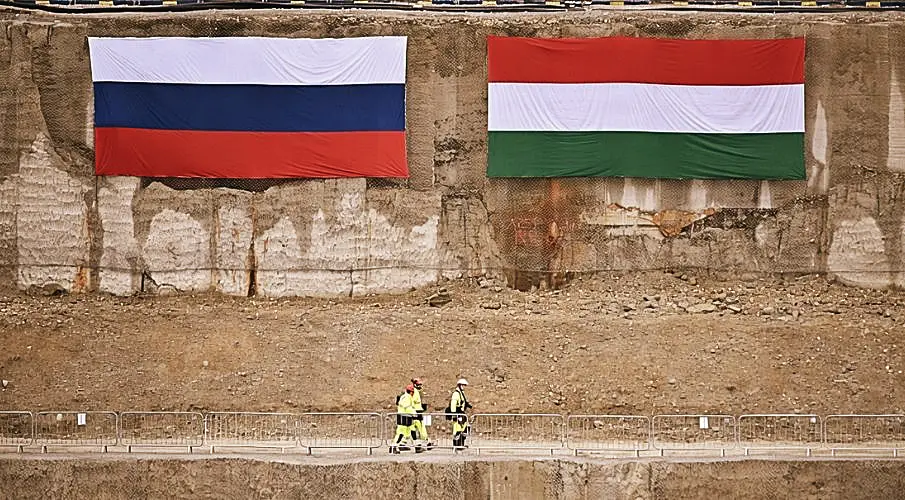
This strategy is reinforced by the expansion of nuclear energy. With the Paks 2 project, Hungary remains the only EU country in which a major project by the Russian state company Rosatom is being implemented. The expansion of the power plant is carried out without open competition, financed by a Russian loan of ten billion euros. This ties Hungary not only technologically but also financially to Russia. The repayment of the loan, the supply of fuel rods and maintenance by Russian specialists create a long term dependency that extends far beyond energy supply.

While other European states have ended projects with Rosatom, Budapest is sticking to it and thus securing Russia’s influence in a sensitive sector. At the same time, close associates of Orbán benefit economically from this project, including businessman Lőrinc Mészáros. The combination of political proximity and economic interests further strengthens the bond.

Alongside energy and infrastructure, older connections also play a role that reach back to the 1990s. During this period, the criminal network leader Semjon Mogilevich was active in Budapest and controlled parts of organized crime. Several statements, including those by Dietmar Clodo, a German criminal convicted of explosives offenses who later described connections to Eastern European underworld structures in sworn testimony, as well as by László Kovács, a former member of a network in Hungary associated with Mogilevich that was allegedly involved in money transfers within these structures, suggest that money from this environment may have flowed into political structures, including campaigns of the Fidesz party. Evidence in the legal sense is lacking, but the timing between Mogilevich’s activities, his release in 2009 and Orbán’s first meeting with Vladimir Putin in the same year is striking. There is also an indication that Mogilevich may have played a role in initiating the Paks 2 nuclear project. Whether these connections actually enabled political influence or serve as leverage remains unclear, but they raise questions that have not been fully clarified to this day.

Paks 2 nuclear project - united in flag and spirit
At the political level, close coordination is also evident. Reports of contacts between Hungarian Foreign Minister Péter Szijjártó and Sergey Lavrov suggest that Budapest regularly informed Moscow about internal discussions within the EU. Sanctions were also deliberately influenced. Hungary successfully advocated for the removal of certain names from EU sanctions lists, including Gulbahor Ismailova, a relative of Alisher Usmanov. At the same time, Budapest attempted to shield additional companies and banks from sanctions. These interventions shift the effect of European measures and show how strongly national decisions can influence the overall structure of the EU.
At the same time, Russia is actively working to influence the political landscape in Hungary. Ahead of the parliamentary elections in April, campaigns intensified on social media, supported by networks of bots, channels and government aligned media. A coordinating role is attributed to the diplomat Tigran Garibyan, who maintains connections between Russian actors and Hungarian media. In addition to these open channels, there are also less visible connections. One of them runs through the Russian Orthodox Church. In Budapest, it was represented for more than two and a half years by Metropolitan Hilarion Alfeev, who not only led the Budapest diocese but was considered a link between the Kremlin, oligarchs and representatives of the Orbán regime. According to statements from his former environment, he transported money from Dubai to Hungary and worked to ease sanctions against key actors from Russia. His contact with Zsolt Semjén, the deputy prime minister and long time confidant of Viktor Orbán, was particularly close. In the further course, Hilarion himself came under pressure after allegations of misconduct became public, and he was eventually transferred to Karlovy Vary, where he moved church assets into a Hungarian legal structure in order to protect them from sanctions.

Against this background, it becomes clear that Orbán’s course cannot be explained by ideological proximity alone. It is based on a network of economic interests, energy policy dependencies and political decisions that reinforce each other. Hungary thus moves into a position that appears increasingly isolated within the EU, while at the same time being strategically valuable for Russia. For Europe, this represents a lasting challenge. Decisions that require unanimity become vulnerable to blockades. At the same time, it becomes evident how closely economic entanglements and political influence can be connected. Orbán’s shift therefore stands not only for a national development, but for a transformation within Europe whose consequences extend far beyond Hungary.
Research is ongoing. To be continued …
Updates – Kaizen News Brief
All current curated daily updates can be found in the Kaizen News Brief.
To the Kaizen News Brief In English


