
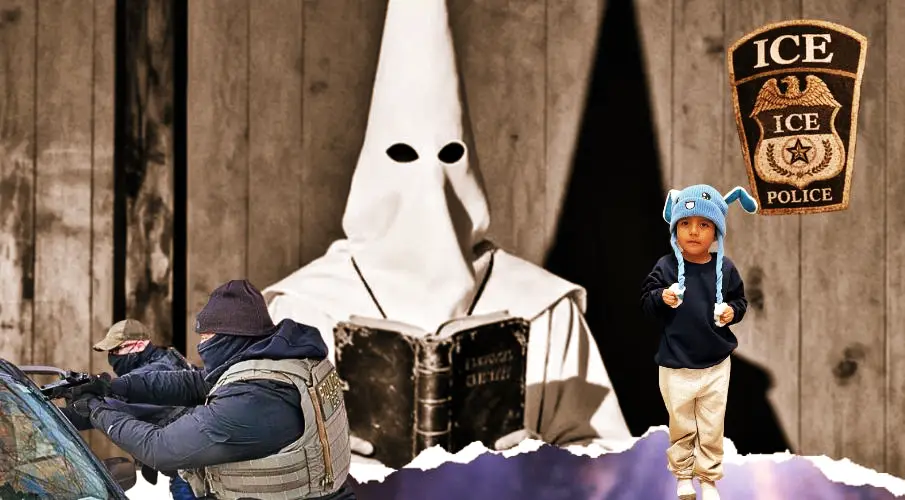
Minnesota looks like a showcase for power holders of what happens when a government politically charges armed federal forces and at the same time sends them into an everyday environment that previously did not resemble a “war zone,” but rather school, bus stop, supermarket and residential street. Two people are dead. Civil society is being pressured. And the language used to justify all of this does not sound like administration, but like war. ICE’s recruitment offensive was marketed as wartime enlistment and launched with a budget of 100 million dollars. Those being addressed were not meant to see themselves as caseworkers, but as fighters. The target audiences were no secret: gun shows, military facilities, local police circles, UFC events, digital spaces for tactical equipment. It went where violence not only exists, but is regarded as strength.

The messages attached to it are not neutral. There is talk of “defending the homeland,” of “foreign intruders,” of “enemies at the gates.” Veterans are courted with phrases such as “your nation calls again.” Alongside images drawn from frontier romanticism, riders, cowboy hats, poses of frontiersmen - and slogans like “one homeland, one people, one heritage.” This is not random aesthetics. It is a worldview: us against the others. Embedded in this language is an old mechanism that cannot be moderated away. The Ku Klux Klan justified its lynchings and terror for decades with the same motif: white women had to be protected from allegedly unrestrained minorities. “Protection” was the moral mask for violence. The lie of sexual threat was the fuel used to form mobs and subjugate neighborhoods.

Bishop Talbert Swan drew a sharp comparison in a widely noted statement: in his view, there is no fundamental difference between the ideology of the Ku Klux Klan of the 1920s and today’s white evangelicalism in parts of the MAGA camp. Both excluded Black and other non white communities, reinterpreted American history in favor of a white perspective and promoted a religious image that has little to do with the historical figure of Jesus. Religion, he argues, is being politically instrumentalized to legitimize exclusion and racist ideas.
It is over. The United States of America, that great experiment of the Enlightenment, is sinking into a vortex of religious delusion so dark that even the bleakest prophecies of the Founding Fathers seem like naive understatement. What is unfolding over there while we look on is nothing less than the metamorphosis of a democracy into a theocratic nightmare, led by a man who brushes aside the separation of church and state with a shrugging “let’s forget that for a moment” - as if it were an annoying formality and not the foundation of the civilized world. No matter where we investigate, no matter which source we tap, no matter which stone we turn - everywhere we encounter the same religious fantasy world that is not only dangerous, but ready to go all the way. These fanatics do not just dream of the return of witch burnings - they are already building the pyres Fanaticism in its pure form - The Apostles of Power - How the Faith Office in Washington became a gateway for Christian extremism - Fight it like the Ku Klux Klann
The new directive of the U.S. Office of Personnel Management dated July 28 reads like a manual for religious overreach disguised as a document on “religious freedom.” Federal employees are now officially allowed to pressure their colleagues to convert to the “right” faith. They may hold prayer groups during working hours, brandish crucifixes and Bibles like weapons, and - unbelievably - doctors in veterans hospitals may pray over their patients whether they want it or not. A supervisor can invite subordinates to Easter services, and we all know what an “invitation” from the boss really means. The state has flung open the office door to the church, and the inquisitors are streaming in. Trump has created a “Task Force to Eradicate Anti Christian Bias” - in a country where Christians make up 70 percent of the population and have produced every single president in history. It is as if one were to create a task force to protect Islam in Saudi Arabia.
Swan goes even further and accuses current Christian nationalist movements of weakening social safety systems and supporting cuts to programs for the elderly, children and the needy. Like the Klan once did, he argues, these groups align themselves with political actors advancing a racially charged agenda. His conclusion is pointed: it is not lived Christianity, but a form of white supremacy disguised in religious language.

This exact pattern is being politically cultivated again today. Instead of addressing structural violence against women, individual cases of young white victims are repeatedly used as symbols to legitimize hard line operations. It is a selection that works politically: it generates fear, it generates anger, it generates the narrative of the rescuing state. And it obscures the fact that the overwhelming majority of deadly violence against women occurs in private settings - by partners, former partners, acquaintances, mostly citizens. That does not fit the desired enemy image.

There is also a second ideological layer that in recent years has moved from extremist niches into public language: the Great Replacement narrative. It claims that immigration is a deliberate plan to displace the white majority society. This idea was not just an internet rumor. It appeared in manifestos. It fueled far right terrorist attacks - El Paso, Buffalo, Pittsburgh, Charleston. When state communication today adopts terms reminiscent of “invasion” and “reconquest,” that is not harmless. Boundaries are being shifted. Minnesota is the place where this shift is no longer abstract. It becomes physical. It becomes armed. It becomes deadly. Renee Nicole Good was shot during an operation. Witnesses report that the officer called her a “damn bitch” as she was dying. In the days that followed, residents described further threats: “Didn’t you learn anything? That’s why we killed this lesbian bitch.” Alex Pretti died from gunfire by border agents. Two deaths are not a “communications mishap.” They mark a point where the debate can no longer be conducted about matters of tone, but about power, impunity and the unrestrained use of state violence.

On the ground there is intimidation in daily life, aggressive stops, a climate in which any refusal to go along is treated as provocation. Schools report absences. Parents avoid bus stops. Teachers openly say that fear has entered the classroom. At the same time, every criticism is deflected: anyone who speaks about ICE is spreading panic. Anyone who asks questions is insulting officers. It is the familiar reversal: not the violence is the problem, but pointing to it. In this logic, criticism becomes “endangerment,” documentation becomes “enemy activity,” civil society becomes “disruption.” And that is precisely where the risk arises that even more will happen. Because when people in uniform learn that they are morally right, that they are “saving the homeland,” that they are fighting “intruders,” the threshold lowers. Those who see themselves as saviors listen less carefully. Those who understand themselves as fighters react more quickly with violence.

The point is not to equate ICE with the KKK. The point is this: state power is once again using the same mechanics of fear that historically legitimized racist violence - protection myths, enemy images, dehumanization. And this mechanism is no longer used only in pamphlets, but in official policy, in recruitment imagery, in official language, in operations on the streets. Minnesota shows how quickly it tips. How quickly “enforcement” becomes a hunt. How quickly “security” becomes a climate in which people die and yet it is treated as the price of necessary order. Anyone who dismisses this as exaggeration has not understood history. Anyone who accepts it abandons the idea that the state is bound by law.

This is not only about deportations. It is punishment and submission. Women who dissent, queer people, political opponents - they are marked as disturbances to an allegedly natural order. Those who do not obey risk violence. Those who question authority become enemies. When armed forces are sent into the streets convinced they are carrying out a sacred mission, the threshold lowers. When they are signaled that harshness is expected and celebrated, the risk of deadly escalation grows. Minnesota shows where such a mixture leads: ideology, weapons, impunity.

Political responsibility does not rest with individual officers alone. It begins with the language used in recruitment, with the images circulated, with the enemy narratives that are stirred up. Those who present violence as the necessary price of order should not be surprised when violence becomes the instrument. Minnesota is not an isolated case. When state power is charged with conspiracy thinking, misogyny and ethnic exclusion, structures emerge in which deaths are calculated. Then it becomes part of the plan.
Updates – Kaizen News Brief
All current curated daily updates can be found in the Kaizen News Brief.
To the Kaizen News Brief In English


„eine Heimat, ein Volk, ein Erbe“
Der Slogan aller Faschisten.
Gegen Einwanderung, gegen Farbige, gegen Queere, gegen Frauen die nicht nur brav die Klappe halten und den Männern dienen.
Hoch lebe die weiße Vorherrschaft 🤬🤬🤬
Wenn die Grenzen zu konstitutionellen Grundrechten überschritten werden, ist das kein Schutz mehr.
Es ist die Ausweitung eines außer Kontrolle geratenen Staates.
Gepaart mit der Sekte der MAGA eine extrem gefährliche Mischung.
Schon lange geht es nicht mehr um die Abschiebung von wirklich kriminellen Nicht US-Amerikanern (also gerichtlich verurteilt).
Es geht um Einschüchterung und Machtmissbrauch.
Viele fühlen sich „noch sicher“.
Sie hören nicht die Alarmglocken.
Sie denken, ich bin US-Amerikaner, wähle republikanisch… alles gut, ich habe nichts zu befürchten.
Bis dann ICE sie ergreift und im schlimmsten Fall erschießt. Weil man einkaufen war und genau dort zufällig eine Razzia stattfand. Man mitten im Geschehen war und ein ICE Typ seine Waffe zu locker hatte.
Dann wird aus dem braven MAGA ein inländischer Terrorist, den man aus Selbstverteidigung erschießen musste.
Die Person wird, wie gehabt, im Nachhinein diffamiert.
Vielleicht nicht heute, nicht morgen.
Aber wenn es nicht gestoppt wurde, dann wird es passieren.
Nicht nur einmal 😞
👍