
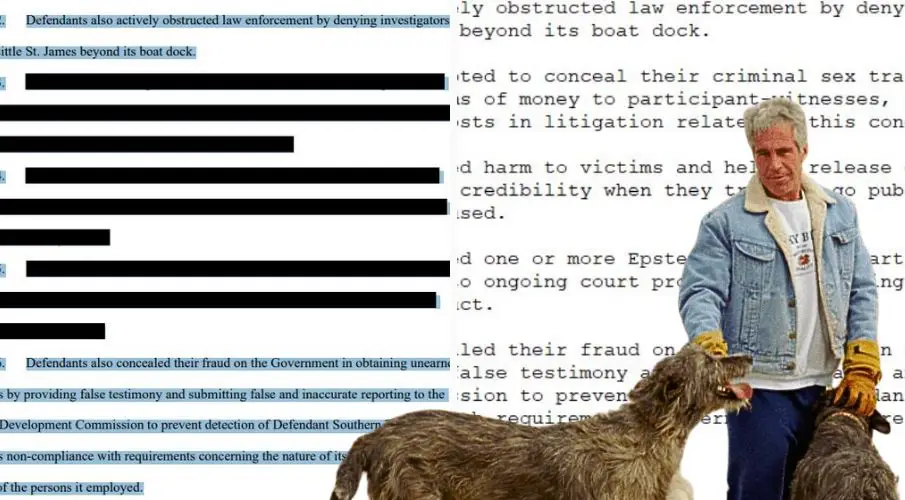
Hardly had the U.S. Department of Justice released new files related to the Jeffrey Epstein case in late December 2025 when a race began online for supposed shortcuts to the truth. A simple flick of the mouse, people said, was enough: select text, copy, paste - and suddenly redacted passages could be read. What sounded like a technical confession of failure by the authorities turned out, on closer inspection, to be far more complicated.

“That a single page became readable was enough to turn a technical error into a global revelation.” From hobby-Anonymous types to social media post distributors, the most wonderful tricks were demonstrated showing how to remove the redactions. Once again, madness in its purest form.
The trigger was real. Among the thousands of pages the Justice Department released in several batches, there was one meaning a single document in which the redaction was purely visual. Anyone who copied the text and pasted it into another program could read what was supposed to be hidden. It was a court filing from 2022 concerning the administration of Epstein’s estate. Three fully redacted paragraphs appeared in plain text once pasted elsewhere. They dealt with payments to witnesses, intimidation of victims, and instructions to destroy evidence.

Media in Germany also opened the tale of One Thousand and One Secrets - investigation? = none - responsibility? = none – Verantwortung? = Fehlanzeige
This single finding was enough to make the story explode. In the media, on TikTok, X, Instagram, Facebook, and other platforms, the claim spread that large parts of the files could be “unlocked” this way. Particularly persistent was the number of more than 600 supposedly hidden mentions of the name Donald Trump. Total nonsense. A review puts the brakes on this dynamic quite clearly. Yes, the document exists. Yes, the redaction could be bypassed there with simple copying. But that is exactly where the sensation ends. In most of the other files, this method did not work. Whether court records from the proceedings against Ghislaine Maxwell or email correspondence from the newer batches - the redactions remained unreadable even after pasting. There is no talk of a systematic error.
This becomes even clearer when looking at the alleged Trump mentions. The screenshots circulating online, promoted by the white knights of unchecked information sharing whose sole purpose serves their own likes and egos, showed text passages with his name, accompanied by file numbers. Anyone who actually found those files discovered that the name was not redacted there at all. It had been visible from the start. In two cases we were able to verify, the circulating text passages matched word for word with freely readable sections. Other file numbers could no longer be assigned or led to completely different documents.
Part of the confusion can be explained. The Justice Department initially released the third batch of files on the afternoon of December 22, 2025, took it offline a few hours later, and reposted it shortly before midnight. Whether additional redactions were made or files reorganized during that phase remained unclear. Several media outlets reported that numbering and content differed between the first and second versions. This made it impossible afterward to verify every alleged find circulating online.
What remains is a sober picture. There was a clear technical error in a single document. How many others might be affected is unknown. There are no indications of a massive, covert unveiling of explosive names. And the oft-cited number of hundreds of hidden Trump mentions does not withstand scrutiny.
This episode says less about the state of the files than about how they are handled by the media and by those who simply adopt and share such information until the doctor comes. In an environment shaped by justified distrust of state transparency, small gaps are enough to claim great certainties. But especially in the Epstein case, marked by proven abuse and real abuses of power, exaggeration helps no one. It shifts the focus away from what is documented toward what merely sounds spectacular.
Copying does not replace accountability. And a technical error in one file, in one document, does not suddenly turn thousands of pages into an open book. Anyone who seriously wants to understand what these documents say - and what they do not - has to read deeper than the next mouse click.
Updates – Kaizen News Brief
All current curated daily updates can be found in the Kaizen News Brief.
To the Kaizen News Brief In English


Danke für diese Analyse.
Bei all den Lügen, Verzögerungen und der enormen Intransparenz sind die Menschen bereit so etwas zu glauben.
Verständlich.
Aber Ihr zeigt, wie wichtig Hinterfragen und Recherche ist.