
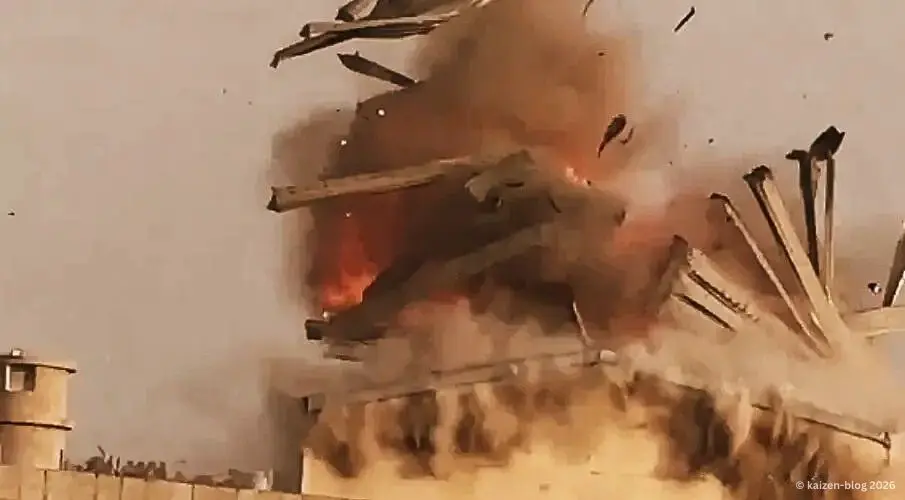
This war no longer only creeps through front lines. It reaches for everything that keeps states running - gas fields, ports, courts, aid deliveries, markets, entire capitals. What began as a military escalation has long drawn wider circles. And the longer it lasts, the more visible it becomes that the chaos does not end at the edges. It moves.
On this Wednesday, this logic struck again in several places at once. In Iran, facilities around the massive offshore gas field South Pars were attacked. State media reported fires in Asaluyeh, Bushehr province. Shortly afterward, Iran’s Khatam al-Anbiya headquarters declared that the attack on fuel, energy and gas infrastructure in the so-called aggressor state was a legitimate right, and that it would respond with force. The tone became even sharper when state television published threats against oil and gas facilities in Qatar, Saudi Arabia and the United Arab Emirates - named were the Saudi Samref refinery, the petrochemical complex in Jubail, a gas field in the Emirates, several facilities in Qatar. Qatar for its part directly blamed Israel for the attack on the shared gas field. A spokesperson for the foreign ministry spoke of a dangerous and irresponsible step and openly warned of consequences for global energy security.
South Pars, Iran’s largest natural gas field in the world, is burning after Israeli-American attacks have put central processing facilities out of operation. The damage to people and environment is also here not at all foreseeable
The price of war
The economic explosive force is obvious. The Strait of Hormuz remains de facto still blocked, one fifth of global oil traffic depends on this bottleneck. In Washington, pressure is growing. Donald Trump reacted with two measures that show how closely war and the energy market are now connected. The White House suspended key provisions of the Jones Act for 60 days - that old shipping rule that binds transport between US ports to American ships and has for years been considered a driver of prices. At the same time, the US Treasury eased sanctions against Venezuela’s state oil company PDVSA. US companies are again allowed to do business with the company, Venezuelan oil may be sold directly to American firms and onto the world market. Washington had blocked exactly these deals for years. Now the administration shows how strongly it is driven by the oil price.
The markets reacted immediately. US stock markets declined, crude oil continued to rise. The S&P 500 fell, the Dow Jones, the Nasdaq. The concern behind it is simple: if energy becomes more expensive, inflation rises, and with it the pressure on everything else grows. A war in the Middle East is never only a regional event. It hits gas stations, freight rates, electricity prices, food costs.
Allies at a distance
At the same time, it becomes visible how fragile the Western camp has become in securing the conflict militarily. Australia declared that it had received no formal request from Washington to provide additional military support to secure the Strait of Hormuz. Australian finance minister Jim Chalmers said openly that no deployment of warships was being considered. Even clearer was German Chancellor Friedrich Merz. He spoke in the Bundestag of open questions about this war and of the fact that there was still no convincing concept of how this operation should end successfully. Washington had not consulted Europe and had stated that European help had not been necessary. Germany shares many American goals, but will not shy away from honestly saying where it sees things differently. Above all, Merz made clear: Germany will not participate in any military mission in the Strait of Hormuz as long as the war continues.
Courts, executions, fragments
While allies mark distance, the number of strikes and the dead grows. In the south of Iran, according to the judiciary, a courthouse in the Larestan district was hit during working hours. At least eight people were killed - a lawyer, six clients, a member of the judiciary. The exact number of injured initially remained unclear. In Iran, therefore, not only military targets are being hit, but also civilian and judicial institutions. At the same time, the country reported the execution of Kourosh Keyvani, whom the judiciary accused of spying for the Mossad. It is the first publicly known execution for espionage during the ongoing war. Iran has for years been among the countries with the highest number of executions worldwide. Now the war is also being used to show new harshness internally.
On the Israeli side, pressure is also growing. Israel reported that in recent days three private aircraft had been damaged by fragments of Iranian missiles that had been intercepted. Such reports show how far the consequences of the attacks are now eating into everyday life. Even where missiles are intercepted, the danger on the ground remains real. Along the Lebanese border, an Israeli bomb disposal unit detonated unexploded ordnance - according to police, it was cluster munitions, spread over a large area. In a kibbutz near the border, a rocket fragment was found. Fragments, unexploded ordnance, clearance operations: that too has now become part of the everyday of this war.
Beirut without a safe place
In Beirut, the attacks continued during the night. The Lebanese health ministry reported ten dead and 27 injured from Israeli airstrikes on central districts of the capital. Since the beginning of the renewed fighting between Israel and Hezbollah on March 2, 912 people have been killed, 2,221 injured. The fact that no longer only the southern suburbs but also the center of Beirut is being hit fundamentally changes the situation in the city. Residents speak of there being no safe place anymore. Exactly this feeling describes the condition of many cities in this war. Security is no longer spatially distributed. It has disappeared.
Israel also declared that it had struck branches of al-Qard al-Hasan in Beirut overnight - a financial institution connected to Hezbollah that, according to Israel, finances the military arm of the militia. France’s special envoy Jean-Yves Le Drian blamed Hezbollah for the renewed escalation, but at the same time called Israel’s response disproportionate and counterproductive because it brings further actors together against Israel. In this too lies a pattern of this war: each side declares the next strike as a reaction, but each strike enlarges the field of opponents.
The heads that fall
In Tehran and beyond, Israel continues the targeted elimination of Iranian leadership cadres. Israeli defense minister Israel Katz declared that Iran’s intelligence minister Esmail Khatib had been killed. Iranian state television confirmed his death. Khatib was one of the central figures of Iran’s repression and intelligence apparatus. The United States had sanctioned him in 2022 for cyber activities against the United States and its allies. The Treasury in Washington accused him of running networks of cyber actors who carried out espionage and ransomware attacks in line with Iranian objectives. He was also associated with the persecution of human rights defenders, journalists, filmmakers, women’s rights activists and members of religious minorities. Under his leadership, according to the US sanctions justification, the ministry tortured people, abused them in secret detention centers and also targeted the families of critics. The White House reacted with unusual openness to his killing. Trump’s spokesperson Karoline Leavitt called Khatib a known terrorist and said on television it was good for the United States and the American people that this man was no longer alive.

Earlier, Israel had already killed the Basij commander Gholam Reza Soleimani. A senior Israeli intelligence official said Soleimani had been hiding in a tent in a forest area. Such attacks are intended to send the message that Iranian leadership figures no longer have any safe place. The Kremlin meanwhile condemned the killing of Ali Larijani. Moscow’s spokesperson Dmitry Peskov stated that the killing of the Iranian leadership was explicitly condemned. Russia is thus reacting not only to an ally under pressure, but also to a war that is eating ever deeper into a region in which Moscow defends its own interests.
Sirens over the region
On the military level, pressure is expanding across the entire region. NATO is reinforcing Patriot air defense in Turkey, a second system is being moved to the province of Adana, where one of the most important air bases of the alliance, Incirlik, is located. Saudi Arabia reported that it had intercepted two drones over Riyadh, both on their way to the diplomatic quarter, where the US embassy is also located. Bahrain warned of Iranian shelling. The United Arab Emirates spoke of 13 ballistic missiles and 27 drones directed at the country. Israel reported further Iranian missile launches. Sirens sounded along the border with Lebanon, in Bahrain, in Jerusalem, in Dubai. The war jumps between states, ports and skies.
Even sport and civilian life no longer escape this dynamic. In Australia, several Iranian female football players sought asylum, two remained there, the rest of the national team returned via Turkey to Iran. Iran is also trying to have its World Cup matches moved from the United States to Mexico. President Claudia Sheinbaum expressed openness to such talks, but FIFA wants to stick to the schedule. A war that was originally described with missiles and airstrikes thus also extends into areas that are otherwise considered safe spaces.
Aid under suspicion
In Gaza, Israel triggered another conflict. UNICEF stated that it was investigating allegations that tobacco or nicotine containing substances had been hidden in an aid delivery. Israel then suspended deliveries by the organization from Egypt to Gaza. UNICEF spoke of a serious investigation and warned that any further disruption of aid work would worsen the already catastrophic situation in Gaza. Even hygiene kits and child aid become in this climate objects of distrust, control and blockade.
What the bomb leaves behind
On the nuclear level as well, several realities are running alongside each other. US intelligence coordinator Tulsi Gabbard stated before a Senate committee that the American attacks had destroyed Iran’s uranium enrichment program and buried underground facilities. One is now observing whether the Iranian leadership is attempting to rebuild the program, but so far there are no signs of this. When Senator Mark Warner asked her whether she had warned Trump about the likelihood that Iran would attack other Gulf states after the strikes and threaten the Strait of Hormuz, she evaded. She would not disclose internal discussions, she said. Warner appeared visibly frustrated and referred to Trump’s own statements, which had suggested that he had not expected such a scenario.
Warner: “The president further said he was surprised that the Iranians tried to take over the Strait of Hormuz”.
Gabbard: “I am not aware of these statements.”
Warner: “What about the president’s statements that he was surprised that Iran attacked neighboring Gulf states?”
Gabbard: “I am not aware of these statements.”
Warner: “Did you inform the president that if he begins a war by choice, the likely consequence would be that Iran attacks neighboring Gulf states and closes the Strait of Hormuz?”
Gabbard: “I will not disclose internal discussions on that.”
IAEA chief Rafael Grossi slowed things down in Washington. Bushehr apparently was not heavily damaged, the reactors were not hit, there were no casualties and no increased radiation. According to initial information, a drone strike likely hit rather a small laboratory building on the site. Even more important was his political sentence: as long as the military campaign continues, he considers a return to negotiations between the United States and Iran unrealistic. Only a ceasefire could reopen that door.
This is how things stand on this day, side by side, in a disturbing clarity. A gas field burns. Gulf states are threatened. Saudi Arabia shoots down drones over the diplomatic quarter. Beirut counts the dead in the center of the city. In Iran, an intelligence minister is killed, a suspected spy executed, a courthouse bombed. Washington tries to dampen the consequences of a war it is itself conducting with Venezuelan oil and loosened shipping rules. Allies step back. Europe’s most important country speaks openly of a lack of concept. Australia says there has not even been a formal request.
Delaware, again

And while all this is happening, Donald Trump again stands in Delaware at the return of fallen US soldiers. Six crew members of a KC-135 tanker aircraft, crashed in western Iraq during operations against Iran, return. Since the beginning of Operation Epic Fury on February 28, the American death toll is thus at least 13, around 200 US soldiers have been injured, ten of them seriously.
That is the actual truth of this war. It does not only expand geographically. It extends the chaos in every direction - into markets, into capitals, into aid deliveries, into courts, into football teams, into electricity prices, into coffins. And the longer it lasts, the less it can still be claimed that anyone has control.
Updates – Kaizen News Brief
All current curated daily updates can be found in the Kaizen News Brief.
To the Kaizen News Brief In English


