
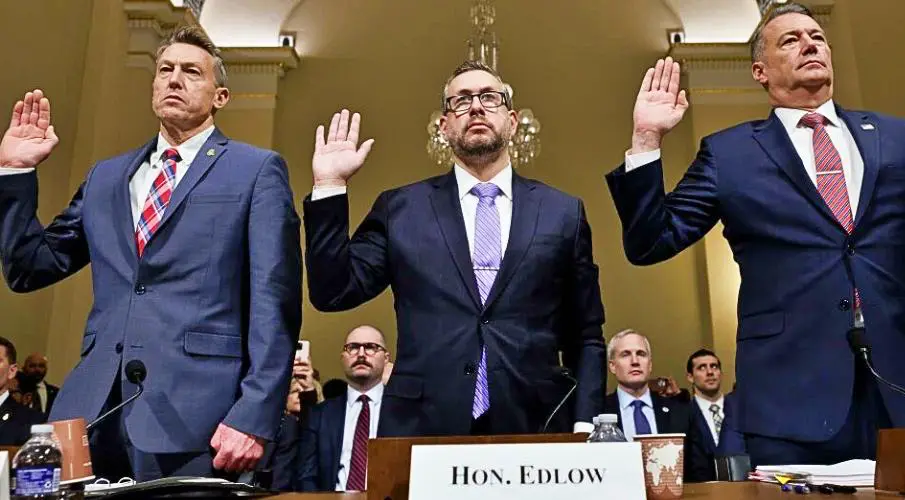
While in Minneapolis two names still hang in the air - Alex Pretti and Renee Good - in Washington the heads of the agencies enforcing Trump’s deportation agenda are appearing before Congress. Before the House Committee on Homeland Security, Todd Lyons of Immigration and Customs Enforcement, Rodney Scott of Customs and Border Protection, and Joseph Edlow of U.S. Citizenship and Immigration Services are expected to explain how they justify the intensified enforcement of immigration law in American cities. The timing is explosive. Public support for the agencies’ actions is declining, yet they are backed by substantial funding from a spending bill passed last year that enabled the nationwide expansion of these measures. More money, more personnel, more operations - and at the same time growing criticism of how those powers are being used.

Rodney Scott of the Border Patrol, Joseph Edlow of U.S. Citizenship and Immigration Services, Todd Lyons of Immigration and Customs Enforcement
The backdrop is incendiary. Public approval is declining, yet the agencies are flush with funding: a spending law passed last year fueled the expansion of operations nationwide. More personnel, more capacity, more flights - and with that more encounters that no longer affect only migrants, but also Americans who watch or protest.
During the debate in the Homeland Security Committee, Goldman asked, among other things, why masked ICE agents were being deployed and argued that the agents’ conduct created impressions resembling a secret police force or an authoritarian regime.
ICE Director Todd Lyons: “We conduct targeted, intelligence driven operations. We are not walking around asking people about their citizenship.”

The fact that this hearing is taking place with such intensity has a name: Minneapolis. In recent weeks, two demonstrators there were killed by officers from the homeland security apparatus. In the case of Alex Pretti, a Border Patrol agent and a Customs and Border Protection officer opened fire. Renee Good died from shots fired by an officer of Immigration and Customs Enforcement. On these exact cases, Lyons refused in committee to make the central gesture that should be self evident in a democracy: he declined to apologize to the families or comment substantively on the deaths. Democratic Representative Eric Swalwell called on Lyons to resign. Lyons refused. When urged to take responsibility, he responded with distance: he would speak with the families, but he would leave the assessment to others in the administration - while the administration simultaneously claims that those killed were involved in “domestic terrorism.”
“Responding to Representative Eric Swalwell’s call for his resignation, Acting ICE Director Todd Lyons said, ‘No, sir, I will not.’ Eric Swalwell: ‘Why not?’
ICE Director Todd Lyons: ‘That child you’re showing there — the men and women of ICE took care of him when his father abandoned him and fled from law enforcement.’”
Instead, Lyons reframed the narrative the department has promoted for weeks: not mistakes, but resistance is the problem. He spoke of intimidation, of ICE employees’ families feeling unsafe in their homes, that his own family had been harassed. And he made clear how he understands the course ahead: anyone who tries to stop ICE will fail. “We are just getting started,” he said.
Then came the layer of numbers. Lyons stated that ICE carried out a total of 379,000 arrests in 2025 and removed more than 475,000 people from the country. The president ordered mass deportation, he said, and they are fulfilling that mandate. Congressional funding allows for more detention beds and more daily deportation flights. The state is described here not as a guardian of rights, but as a machine accelerating.
At the same time, the next controversy ran straight into the hearing: the case of five year old Liam Conejo Ramos. Images of the child wearing a bunny hat and carrying a Spiderman backpack, surrounded by officers, had sparked outrage. Republican Representative Brad Knott asked Lyons whether the child had been used as bait to lure a parent out of the house - as neighbors and school officials claim. Lyons denied that and instead presented the department’s version: the father fled, the officers cared for the boy. He was upset, they placed him in the vehicle, played his favorite music and later took him to McDonald’s. This scene was sold in committee as compassion, while the real question remains: why was a preschool child involved in such an operation at all - and who considers that normal. We worked on this case.
Back From Detention – How a Five Year Old Became a Symbol

When Liam Conejo Ramos arrived back in Minnesota on Sunday, it was not just a child returning home. It was the end of a week that showed how quickly state severity can tip into outright overreach. The five year old had been detained by Immigration and Customs Enforcement officers on January 20 in a suburb of Minneapolis, immediately after returning home from kindergarten. Together with his father, Adrian Conejo Arias, he was taken across the country to an immigration detention facility in Dilley, Texas.
Legally as well, there was explosive material on the table. Lyons must answer questions about a memo he is said to have signed last year that signaled to ICE officers they could forcibly enter homes to make arrests even without a judicial warrant. That would break with years of practice and strikes at the core of protection against unlawful searches. At the same time, it is becoming clear how significantly the role of Customs and Border Protection has changed: an agency traditionally operating at the border is increasingly acting in the interior, making arrests, carrying out removals - as if the border were now everywhere. We published our reporting on this on February 1, 2026.
Investigations Reveal: Detention Without a Judge – How an Internal ICE Document Lowers the Threshold for Arrest

Quietly and without public debate, a new guideline has taken effect that massively expands the discretion of ICE officers. An internal memorandum, now disclosed in a federal court proceeding overseen by Judge Kate Menendez, allows deportation officers to detain people without a judicial warrant – based on a far broader interpretation of what qualifies as flight risk. Through other investigations, we already had access to the original memorandum.
The political situation intensifies the entire picture. Democrats, ahead of a possible funding lapse for the Department of Homeland Security on Friday evening, are demanding concrete changes: better identification of officers, new rules on the use of firearms, an end to racial profiling. The White House presented a counterproposal that has not even been made public. Democratic leaders rejected it as incomplete. In the middle of this struggle, the agency heads appear and speak as if this were not negotiation, but chain of command. Even topics that outwardly appear normal slide into this new reality. Democratic Representative Nellie Pou of New Jersey asked Lyons whether ICE would pause operations during the World Cup soccer matches this summer, because visitors might otherwise fear being “wrongfully detained or pulled aside.” Lyons said he understood the concern and that they are committed to the safety of all - he refused to commit to suspending operations. The message is simple: there will be no zone in which these agencies do not intend to act.
Rodney Scott, for his part, used his platform to present himself as a guarantor of security: he praised border barriers and ports of entry, spoke of declining border crossings, rising drug seizures and called that “what a secure border looks like.” At the same time, he spoke of “unprecedented” interference and intimidation against federal officers, of coordinated, well funded attacks. He offered no evidence, but the purpose of the statement is clear: protest is framed as a managed threat, not as the exercise of fundamental rights.
In between, it becomes clear how far the debate has already slid. In a heated exchange, a representative asked Lyons whether he was religious and how he would stand on “Judgment Day” with “so much blood on his hands.” Lyons refused to answer, the chair cut off the line of questioning. That, too, is telling: the moral dimension is pushed aside, the legal one remains contested, the operational one continues. At the end of this hearing, one image became clearer with every passing minute: an apparatus that has received more money and more powers responds to public criticism not with self examination, but with defiance. Two deaths in Minneapolis are not treated as a warning signal, but as background noise. A five year old child is reshaped into a public relations story. And the statement that they are “just getting started” is delivered not as a slip, but as a program.
Updates – Kaizen News Brief
All current curated daily updates can be found in the Kaizen News Brief.
To the Kaizen News Brief In English


„Wir fangen gerade erst an“
Das sind Millionen von red flags.
Die Aussage manifestiert, dass hier nicht eingelenkt werden soll, ICE Typen weiterhin ohne Rechtsbefugnisse agieren, verfassungsrechtliche Rechte außer Kraft gesetzt werden.
Das diese Behörde außerhalb jeglicher rechtlicher Konsequenz, auch gegen US-Bürger, ihren brutalen Aktionen nachgehen sollen.
Demokraten im Senat und im Repräsentantenhaus, ich hoffe, dass Ihr das genau verstanden habt und einer weiteren Erhöhung des Budget für ICE auf gar keinen Fall zustimmt.
Und falls es noch ein paar moralisch nicht versumpfte Republikaner gibt, blockiert es ebenfalls.
Ich hatte mir eh von der Anhörung nicht viel versorochen.
Trumps Linie ist das Einzige was zählt.
Das wird bis zum letzten Atemzug, gegen das eigene Volk, verteidigt.