
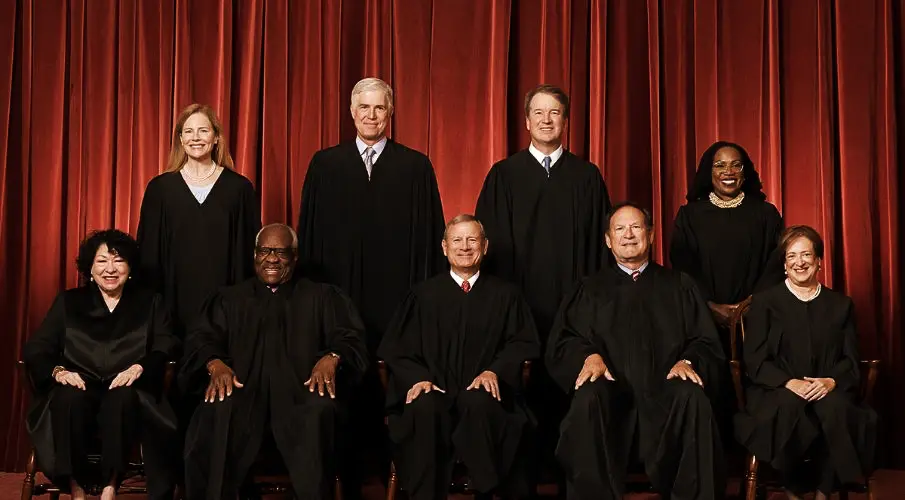
The Supreme Court has drawn a clear line for Donald Trump and declared his sweeping import tariffs unlawful. By a vote of six to three, the Court ruled that the president exceeded his authority when he invoked the International Emergency Economic Powers Act of 1977 to impose punitive tariffs on nearly the entire world. For the White House, this is a significant setback; for the separation of powers, a clear clarification.
Trump was the first president ever to claim that the emergency law from the 1970s allowed him to impose tariffs independently, without the consent of Congress. The law itself, however, does not mention “tariffs,” “taxes,” or “duties.” It grants the president the ability to take measures in a national emergency to respond to an “unusual and extraordinary threat” to national security, foreign policy, or the economy. Previous presidents used this authority for sanctions or embargoes. Trump turned it into an instrument of global trade policy.

In the majority opinion, Chief Justice John G. Roberts Jr. made clear that the statute contains no authorization to introduce tariffs. The president, he wrote, claims an extraordinary power to impose tariffs without limitation as to amount, duration, or scope. Given the magnitude of such authority, a clear statutory basis is required. That is precisely what is lacking. The Constitution assigns the power to levy taxes and tariffs primarily to Congress. Anyone asserting an exception must demonstrate it unequivocally.
Three conservative justices - Clarence Thomas, Samuel A. Alito Jr., and Brett M. Kavanaugh - dissented. The majority, however, followed the reasoning already adopted by several lower courts. Three prior instances had declared the tariffs unlawful. In August, the US Court of Appeals for the Federal Circuit ruled seven to four that the emergency statute did not provide a basis for the sweeping duties. Whenever Congress intends to grant the president the authority to impose tariffs, it does so explicitly, the judges stated at the time.
Trump’s tariffs affected imports from more than one hundred countries. They initially targeted China, Canada, and Mexico, officially in response to allegations that those countries were not doing enough to combat fentanyl smuggling. Later, the president expanded the measures to nearly all trading partners. The stated goals were to reduce the trade deficit, strengthen domestic production, generate revenue, and apply pressure in negotiations. The Congressional Budget Office estimated the scope of the measures at roughly three trillion dollars over a ten year period. This is not a political symbol, but a massive intervention in global supply chains.
A dozen states and small businesses, including a manufacturer of educational toys and a wine importer, challenged the tariffs. They argued that the president had violated the constitutional rights of Congress. For them, the issue was not only jurisdiction, but concrete consequences: disrupted operations, higher procurement costs, layoffs. In their filings, they stated that the duties put pressure on their business models and forced costs to be passed on to consumers.
The White House had portrayed the case as a historic turning point. A loss before the Supreme Court, it said, would trigger economic chaos. The administration warned of the need to unwind trade agreements and potentially issue large refunds to importers. The president described it as one of the most important cases in the history of the United States and suggested that defeat would amount to a blow to the national economy. Yet resistance to the expansive interpretation of emergency powers did not come only from Democrats. Libertarian and business aligned groups often associated with the Republican Party also opposed the administration’s argument. In polls, tariffs have not proven to be a popular instrument, particularly against the backdrop of rising living costs.
While the case was pending, the administration was already exploring alternatives. Trump’s trade representative, Jamieson Greer, stated that any emergency tariffs declared invalid would be swiftly replaced by other duties. In fact, the president has also relied on other statutes, including provisions related to national security for specific industries. These instruments, however, are more narrowly tailored and less flexible than the 1977 emergency law.
With this ruling, it is now established: a president may not reinterpret a general emergency statute as a blank check for global tariff policy. The decision is more than a legal defeat for Trump. It is a signal that even a Court with a conservative majority is not prepared to relinquish Congress’s power over taxation and revenue. For the economy, it means short term uncertainty regarding existing duties and possible refunds. For the political debate, it marks a boundary that must not be crossed if power is not to be shifted unilaterally.
Trump will seek ways to continue his trade policy course. But the major lever with which he could pressure nearly every trading partner has been taken from his hands.
Updates – Kaizen News Brief
All current curated daily updates can be found in the Kaizen News Brief.
To the Kaizen News Brief In English


Das wird aber jemanden überhaupt nicht freuen.
Man darf gespannt sein, wer das ausbaden muss.
Sieht so aus, als ob sich Von der Leyen zu früh mit miserablen Bedingungen hat festnageln lassen, nur um den Schaden von immer neuen Zolldrohungen zu entkommen. Hoffentlich können sie da noch nachjustieren.